Chapter 14
PROBABILITY
♦ Where a mathematical reasoning can be had, it is as great a folly to make use of any other, as to grope for a thing in the dark, when you have a candle in your hand. – JOHN ARBUTHNOT ♦
14.1 Event
Our previous discussions have covered random experiments and their corresponding sample spaces. The sample space functions as a universal set encompassing all potential inquiries related to a given experiment.
Let's examine the experiment involving two coin tosses. The pertinent sample space for this scenario is $S = {HH, HT, TH, TT}$.
Suppose our focus lies on outcomes where precisely one head occurs. We observe that HT and TH are the sole elements within S that align with this specific occurrence (event). Consequently, these two elements constitute the set $E = {HT, TH}$.
It is established that set $E$ constitutes a subset of the sample space $S$. Analogously, a direct correlation exists between events and subsets of $S$, as illustrated below.
| Description of events | Corresponding subset of ‘S’ |
|---|---|
| Number of tails is exactly 2 | A = {TT} |
| Number of tails is at least one | B = {HT, TH, TT} |
| Number of heads is at most one | C = {HT, TH, TT} |
| Second toss is not head | D = { HT, TT} |
| Number of tails is at most two | S = {HH, HT, TH, TT} |
| Number of tails is more than two | φ |
From the preceding discourse, it becomes evident that a subset of a sample space is linked to an event, and conversely, an event is linked to a subset of a sample space. Given this understanding, we formalize the definition of an event as follows.
Definition Any subset $E$ of a sample space $S$ is called an event.
14.1.1 Occurrence of an Event
Let's consider the experiment of rolling a die. Suppose E represents the event "a number less than 4 appears." If, for instance, a '1' is the actual outcome on the die, we state that event E has occurred. Similarly, if the outcomes are '2' or '3', event E is also considered to have occurred.
Consequently, an event E within a sample space S is deemed to have occurred if the experimental outcome $\omega$ satisfies the condition $\omega \in \mathrm{E}$. Conversely, if the outcome $\omega$ is such that $\omega \notin \mathrm{E}$, then event E is considered not to have occurred.
14.1.2 Types of Events
Events are categorised into different types, depending on their constituent elements.
- Impossible and Sure Events The empty set, denoted $\phi$, and the sample space S itself represent specific types of events. Specifically, $\phi$ is termed an impossible event, whereas S, which encompasses the entire sample space, is referred to as a sure event.
To illustrate these concepts, let's examine the experiment of rolling a single die. The corresponding sample space is expressed as:
$ \mathrm{S} = {1, 2, 3, 4, 5, 6} $
Suppose E signifies the event "the number displayed on the die is a multiple of 7." Could you identify the subset corresponding to event E?
Evidently, no outcome fulfills the specified condition for this event; that is, no element within the sample space guarantees the realization of event E. Consequently, we assert that only the empty set corresponds to event E. Stated differently, it is impossible for a multiple of 7 to appear on the upper face of the die. Therefore, the event $\mathrm{E} = \phi$ is classified as an impossible event.
Consider a different event, F, defined as 'the number resulting from the roll is odd or even.' It is evident that $\mathrm{F} = {1, 2, 3, 4, 5, 6} = \mathrm{S}$, signifying that every possible outcome of the experiment guarantees the realization of event F. Consequently, the event $\mathrm{F} = \mathrm{S}$ constitutes a certain (or sure) event.
- Simple Event An event E is termed a simple (or elementary) event if it comprises precisely one sample point from a given sample space.
Within a sample space consisting of $n$ unique elements, there are exactly $n$ corresponding simple events.
For instance, when conducting the experiment of tossing two coins, the associated sample space is:
$ \mathrm{S} = {\mathrm{HH}, \mathrm{HT}, \mathrm{TH}, \mathrm{TT}} $
This sample space accommodates four distinct simple events, which are:
$ \mathrm{E}_1 = {\mathrm{HH}}, \quad \mathrm{E}_2 = {\mathrm{HT}}, \quad \mathrm{E}_3 = {\mathrm{TH}} \text{ and } \mathrm{E}_4 = {\mathrm{TT}}. $
PROBABILITY
- Compound Event An event is categorized as a compound event if it encompasses more than a single sample point.
For instance, consider the experiment of "tossing a coin thrice." The following events— E: 'Precisely one head is observed' F: 'A minimum of one head is observed' G: 'A maximum of one head is observed' and similar events—all qualify as compound events. The corresponding subsets of the sample space S for these events are:
$\mathrm{E} = {\mathrm{HTT},\mathrm{THT},\mathrm{TTH}}$ $\mathrm{F} = {\mathrm{HTT},\mathrm{THT},\mathrm{TTH},\mathrm{HHT},\mathrm{HTH},\mathrm{THH},\mathrm{HHH}}$ $\mathrm{G} = {\mathrm{TTT},\mathrm{THT},\mathrm{HTT},\mathrm{TTH}}$
Since each of these subsets contains multiple sample points, they are all classified as compound events.
14.1.3 Algebra of events
As explored in the Chapter on Sets, various methods exist for combining two or more sets, including union, intersection, set difference, and complementation. Similarly, events can be combined using analogous set-theoretic notations.
Let A, B, and C represent events linked to an experiment with a sample space S.
- Complementary Event Corresponding to any event A, there exists another event, denoted A', known as its complementary event. This is also referred to as the event 'not A'.
As an illustration, consider the experiment of 'tossing three coins'. A pertinent sample space for this experiment is:
$ \mathrm {S} = {\mathrm {H H H}, \mathrm {H H T}, \mathrm {H T H}, \mathrm {T H H}, \mathrm {H T T}, \mathrm {T H T}, \mathrm {T T H}, \mathrm {T T T} } $
Suppose $\mathrm{A} = {\mathrm{HTH}, \mathrm{HHT}, \mathrm{THH}}$ represents the event 'exactly one tail is observed'.
Evidently, if the outcome is HTT, event A has not transpired. However, in such a case, we can assert that the event 'not A' has occurred. Therefore, for any outcome that is not included in A, we conclude that 'not A' takes place.
Consequently, the complementary event 'not A' to event A is given by:
$ \mathrm {A} ^ {\prime} = {\mathrm {H H H}, \mathrm {H T T}, \mathrm {T H T}, \mathrm {T T H}, \mathrm {T T T} } $
Alternatively, $\mathrm{A}^{\prime} = {\omega :\omega \in \mathrm{S}\text{and}\omega \notin \mathrm{A}} = \mathrm{S} - \mathrm{A}.$
- The Event 'A or B' It is important to recall that the union of two sets, A and B, symbolized as $\mathrm{A} \cup \mathrm{B}$, comprises all elements that belong to A, or to B, or to both.
When sets A and B represent two distinct events within a given sample space, then $\mathrm{A} \cup \mathrm{B}$ denotes the event 'either A or B or both'. This composite event, $\mathrm{A} \cup \mathrm{B}$, is also commonly referred to as 'A or B'.
Therefore Event 'A or B' = A ∪ B
$ = {\omega : \omega \in A \text{ or } \omega \in B } $
MATHEMATICS
- The Event ‘A and B’ It is understood that the intersection of two sets, $A \cap B$, comprises those elements common to both A and B; that is, elements belonging to both ‘A and B’.
Should A and B be two distinct events, their intersection, $A \cap B$, signifies the event ‘A and B’.
Thus, $A \cap B = {\omega : \omega \in A \text{ and } \omega \in B}$
For instance, in the experiment of ‘throwing a die twice’, let A be the event ‘the score on the first throw is six’ and B be the event ‘the sum of the two scores is at least 11’. In this scenario:
$ A = {(6,1),\ (6,2),\ (6,3),\ (6,4),\ (6,5),\ (6,6)}, \text{ and } B = {(5,6),\ (6,5),\ (6,6)} $
so $A \cap B = {(6,5),\ (6,6)}$
It is noteworthy that the set $A \cap B = {(6,5), (6,6)}$ can represent the event ‘the score on the first throw is six and the sum of the scores is at least 11’.
- The Event ‘A but not B’ We recognize that A–B constitutes the set of all elements present in A but absent from B. Consequently, the set A–B can represent the event ‘A but not B’. It is known that:
$ A - B = A \cap B' $
Example 1 Consider the experiment of rolling a die. Let A be the event ‘getting a prime number’, B be the event ‘getting an odd number’. Write the sets representing the events (i) A or B (ii) A and B (iii) A but not B (iv) ‘not A’.
Solution Here $S = {1,2,3,4,5,6}, A = {2,3,5}$ and $B = {1,3,5}$
Obviously
(i) ‘A or B’ = A ∪ B = {1, 2, 3, 5} (ii) ‘A and B’ = A ∩ B = {3,5} (iii) ‘A but not B’ = A – B = {2} (iv) ‘not A’ = A' = {1,4,6}
14.1.4 Mutually exclusive events In the experiment of rolling a die, a sample space is S = {1, 2, 3, 4, 5, 6}. Consider events, A ‘an odd number appears’ and B ‘an even number appears’
Clearly the event A excludes the event B and vice versa. In other words, there is no outcome which ensures the occurrence of events A and B simultaneously. Here
$ A = {1, 3, 5} \text{ and } B = {2, 4, 6} $
Clearly $A \cap B = \phi$, i.e., A and B are disjoint sets.
In general, two events A and B are called mutually exclusive events if the occurrence of any one of them excludes the occurrence of the other event, i.e., if they cannot occur simultaneously. In this case the sets A and B are disjoint.
PROBABILITY
Again in the experiment of rolling a die, consider the events A 'an odd number appears' and event B 'a number less than 4 appears'
Obviously $\mathrm{A} = {1,3,5}$ and $\mathrm{B} = {1,2,3}$
Now $3 \in \mathrm{A}$ as well as $3 \in \mathrm{B}$
Therefore, A and B are not mutually exclusive events.
Remark Simple events of a sample space are always mutually exclusive.
14.1.5 Exhaustive events Consider the experiment of throwing a die. We have S = {1, 2, 3, 4, 5, 6}. Let us define the following events
Consider the events: A: 'the outcome is a number less than 4', B: 'the outcome is a number between 2 and 5 (exclusive of 2 and 5)', and C: 'the outcome is a number exceeding 4'.
These events correspond to the sets: $\mathrm{A} = {1,2,3}$, $\mathrm{B} = {3,4}$, and $\mathrm{C} = {5,6}$. It can be observed that their union encompasses the entire sample space $\mathrm{S}$: $ \mathrm {A} \cup \mathrm {B} \cup \mathrm {C} = {1, 2, 3 } \cup {3, 4 } \cup {5, 6 } = \mathrm {S}. $ Events like A, B, and C, which collectively span the entire sample space, are termed exhaustive events. More broadly, a collection of $n$ events, $\mathrm{E}_1, \mathrm{E}_2, \dots, \mathrm{E}n$, within a sample space $\mathrm{S}$ is defined as exhaustive if their union equals $\mathrm{S}$: $ \mathrm {E} _ {1} \cup \mathrm {E} _ {2} \cup \mathrm {E} _ {3} \cup \dots \cup \mathrm {E} _ {n} = \bigcup {i = 1} ^ {n} \mathrm {E} _ {i} = \mathrm {S}. $ This implies that for any execution of the experiment, at least one of the exhaustive events $\mathrm{E}_1, \mathrm{E}_2, \dots, \mathrm{E}_n$ is guaranteed to occur.
Moreover, if the events $\mathrm{E}_i$ and $\mathrm{E}_j$ are pairwise disjoint, meaning $\mathrm{E}_i \cap \mathrm{E}j = \phi$ for any distinct indices $i \neq j$, and their union covers the entire sample space ($\bigcup{i=1}^{n} \mathrm{E}_i = \mathrm{S}$), then these events $\mathrm{E}_1, \mathrm{E}_2, \dots, \mathrm{E}_n$ are designated as mutually exclusive and exhaustive.
Let us proceed to examine some illustrative cases.
Example 2 Consider an experiment where two standard dice are rolled, and their sum is recorded. We define the following events pertaining to this experiment:
A: 'the resultant sum is an even number'. B: 'the resultant sum is a multiple of 3'. C: 'the resultant sum is less than 4'. D: 'the resultant sum is greater than 11'.
Identify which pairs among these events are mutually exclusive.
Solution The sample space, $\mathrm{S}$, for rolling two dice consists of 36 ordered pairs, where each element $(x, y)$ represents the outcome of the first and second die, respectively, for $x, y \in {1, 2, 3, 4, 5, 6}$. The events can be explicitly listed as: $ \begin{array}{l} \mathrm{A} = {(1, 1), (1, 3), (1, 5), (2, 2), (2, 4), (2, 6), (3, 1), (3, 3), (3, 5), (4, 2), (4, 4), \ (4, 6), (5, 1), (5, 3), (5, 5), (6, 2), (6, 4), (6, 6)} \ \mathrm{B} = {(1, 2), (2, 1), (1, 5), (5, 1), (3, 3), (2, 4), (4, 2), (3, 6), (6, 3), (4, 5), (5, 4), \ (6, 6)} \ \mathrm{C} = {(1, 1), (2, 1), (1, 2)} \text{ and } \mathrm{D} = {(6, 6)} \ \end{array} $ Upon examining the intersections, we determine: $ \mathrm{A} \cap \mathrm{B} = {(1, 5), (2, 4), (3, 3), (4, 2), (5, 1), (6, 6)} \neq \phi. $ Consequently, events A and B are not mutually exclusive.
A similar analysis reveals that $A \cap C \neq \phi$, $A \cap D \neq \phi$, $B \cap C \neq \phi$, and $B \cap D \neq \phi$.
Therefore, the pairs of events (A, C), (A, D), (B, C), and (B, D) are also not mutually exclusive.
However, the intersection of C and D is empty ($C \cap D = \phi$), which means C and D are mutually exclusive events.
Example 3 Consider an experiment involving three successive tosses of a coin. Let us define the following events:
A: 'No heads are observed'. B: 'Exactly one head is observed'. C: 'At least two heads are observed'.
Do these events collectively constitute a set of mutually exclusive and exhaustive events?
Solution The complete sample space for this experiment is given by: $ S = {HHH, HHT, HTH, THH, HTT, THT, TTH, TTT}. $ The individual events can be represented as: $ A = {TTT}, B = {HTT, THT, TTH}, C = {HHT, HTH, THH, HHH}. $ Now
$ \mathrm{A} \cup \mathrm{B} \cup \mathrm{C} = {\mathrm{TTT}, \mathrm{HTT}, \mathrm{THT}, \mathrm{TTH}, \mathrm{HHT}, \mathrm{HTH}, \mathrm{THH}, \mathrm{HHH}} = S $
Consequently, events A, B, and C constitute an exhaustive set.
Furthermore, it is observed that $A \cap B = \phi$, $A \cap C = \phi$, and $B \cap C = \phi$.
This demonstrates that the events are pairwise disjoint, signifying their mutual exclusivity.
Thus, A, B, and C collectively represent a set of events that are both mutually exclusive and exhaustive.
EXERCISE 14.1
Consider a single die roll. Let event E represent the outcome 'the die displays a 4', and event F represent 'the die displays an even number'. Are events E and F mutually exclusive?
A standard die is cast. Define the subsequent events:
(i) A: an outcome less than 7 (ii) B: an outcome exceeding 7 (iii) C: a value that is a multiple of 3 (iv) D: an outcome smaller than 4 (v) E: an even outcome exceeding 4 (vi) F: an outcome not inferior to 3
Additionally, determine the following set operations: $A \cup B$, $A \cap B$, $B \cup C$, $E \cap F$, $D \cap E$, $A - C$, $D - E$, $E \cap F'$, $F'$
- An experimental procedure involves the simultaneous rolling of two dice, with the resulting numbers being recorded. Characterize the subsequent events:
A: the sum of the numbers is greater than 8; B: the number 2 appears on at least one die; C: the sum of the numbers is at least 7 and also a multiple of 3.
Identify which pairs among these events are mutually exclusive.
- A single trial consists of tossing three coins. Let event A signify “three heads appear”, event B denote “two heads and one tail appear”, event C represent “three tails appear”, and event D indicate “a head appears on the initial coin toss”. Which of the following categories do these events fall into:
(i) mutually exclusive? (ii) simple? (iii) Compound?
- Consider the experiment of tossing three coins. Describe:
(i) Two events that are mutually exclusive. (ii) Three events that are both mutually exclusive and exhaustive. (iii) Two events that are not mutually exclusive. (iv) Two events that are mutually exclusive but not exhaustive. (v) Three events that are mutually exclusive but not exhaustive.
- Two dice are cast. The specified events A, B, and C are defined as follows:
A: obtaining an even number on the first die. B: obtaining an odd number on the first die. C: the sum of the numbers displayed on the dice $\leq 5$.
Characterize the following events:
(i) A' (ii) not B (iii) A or B (iv) A and B (v) A but not C (vi) B or C (vii) B and C (viii) A $\cap$ B' $\cap$ C'
- With reference to the preceding question 6, indicate whether each statement is true or false, providing justification for your response:
(i) A and B are mutually exclusive. (ii) A and B are mutually exclusive and exhaustive. (iii) A = B' (iv) A and C are mutually exclusive. (v) A and B' are mutually exclusive. (vi) A', B', C are mutually exclusive and exhaustive.
14.2 Axiomatic Approach to Probability
Prior sections explored the concepts of random experiments, their respective sample spaces, and associated events. Daily discourse frequently involves terminology pertaining to the likelihood of events. Probability theory endeavors to assign quantitative measures to these probabilities of events transpiring or not transpiring.
Previous educational contexts introduced various methodologies for attributing probabilities to events linked with experiments where the total number of possible outcomes was predetermined.
The axiomatic framework presents an alternative methodology for defining an event's probability. Within this paradigm, a set of fundamental axioms or principles is established to facilitate the assignment of probabilities.
Consider $S$ as the sample space pertinent to a stochastic experiment. The probability function, denoted by $P$, is a real-valued mapping whose input domain encompasses the power set of $S$, and whose output range is confined to the closed interval [0,1], subject to the satisfaction of the subsequent axioms:
(i) For any event $E$, $P(E) \geq 0$ (ii) $P(S) = 1$ (iii) If $E$ and $F$ constitute disjoint events, then $P(E \cup F) = P(E) + P(F)$. A direct consequence of axiom (iii) is that $P(\phi) = 0$. To demonstrate this, let $F = \phi$ and observe that $E$ and $\phi$ are inherently disjoint. Consequently, applying axiom (iii) yields:
$ P (E \cup \phi) = P (E) + P (\phi) \quad \text{or} \quad P (E) = P (E) + P (\phi) \quad \text{i.e.} \quad P (\phi) = 0. $
Suppose $S$ represents a sample space comprising the individual outcomes $\omega_{1}, \omega_{2}, \ldots, \omega_{n}$; specifically,
$ S = {\omega_{1}, \omega_{2}, \ldots, \omega_{n}} $
The axiomatic formulation of probability implies the following:
(i) $0 \leq P(\omega_{i}) \leq 1$ for each $\omega_{i} \in S$ (ii) $P(\omega_1) + P(\omega_2) + \ldots + P(\omega_n) = 1$ (iii) For any event $A$, $P(A) = \sum P(\omega_i)$, $\omega_i \in A$.
Note It is important to recognize that the singleton set ${\omega_i}$ is referred to as an elementary event, and for the sake of simplifying notation, $P(\omega_i)$ is conventionally used in place of $P({\omega_i})$.
As an illustration, consider a 'coin-tossing' experiment; we can attribute a probability of $\frac{1}{2}$ to each of the possible outcomes, namely $H$ (Heads) and $T$ (Tails).
i.e.
$ P (H) = \frac {1}{2} \quad \text{and} \quad P (T) = \frac {1}{2} $
(1)
Evidently, this particular assignment fulfills both stipulated criteria; that is, each probability value is neither negative nor exceeds unity, and additionally,
$ P (H) + P (T) = \frac {1}{2} + \frac {1}{2} = 1 $
Consequently, under these circumstances, it can be stated that the probability of $H$ is $\frac{1}{2}$, and the probability of $T$ is $\frac{1}{2}$.
$ \text{If we take } P (H) = \frac {1}{4} \quad \text{and} \quad P (T) = \frac {3}{4} \tag{2} $
Does this assignment satisfy the conditions of axiomatic approach?
Yes, in this case, probability of $\mathrm{H} = \frac{1}{4}$ and probability of $\mathrm{T} = \frac{3}{4}$.
It is observed that both assignments, (1) and (2), represent legitimate probability distributions for outcomes H and T.
More generally, one can allocate the values $p$ and $(1 - p)$ to these two outcomes, provided that $0 \leq p \leq 1$, and concurrently, $\mathrm{P}(\mathrm{H}) + \mathrm{P}(\mathrm{T}) = p + (1 - p) = 1$ is satisfied.
This particular assignment likewise conforms to both prerequisites of the axiomatic framework of probability. Consequently, it can be concluded that numerous (indeed, infinitely many) methods exist for attributing probabilities to the outcomes of a given experiment. We shall now proceed to examine a few illustrative examples.
Example 4 Consider a sample space denoted as $\mathrm{S} = {\omega_1, \omega_2, \dots, \omega_6}$. Determine which of the subsequent probability distributions for each outcome are permissible.
| Outcomes | ω1 | ω2 | ω3 | ω4 | ω5 | ω6 |
|---|---|---|---|---|---|---|
| (a) | 1/6 | 1/6 | 1/6 | 1/6 | 1/6 | 1/6 |
| (b) | 1 | 0 | 0 | 0 | 0 | 0 |
| (c) | 1/8 | 2/3 | 1/3 | 1/3 | -1/4 | -1/3 |
| (d) | 1/12 | 1/12 | 1/6 | 1/6 | 1/6 | 3/2 |
| (e) | 0.1 | 0.2 | 0.3 | 0.4 | 0.5 | 0.6 |
Solution (a) Condition (i): Every value $p(\omega_i)$ must be positive and strictly less than one.
Condition (ii): The aggregate of probabilities
$ = \frac {1}{6} + \frac {1}{6} + \frac {1}{6} + \frac {1}{6} + \frac {1}{6} + \frac {1}{6} = 1 $
Consequently, this assignment is deemed valid.
(b) Condition (i): Each $p(\omega_i)$ is either zero or one.
Condition (ii): The total sum of these probabilities is $= 1 + 0 + 0 + 0 + 0 + 0 = 1$.
Thus, this particular assignment is acceptable.
(c) Condition (i): Since two of the probabilities, specifically $p(\omega_5)$ and $p(\omega_6)$, are negative, this assignment is invalid. (d) Given that $p(\omega_6) = \frac{3}{2}$, which exceeds 1, the assignment is consequently invalid.
(e) As the summation of probabilities totals $0.1 + 0.2 + 0.3 + 0.4 + 0.5 + 0.6 = 2.1$, this assignment is therefore invalid.
14.2.1 Probability of an event
Let S represent the sample space corresponding to the experiment involving the inspection of three sequential pens manufactured by a machine, categorized as either Good (non-defective) or Bad (defective). This inspection could yield zero, one, two, or three defective pens.
The pertinent sample space for this experiment is given by
$ S = {BBB, BBG, BGB, GBB, BGG, GBG, GGB, GGG}, $
Here, B signifies a defective or faulty pen, while G denotes a non-defective or functional pen.
Assume the following probabilities are allocated to the respective outcomes:
Sample point: BBB BBG BGB GBB BGG GBG GGB GGG
Probability: $\frac{1}{8} \quad \frac{1}{8} \quad \frac{1}{8} \quad \frac{1}{8} \quad \frac{1}{8} \quad \frac{1}{8}$
Define event A as the occurrence of precisely one defective pen, and event B as the occurrence of at least two defective pens.
Hence $A = {BGG, GBG, GGB}$ and $B = {BBG, BGB, GBB, BBB}$
The probability of event A is then given by $P(A) = \sum P(\omega_i)$, for all $\omega_i \in A$.
$ = P(BGG) + P(GBG) + P(GBB) = \frac{1}{8} + \frac{1}{8} + \frac{1}{8} = \frac{3}{8} $
and $P(B) = \sum P(\omega_i)$, for all $\omega_i \in B$.
$ = P(BBG) + P(BGB) + P(GBB) + P(BBB) = \frac{1}{8} + \frac{1}{8} + \frac{1}{8} + \frac{1}{8} = \frac{4}{8} = \frac{1}{2} $
Next, let us examine an additional experiment involving 'tossing a coin twice'.
The corresponding sample space for this experiment is $S = {HH, HT, TH, TT}$.
The subsequent probabilities are allocated to these outcomes:
$ P(HH) = \frac{1}{4}, \quad P(HT) = \frac{1}{7}, \quad P(TH) = \frac{2}{7}, \quad P(TT) = \frac{9}{28} $
This distribution demonstrably fulfills the requirements of the axiomatic framework. We will now determine the probability of event E, defined as 'Both coin tosses produce identical results'.
Here $E = {HH, TT}$
Then $P(E) = \sum P(w_i)$, for all $w_i \in E$.
PROBABILITY
$ = \mathrm{P}(\mathrm{HH}) + \mathrm{P}(\mathrm{TT}) = \frac{1}{4} + \frac{9}{28} = \frac{4}{7} $
Considering event F, defined as 'exactly two heads', its representation is $\mathrm{F} = {\mathrm{HH}}$
and
$ \mathrm{P}(\mathrm{F}) = \mathrm{P}(\mathrm{HH}) = \frac{1}{4} $
14.2.2 Probabilities of equally likely outcomes
Suppose an experiment possesses a sample space denoted as
$ S = {\omega_1, \omega_2, \dots, \omega_n}. $
Assuming all constituent outcomes exhibit equiprobability, implying that the likelihood of each elementary event's manifestation is uniform.
i.e.
$ \mathrm{P}(\omega_i) = p, \text{ for all } \omega_i \in S \text{ where } 0 \leq p \leq 1 $
Since
$ \sum_{i=1}^{n} \mathrm{P}(\omega_i) = 1 \text{ i.e., } p + p + \dots + p \text{ (n times)} = 1 $
or
$ np = 1 \text{ i.e., } p = \frac{1}{n} $
Given a sample space S and an event E, where $n(S) = n$ represents the total number of outcomes and $n(E) = m$ denotes the number of outcomes in E. When each outcome is equiprobable, the probability is consequently determined by:
$ \mathrm{P}(E) = \frac{m}{n} = \frac{\text{Number of outcomes favourable to E}}{\text{Total possible outcomes}} $
14.2.3 Probability of the event 'A or B'
Our objective is to determine the probability of the compound event 'A or B', denoted as $\mathrm{P}(\mathrm{A} \cup \mathrm{B})$.
Consider an experiment involving 'tossing a coin thrice', and let two events be defined as $A = {\mathrm{HHT}, \mathrm{HTH}, \mathrm{THH}}$ and $B = {\mathrm{HTH}, \mathrm{THH}, \mathrm{HHH}}$. The union of these events is clearly $A \cup B = {\mathrm{HHT}, \mathrm{HTH}, \mathrm{THH}, \mathrm{HHH}}$.
Now, the probability of this union is expressed as: $ \mathrm{P}(A \cup B) = \mathrm{P}(\mathrm{HHT}) + \mathrm{P}(\mathrm{HTH}) + \mathrm{P}(\mathrm{THH}) + \mathrm{P}(\mathrm{HHH}) $ Assuming that all elementary outcomes possess equal likelihood, the probability becomes: $ \mathrm{P}(A \cup B) = \frac{1}{8} + \frac{1}{8} + \frac{1}{8} + \frac{1}{8} = \frac{4}{8} = \frac{1}{2} $ Furthermore, let's calculate the probabilities of the individual events: $ \mathrm{P}(A) = \mathrm{P}(\mathrm{HHT}) + \mathrm{P}(\mathrm{HTH}) + \mathrm{P}(\mathrm{THH}) = \frac{3}{8}
$ and $\mathrm{P}(B) = \mathrm{P}(\mathrm{HTH}) + \mathrm{P}(\mathrm{THH}) + \mathrm{P}(\mathrm{HHH}) = \frac{3}{8}$.
Consequently, summing these individual probabilities yields: $\mathrm{P}(A) + \mathrm{P}(B) = \frac{3}{8} + \frac{3}{8} = \frac{6}{8}$.
It becomes apparent from these calculations that $\mathrm{P}(A \cup B) \neq \mathrm{P}(A) + \mathrm{P}(B)$. The discrepancy arises because the outcomes HTH and THH are shared by both event A and event B. When computing $\mathrm{P}(A) + \mathrm{P}(B)$, the probabilities associated with HTH and THH, which constitute the elements of $\mathrm{A} \cap \mathrm{B}$, are effectively counted twice. Therefore, to accurately obtain $\mathrm{P}(A \cup B)$, it is necessary to subtract the probabilities of the sample points belonging to $\mathrm{A} \cap \mathrm{B}$ from the sum $\mathrm{P}(A) + \mathrm{P}(B)$.
Expressed mathematically: $\mathrm{P}(A \cup B) = \mathrm{P}(A) + \mathrm{P}(B) - \sum P(\omega_i),\forall\omega_i\in A\cap B$. $ = \mathrm {P} (\mathrm {A}) + \mathrm {P} (\mathrm {B}) - \mathrm {P} (\mathrm {A} \cap \mathrm {B}) $ Thus, we deduce the relationship: $\mathrm{P}(A \cup B) = \mathrm{P}(A) + \mathrm{P}(B) - \mathrm{P}(A \cap B)$.
More generally, for any two events A and B within a random experiment, the fundamental definition of the probability of an event states: $ \mathrm {P} (\mathrm {A} \cup \mathrm {B}) = \sum p (\omega_ {i}), \forall \omega_ {i} \in A \cup B. $ Given that the union $\mathrm{A}\cup \mathrm{B}$ can be expressed as the disjoint union of three mutually exclusive sets: $\mathrm{A}\cup \mathrm{B} = (\mathrm{A} - \mathrm{B})\cup (\mathrm{A}\cap \mathrm{B})\cup (\mathrm{B} - \mathrm{A})$, we can write: $ \mathrm {P} (\mathrm {A} \cup \mathrm {B}) = \left[ \sum \mathrm {P} \left(\omega_ {i}\right) \forall \omega_ {i} \in (A - B) \right] + \left[ \sum P \left(\omega_ {i}\right) \forall \omega_ {i} \in A \cap B \right] + \left[ \sum \mathrm {P} \left(\omega_ {i}\right) \forall \omega_ {i} \in B - A \right] $ (since A-B, A $\cap$ B, and B-A are mutually exclusive) ... (1)
Furthermore, considering the sum of individual probabilities: $\mathrm{P}(A) + \mathrm{P}(B) = [\sum p(\omega_i)\forall\omega_i\in A] + [\sum p(\omega_i)\forall\omega_i\in B]$ $ \begin{array}{l} = \left[ \sum \mathrm {P} \left(\omega_ {i}\right) \forall \omega_ {i} \in (A - B) \cup (A \cap B) \right] + \left[ \sum \mathrm {P} \left(\omega_ {i}\right) \forall \omega_ {i} \in (B - A) \cup (A \cap B) \right] \ = \left[ \sum \mathrm {P} \left(\omega_ {i}\right) \forall \omega_ {i} \in (A - B) \right] + \left[ \sum P \left(\omega_ {i}\right) \forall \omega_ {i} \in (A \cap B) \right] + \left[ \sum \mathrm {P} \left(\omega_ {i}\right) \forall \omega_ {i} \in (B - A) \right] + \ \left[ \sum \mathrm {P} \left(\omega_ {i}\right) \forall \omega_ {i} \in (A \cap B) \right] \ = \mathrm {P} (\mathrm {A} \cup \mathrm {B}) + \left[ \sum \mathrm {P} \left(\omega_ {i}\right) \forall \omega_ {i} \in A \cap B \right] [ \text {using (1)} ] \ = \mathrm {P} (\mathrm {A} \cup \mathrm {B}) + \mathrm {P} (\mathrm {A} \cap \mathrm {B}). \ \end{array} $
Thus, $\mathrm{P(A\cup B) = P(A) + P(B) - P(A\cap B)}$.
An alternative demonstration of this relationship proceeds as follows:
The union of sets $\mathrm{A}$ and $\mathrm{B}$ can be expressed as $\mathrm{A} \cup \mathrm{B} = \mathrm{A} \cup (\mathrm{B} - \mathrm{A})$, where $\mathrm{A}$ and the set difference $\mathrm{B} - \mathrm{A}$ are mutually exclusive events.
Furthermore, set $\mathrm{B}$ can be decomposed into $\mathrm{B} = (\mathrm{A}\cap \mathrm{B})\cup (\mathrm{B} - \mathrm{A})$, where the intersection $\mathrm{A}\cap \mathrm{B}$ and the set difference $\mathrm{B} - \mathrm{A}$ are also mutually exclusive.
Applying Axiom (iii) of probability, we obtain:
$
\mathrm {P} (\mathrm {A} \cup \mathrm {B}) = \mathrm {P} (\mathrm {A}) + \mathrm {P} (\mathrm {B} - \mathrm {A}) \tag {2} $
and $\mathrm{P(B) = P(A\cap B) + P(B - A)}$ (3)
Subtracting Equation (3) from Equation (2) yields:
$ \mathrm {P} (\mathrm {A} \cup \mathrm {B}) - \mathrm {P} (\mathrm {B}) = \mathrm {P} (\mathrm {A}) - \mathrm {P} (\mathrm {A} \cap \mathrm {B}) $
Rearranging the terms, we arrive at: $\mathrm{P(A\cup B) = P(A) + P(B) - P(A\cap B)}$.
This result can additionally be substantiated through examination of the Venn Diagram (Fig 14.1).
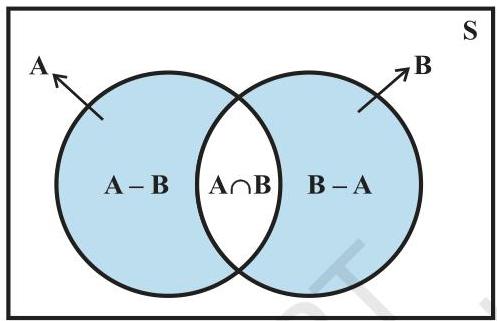 Fig 14.1
In the scenario where $\mathrm{A}$ and $\mathrm{B}$ are disjoint sets, signifying that they represent mutually exclusive events, their intersection is the empty set: $\mathrm{A} \cap \mathrm{B} = \phi$.
Consequently, the probability of their intersection is zero: $\mathrm{P(A\cap B) = P(\phi) = 0}$.
Hence, for events $\mathrm{A}$ and $\mathrm{B}$ that are mutually exclusive, the formula simplifies to:
$ \mathrm {P} (\mathrm {A} \cup \mathrm {B}) = \mathrm {P} (\mathrm {A}) + \mathrm {P} (\mathrm {B}), $
which corresponds precisely to Axiom (iii) of probability.
14.2.4 Probability of event 'not $\mathrm{A}
Personal 1:1 AI Tutor for CBSE, JEE & NEET Students
YoLearn.AI is India's #1 AI tutoring platform for Class 1 to 12, JEE, and NEET preparation.
Students talk to expert AI tutors in real time through live voice calls, solve doubts instantly
on an interactive sketch board, and practice with mock tests, flashcards, quizzes, and slide decks.
Learn from top educators including DC Pandey and other verified teachers who create AI avatars of themselves.
Live voice tutoring and doubt solving
Unlike text-only chatbots, YoLearn.AI lets you speak naturally to your AI tutor — just like a real
one-on-one session. Get step-by-step explanations for Physics, Chemistry, Maths, and Biology
for board exams, JEE Main, JEE Advanced, and NEET.
Mock tests, flashcards, and exam prep
Prepare for JEE 2026, NEET 2026, and CBSE board exams with personalized mock tests, AI-generated
quizzes, and flashcard makers. Build daily study habits with an AI study buddy designed for Indian students.
For school, JEE, and NEET
Whether you need a Class 10 CBSE tutor, Class 12 board exam help, or full JEE and NEET coaching online,
YoLearn.AI adapts to your grade, syllabus, and learning pace. Start free today on web, iOS, and Android.
#39;
Personal 1:1 AI Tutor for CBSE, JEE & NEET Students
YoLearn.AI is India's #1 AI tutoring platform for Class 1 to 12, JEE, and NEET preparation. Students talk to expert AI tutors in real time through live voice calls, solve doubts instantly on an interactive sketch board, and practice with mock tests, flashcards, quizzes, and slide decks. Learn from top educators including DC Pandey and other verified teachers who create AI avatars of themselves.
Live voice tutoring and doubt solving
Unlike text-only chatbots, YoLearn.AI lets you speak naturally to your AI tutor — just like a real one-on-one session. Get step-by-step explanations for Physics, Chemistry, Maths, and Biology for board exams, JEE Main, JEE Advanced, and NEET.
Mock tests, flashcards, and exam prep
Prepare for JEE 2026, NEET 2026, and CBSE board exams with personalized mock tests, AI-generated quizzes, and flashcard makers. Build daily study habits with an AI study buddy designed for Indian students.
For school, JEE, and NEET
Whether you need a Class 10 CBSE tutor, Class 12 board exam help, or full JEE and NEET coaching online, YoLearn.AI adapts to your grade, syllabus, and learning pace. Start free today on web, iOS, and Android.
Let us consider an event $\mathrm{A} = {2, 4, 6, 8}$, which is defined within the context of an experiment involving the selection of a single card from a collection of ten cards, each distinctly numbered from 1 to 10. The corresponding sample space for this experiment is therefore $\mathrm{S} = {1, 2, 3, \dots, 10}$.
Assuming that all possible outcomes, from 1 to 10, possess an equal likelihood of occurrence, the probability assigned to each individual outcome is $\frac{1}{10}$.
The probability of event $\mathrm{A}$ is calculated as: $\mathrm{P(A) = P(2) + P(4) + P(6) + P(8)}$
$ = \frac {1}{1 0} + \frac {1}{1 0} + \frac {1}{1 0} + \frac {1}{1 0} = \frac {4}{1 0} = \frac {2}{5} $
Conversely, the event 'not $\mathrm{A}
YoLearn.AI is India's #1 AI tutoring platform for Class 1 to 12, JEE, and NEET preparation.
Students talk to expert AI tutors in real time through live voice calls, solve doubts instantly
on an interactive sketch board, and practice with mock tests, flashcards, quizzes, and slide decks.
Learn from top educators including DC Pandey and other verified teachers who create AI avatars of themselves.
Unlike text-only chatbots, YoLearn.AI lets you speak naturally to your AI tutor — just like a real
one-on-one session. Get step-by-step explanations for Physics, Chemistry, Maths, and Biology
for board exams, JEE Main, JEE Advanced, and NEET.
Prepare for JEE 2026, NEET 2026, and CBSE board exams with personalized mock tests, AI-generated
quizzes, and flashcard makers. Build daily study habits with an AI study buddy designed for Indian students.
Whether you need a Class 10 CBSE tutor, Class 12 board exam help, or full JEE and NEET coaching online,
YoLearn.AI adapts to your grade, syllabus, and learning pace. Start free today on web, iOS, and Android.
Personal 1:1 AI Tutor for CBSE, JEE & NEET Students
Live voice tutoring and doubt solving
Mock tests, flashcards, and exam prep
For school, JEE, and NEET
The probability of event $\mathrm{A}'$ is determined by: $\mathrm{P(A^{\prime}) = P(1) + P(3) + P(5) + P(7) + P(9) + P(10)}$
$
= \frac {6}{1 0} = \frac {3}{5} $
Consequently, we observe that $\mathrm{P(A^{\prime})} = \frac{3}{5} = 1 - \frac{2}{5} = 1 - \mathrm{P(A)}$.
Furthermore, it is established that events $\mathrm{A}'$ and $\mathrm{A}$ are both mutually exclusive and exhaustive. This implies that:
$ \mathrm {A} \cap \mathrm {A} ^ {\prime} = \phi \text { and } \mathrm {A} \cup \mathrm {A} ^ {\prime} = \mathrm {S} $
This leads to the conclusion that $\mathrm{P(A\cup A^{\prime}) = P(S)}$.
By applying Axioms (ii) and (iii) of probability, it follows that $\mathrm{P(A) + P(A') = 1}$.
Therefore, we can state that $\mathrm{P(A^{\prime}) = P(notA) = 1 - P(A)}$.
We shall now proceed to examine several illustrative examples and associated exercises, where, unless explicitly specified otherwise, outcomes are presumed to be equally likely.
Example 5 One card is drawn from a well-shuffled deck of 52 cards. If each outcome is equally likely, calculate the probability that the card will be
(i) a diamond
(ii) not an ace
(iii) a black card (i.e., a club or, a spade)
(iv) not a diamond
(v) not a black card.
Solution When a card is selected from a thoroughly shuffled deck containing 52 cards, the total number of potential outcomes is 52.
(i) Let $A$ represent the event 'the card selected is a diamond'.
The cardinality of set A is clearly 13.
Consequently, $\mathrm{P(A)} = \frac{13}{52} = \frac{1}{4}$.
Thus, the probability of drawing a diamond card is $\frac{1}{4}$.
(ii) We designate the event 'Card drawn is an ace' as B.
Therefore, the event 'Card drawn is not an ace' is appropriately represented as $\mathbf{B}'$.
It is established that $\mathrm{P(B') = 1 - P(B) = 1 - \frac{4}{52} = 1 - \frac{1}{13} = \frac{12}{13}}$.
(iii) Let $C$ symbolize the event 'card drawn is a black card'.
The number of elements within set $\mathrm{C}$ is consequently 26.
Hence, $\mathrm{P(C)} = \frac{26}{52} = \frac{1}{2}$.
The probability of obtaining a black card is $\frac{1}{2}$.
(iv) As established in part (i), A signifies the event ‘card drawn is a diamond’. Thus, the event ‘card drawn is not a diamond’ can be expressed as A' or ‘not A’.
Then, $P(\text{not A}) = 1 - P(\text{A}) = 1 - \frac{1}{4} = \frac{3}{4}$.
(v) The event ‘card drawn is not a black card’ can be denoted as $C'$ or ‘not $C$’.
We recognize that $P(\text{not } C) = 1 - P(C) = 1 - \frac{1}{2} = \frac{1}{2}$.
Therefore, the probability of not drawing a black card is $\frac{1}{2}$.
Example 6 A container holds 9 discs, comprising 4 red, 3 blue, and 2 yellow discs. These discs are uniform in shape and size. If one disc is randomly selected from the container, determine the probability that it will be (i) red, (ii) yellow, (iii) blue, (iv) not blue, (v) either red or blue.
Solution Given a total of 9 discs, the total count of possible outcomes for a single draw is 9.
Let the events A, B, and C be defined as follows:
A: ‘the disc drawn is red’
B: ‘the disc drawn is yellow’
C: ‘the disc drawn is blue’.
(i) The quantity of red discs is 4, implying $n(\mathrm{A}) = 4$.
Consequently, $P(A) = \frac{4}{9}$.
(ii) The quantity of yellow discs is 2, implying $n(\mathrm{B}) = 2$.
Hence, $P(B) = \frac{2}{9}$.
(iii) The quantity of blue discs is 3, implying $n(C) = 3$.
Therefore, $P(C) = \frac{3}{9} = \frac{1}{3}$.
(iv) The event ‘not blue’ is clearly equivalent to ‘not C’. We recall that $P(\text{not } C) = 1 - P(C)$.
Thus, $\mathrm{P}(\mathrm{not~C}) = 1 - \frac{1}{3} = \frac{2}{3}$.
(v) The event ‘either red or blue’ can be characterized by the set ‘A or C’.
Since A and C represent mutually exclusive events, we deduce:
$ \mathrm {P} (\mathrm {A} \text { or } \mathrm {C}) = \mathrm {P} (\mathrm {A} \cup \mathrm {C}) = \mathrm {P} (\mathrm {A}) + \mathrm {P} (\mathrm {C}) = \frac {4}{9} + \frac {1}{3} = \frac {7}{9} $
Example 7 Anil and Ashima, two students, participated in an examination. The likelihood of Anil qualifying the examination is 0.05, and the likelihood of Ashima qualifying is 0.10. The probability that both students will qualify the examination is 0.02. Determine the probability that:
(a) Both Anil and Ashima will not qualify the examination. (b) At least one of them will not qualify the examination and (c) Only one of them will qualify the examination.
Solution Consider E and F as the events representing Anil's and Ashima's qualification for the examination, respectively. The following probabilities are provided:
$ \mathrm {P} (\mathrm {E}) = 0. 0 5, \mathrm {P} (\mathrm {F}) = 0. 1 0 \text { and } \mathrm {P} (\mathrm {E} \cap \mathrm {F}) = 0. 0 2. $
Consequently,
(a) The scenario where neither Anil nor Ashima qualifies for the examination can be represented by the event $\mathrm{E}^{\prime}\cap \mathrm{F}^{\prime}$. This is because $\mathrm{E}^{\prime}$ signifies that Anil does not qualify, and $\mathrm{F}^{\prime}$ signifies that Ashima does not qualify.
Furthermore, by De Morgan's Law, $\mathrm{E}^{\prime}\cap \mathrm{F}^{\prime}$ is equivalent to $(\mathrm{E}\cup \mathrm{F})^{\prime}$.
The probability of either Anil or Ashima qualifying is calculated as $\mathrm{P(E\cup F) = P(E) + P(F) - P(E\cap F)}$, which yields $\mathrm{P(E\cup F) = 0.05 + 0.10 - 0.02 = 0.13}$.
Hence, the probability that both will not qualify is $\mathrm{P(E^{\prime}\cap F^{\prime}) = P(E\cup F)^{\prime} = 1 - P(E\cup F) = 1 - 0.13 = 0.87}$.
(b) The probability that at least one individual will not qualify:
$ \begin{array}{l} = 1 - \mathrm {P} (\text {both of them will qualify}) \ = 1 - 0. 0 2 = 0. 9 8 \ \end{array} $
(c) The event signifying that precisely one of them qualifies for the examination is equivalent to the occurrence of either (Anil qualifies and Ashima does not qualify) or (Anil does not qualify and Ashima
will qualify) i.e., $\mathrm{E} \cap \mathrm{F}'$ or $\mathrm{E}' \cap \mathrm{F}$, where $\mathrm{E} \cap \mathrm{F}'$ and $\mathrm{E}' \cap \mathrm{F}$ are mutually exclusive.
Consequently, the probability of only one person qualifying is given by $\mathrm{P}(\text{only one of them will qualify}) = \mathrm{P}(\mathrm{E} \cap \mathrm{F}' \text{ or } \mathrm{E}' \cap \mathrm{F})$
$ \begin{array}{l} = \mathrm {P} (\mathrm {E} \cap \mathrm {F} ^ {\prime}) + \mathrm {P} (\mathrm {E} ^ {\prime} \cap \mathrm {F}) = \mathrm {P} (\mathrm {E}) - \mathrm {P} (\mathrm {E} \cap \mathrm {F}) + \mathrm {P} (\mathrm {F}) - \mathrm {P} (\mathrm {E} \cap \mathrm {F}) \ = 0. 0 5 - 0. 0 2 + 0. 1 0 - 0. 0 2 = 0. 1 1 \ \end{array} $
Example 8 A committee consisting of two individuals is to be formed from a group comprising two men and two women. Determine the probability that the committee will contain (a) no men, (b) one man, (c) two men.
Solution The total pool of individuals is $2 + 2 = 4$. From this group of four, two persons can be chosen in ${}^4\mathrm{C}_2$ distinct ways.
(a) For the two-person committee to have no men, it must consist entirely of women. From the two available women, two can be selected in ${}^2\mathrm{C}_2 = 1$ way.
Thus, the probability of having no men is $\mathrm{P}(\text{no man}) = \frac{^2\mathrm{C}_2}{^4\mathrm{C}_2} = \frac{1\times 2\times 1}{4\times 3} = \frac{1}{6}$.
(b) A committee comprising one man implies the inclusion of one woman. One man can be chosen from the two available men in $^2\mathrm{C}_1$ ways, and one woman can be selected from the two available women in $^2\mathrm{C}_1$ ways. The combined selection of one man and one woman is therefore $^2\mathrm{C}_1 \times {}^2\mathrm{C}_1$ ways.
Consequently, the probability of selecting one man is $\mathrm{P}(\text{One man}) = \frac{^2\mathrm{C}_1\times{}^2\mathrm{C}_1}{^4\mathrm{C}_2} = \frac{2\times 2}{2\times 3} = \frac{2}{3}$.
(c) The selection of two men is possible in ${}^{2}\mathrm{C}_{2}$ ways.
Hence $\mathrm{P}(\text{Two men}) = \frac{^2\mathrm{C}_2}{^4\mathrm{C}_2} = \frac{1}{^4\mathrm{C}_2} = \frac{1}{6}$
EXERCISE 14.2
- Identify which of the subsequent probability assignments is not permissible for the outcomes within the sample space $\mathbf{S} = {\omega_1, \omega_2, \omega_3, \omega_4, \omega_5, \omega_6, \omega_7}$
| Assignment | $\omega_{1}$ | $\omega_{2}$ | $\omega_{3}$ | $\omega_{4}$ | $\omega_{5}$ | $\omega_{6}$ | $\omega_{7}$ |
|---|---|---|---|---|---|---|---|
| (a) | 0.1 | 0.01 | 0.05 | 0.03 | 0.01 | 0.2 | 0.6 |
| (b) | 1/7 | 1/7 | 1/7 | 1/7 | 1/7 | 1/7 | 1/7 |
| (c) | 0.1 | 0.2 | 0.3 | 0.4 | 0.5 | 0.6 | 0.7 |
| (d) | -0.1 | 0.2 | 0.3 | 0.4 | -0.2 | 0.1 | 0.3 |
| (e) | 1/14 | 2/14 | 3/14 | 4/14 | 5/14 | 6/14 | 15/14 |
A coin is flipped two times. Determine the probability of observing at least one tail.
Upon the roll of a standard die, compute the probabilities for the subsequent events:
(i) The appearance of a prime number, (ii) The occurrence of a number equal to or exceeding 3, (iii) The appearance of a number no greater than one, (iv) The occurrence of a number strictly greater than 6, (v) The appearance of a number strictly less than 6.
- One card is chosen randomly from a 52-card deck.
(a) What is the cardinality of the sample space? (b) Compute the likelihood of drawing the ace of spades. (c) Determine the probability that the drawn card is (i) an ace, (ii) a black card.
An equitable coin, marked '1' on one face and '6' on the other, is rolled alongside an unbiased die. Ascertain the probability that the aggregate of the resulting numbers is (i) 3, (ii) 12.
The city council comprises four male members and six female members. If a single council member is chosen randomly to serve on a committee, what is the probability that the selected individual is a woman?
An unbiased coin is flipped four times. For each head that appears, an individual gains Re 1, while for each tail, a loss of Rs 1.50 is incurred. Utilizing the sample space, determine the total number of distinct monetary outcomes possible after four tosses, and calculate the probability associated with each of these amounts.
Three coins are simultaneously flipped. Determine the probability of obtaining the following:
(i) Exactly three heads, (ii) Exactly two heads, (iii) At least two heads, (iv) At most two heads, (v) No heads, (vi) Exactly three tails, (vii) Precisely two tails, (viii) No tails, (ix) At most two tails.
Given that the probability of an event A is $\frac{2}{11}$, what is the probability of the complementary event, denoted as 'not A'?
From the letters composing the word 'ASSASSINATION', one letter is selected randomly. Determine the probability that the chosen letter is (i) a vowel, (ii) a consonant.
In a lottery game, a participant randomly selects six distinct natural numbers from the range of 1 to 20. A prize is awarded if these six chosen numbers correspond exactly to the six numbers predetermined by the lottery committee. What is the probability of securing a win in this game? [Note: The sequence in which the numbers are selected is not relevant.]
Verify if the subsequent probabilities $\mathrm{P(A)}$ and $\mathrm{P(B)}$ are defined in a consistent manner:
(i) $\mathrm{P(A)} = 0.5$ $\mathrm{P(B)} = 0.7$ $\mathrm{P(A\cap B)} = 0.6$ (ii) $\mathrm{P(A)} = 0.5$ $\mathrm{P(B)} = 0.4$ $\mathrm{P(A\cup B)} = 0.8$
- Fill in the blanks in the following table:
| P(A) | P(B) | P(A∩B) | P(A∪B) | |
|---|---|---|---|---|
| (i) | 1/3 | 1/5 | 1/15 | ... |
| (ii) | 0.35 | ... | 0.25 | 0.6 |
| (iii) | 0.5 | 0.35 | ... | 0.7 |
Given that $\mathrm{P(A)} = \frac{3}{5}$ and $\mathrm{P(B)} = \frac{1}{5}$, ascertain $\mathrm{P(A or B)}$ when events A and B are mutually exclusive.
Given events E and F, where $\mathrm{P(E)} = \frac{1}{4}$, $\mathrm{P(F)} = \frac{1}{2}$, and $\mathrm{P(E and F)} = \frac{1}{8}$, calculate: (i) $\mathrm{P(E or F)}$, and (ii) $\mathrm{P(not E and not F)}$.
Given that $\mathrm{P(notE or notF)} = 0.25$ for events E and F, ascertain if E and F are mutually exclusive.
For events A and B, with $\mathrm{P(A)} = 0.42$, $\mathrm{P(B)} = 0.48$, and $\mathrm{P(A and B)} = 0.16$, compute: (i) $\mathrm{P(notA)}$, (ii) $\mathrm{P(notB)}$, and (iii) $\mathrm{P(A or B)}$.
Within a Class XI cohort, $40%$ of students are enrolled in Mathematics, and $30%$ are enrolled in Biology. Additionally, $10%$ of the class pursues both Mathematics and Biology. If a student is chosen randomly from this cohort, what is the probability that this student is studying either Mathematics or Biology?
An entrance assessment comprises two examinations. The likelihood of a randomly selected candidate successfully completing the first examination is 0.8, and for the second examination, it is 0.7. The probability of passing at least one of these examinations is 0.95. Determine the probability of a candidate passing both examinations.
The probability of a student successfully passing their final examinations in both English and Hindi subjects is 0.5, while the probability of failing to pass either subject is 0.1. Given that the probability of passing the English examination is 0.75, what is the probability of passing the Hindi examination?
From a group of 60 students, 30 chose NCC, 32 selected NSS, and 24 enrolled in both NCC and NSS. Should a student be chosen randomly from this group, calculate the probability that:
(i) The student selected NCC or NSS. (ii) The student selected neither NCC nor NSS. (iii) The student selected NSS but not NCC.
Miscellaneous Examples
Example 9 Veena travels to four distinct cities (A, B, C, and D) during her vacations, selecting their order randomly. Determine the probability of the following events:
(i) She visits City A before City B? (ii) She visits City A before City B, and City B before City C? (iii) She visits City A first and City B last? (iv) She visits City A as either the first or second city? (v) She visits City A immediately preceding City B?
Solution The total number of unique sequences in which Veena can visit the four cities (A, B, C, D) is given by $4!$, which evaluates to 24. Consequently, the cardinality of the sample space, $n(\mathrm{S})$, is 24.
Since the sample space for this experiment contains 24 elements, all potential outcomes are considered equiprobable. The complete sample space for this experiment is:
$ \begin{array}{l} S = {ABCD, ABDC, ACBD, ACDB, ADBC, ADCB \ BACD, BADC, BDAC, BDCA, BCAD, BCDA \ CABD, CADB, CBDA, CBAD, CDAB, CDBA \ DABC, DACB, DBCA, DBAC, DCAB, DCBA} \end{array} $
(i) Let E represent the event that Veena visits City A prior to City B.
Thus, the set E comprises the following arrangements: $E = {ABCD, CABD, DABC, ABDC, CADB, DACB, ACBD, ACDB, ADBC, CDAB, DCAB, ADCB}$.
Therefore, the probability $P(E)$ is calculated as $P(E) = \frac{n(E)}{n(S)} = \frac{12}{24} = \frac{1}{2}$.
(ii) Let F denote the event where Veena visits City A before City B, and City B before City C. The specific arrangements included in F are: $F = {ABCD, DABC, ABDC, ADBC}$.
Consequently, the probability $P(F)$ is determined by $P(F) = \frac{n(F)}{n(S)} = \frac{4}{24} = \frac{1}{6}$.
Students are encouraged to independently calculate the probabilities for cases (iii), (iv), and (v).
Example 10 From a standard, well-shuffled deck of 52 cards, a hand of 7 cards is drawn. Determine the probability that this hand contains: (i) all Kings, (ii) exactly 3 Kings, (iii) at least 3 Kings.
Solution The total number of distinct 7-card hands possible is ${}^{52}\mathrm{C}_{7}$.
(i) The number of hands that include all 4 Kings is ${}^{4}\mathrm{C}{4} \times {}^{48}\mathrm{C}{3}$ (as the remaining 3 cards must be chosen from the 48 non-King cards).
Hence, the probability $\mathrm{P}(\text{a hand will have 4 Kings})$ is $\frac{{}^{4}\mathrm{C}{4} \times {}^{48}\mathrm{C}{3}}{{}^{52}\mathrm{C}_{7}} = \frac{1}{7735}$.
(ii) The count of hands containing 3 Kings and 4 non-King cards is ${}^{4}\mathrm{C}{3} \times {}^{48}\mathrm{C}{4}$.
Therefore, $\mathrm{P}(3\mathrm{Kings}) = \frac{{}^{4}\mathrm{C}{3} \times {}^{48}\mathrm{C}{4}}{{}^{52}\mathrm{C}_{7}} = \frac{9}{1547}$.
(iii) The probability of having at least 3 Kings, $\mathrm{P}(\text{at least 3 King})$, is equivalent to the probability of having either 3 Kings or 4 Kings.
$ \begin{array}{l} = \mathrm{P}(3 \text{ Kings}) + \mathrm{P}(4 \text{ Kings}) \ = \frac{9}{1547} + \frac{1}{7735} = \frac{46}{7735} \end{array} $
Example 11 Let A, B, and C be three events associated with a random experiment. Prove the following identity:
$ \begin{array}{l} \mathrm{P}(\mathrm{A} \cup \mathrm{B} \cup \mathrm{C}) = \mathrm{P}(\mathrm{A}) + \mathrm{P}(\mathrm{B}) + \mathrm{P}(\mathrm{C}) - \mathrm{P}(\mathrm{A} \cap \mathrm{B}) - \mathrm{P}(\mathrm{A} \cap \mathrm{C}) \
- \mathrm{P}(\mathrm{B} \cap \mathrm{C}) + \mathrm{P}(\mathrm{A} \cap \mathrm{B} \cap \mathrm{C}) \end{array} $
Solution Consider the event $\mathrm{E}$ defined as the union of $\mathrm{B}$ and $\mathrm{C}$, i.e., $\mathrm{E} = \mathrm{B} \cup \mathrm{C}$. This allows us to write:
$ \begin{array}{l} \mathrm{P}(\mathrm{A} \cup \mathrm{B} \cup \mathrm{C}) = \mathrm{P}(\mathrm{A} \cup \mathrm{E}) \ = \mathrm{P}(\mathrm{A}) + \mathrm{P}(\mathrm{E}) - \mathrm{P}(\mathrm{A} \cap \mathrm{E}) \tag{1} \end{array} $
Subsequently, $ \begin{array}{l} \mathrm{P}(\mathrm{E}) = \mathrm{P}(\mathrm{B} \cup \mathrm{C}) \ = \mathrm{P}(\mathrm{B}) + \mathrm{P}(\mathrm{C}) - \mathrm{P}(\mathrm{B} \cap \mathrm{C}) \tag{2} \end{array} $ Furthermore, the expression $\mathrm{A} \cap \mathrm{E} = \mathrm{A} \cap (\mathrm{B} \cup \mathrm{C})$ can be expanded to $(\mathrm{A} \cap \mathrm{B}) \cup (\mathrm{A} \cap \mathrm{C})$ by applying the distributive property of set intersection over set union. Consequently, $ \mathrm{P}(\mathrm{A} \cap \mathrm{E}) = \mathrm{P}(\mathrm{A} \cap \mathrm{B}) + \mathrm{P}(\mathrm{A} \cap \mathrm{C}) - \mathrm{P}\left[ (\mathrm{A} \cap \mathrm{B}) \cap (\mathrm{A} \cap \mathrm{C}) \right] $ $
= \mathrm {P} (\mathrm {A} \cap \mathrm {B}) + \mathrm {P} (\mathrm {A} \cap \mathrm {C}) - \mathrm {P} [ \mathrm {A} \cap \mathrm {B} \cap \mathrm {C} ] \quad \dots \tag {3} $ Substituting expressions (2) and (3) into equation (1) yields: $ \begin{array}{l} \mathrm {P} [ \mathrm {A} \cup \mathrm {B} \cup \mathrm {C} ] = \mathrm {P} (\mathrm {A}) + \mathrm {P} (\mathrm {B}) + \mathrm {P} (\mathrm {C}) - \mathrm {P} (\mathrm {B} \cap \mathrm {C}) \ - \mathrm {P} (\mathrm {A} \cap \mathrm {B}) - \mathrm {P} (\mathrm {A} \cap \mathrm {C}) + \mathrm {P} (\mathrm {A} \cap \mathrm {B} \cap \mathrm {C}) \ \end{array} $
Example 12 A relay race involves five competing teams: A, B, C, D, and E.
(a) Determine the probability that teams A, B, and C secure the first, second, and third positions, in that specific order. (b) Determine the probability that teams A, B, and C constitute the top three finishers, irrespective of their specific order. (Assume that all possible finishing arrangements are equiprobable.)
Solution To begin, let us define the sample space as comprising all distinct sequences of the first three finishing positions. The total number of such arrangements is given by the permutation formula ${}^5\mathrm{P}_3$, which calculates to $\frac{5!}{(5 - 3)!} = 5 \times 4 \times 3 = 60$ potential outcomes. Each of these outcomes is assigned an equal probability of $\frac{1}{60}$.
(a) For teams A, B, and C to finish first, second, and third in precise order (ABC), there is only a singular arrangement that satisfies this condition.
Therefore, the probability that A, B, and C finish first, second, and third respectively is $\mathrm{P}(\text{A,B and C finish first, second and third respectively}) = \frac{1}{60}$.
(b) When considering that A, B, and C are simply the first three teams to complete the race, without regard to their specific ranking among themselves, there are $3!$ possible permutations for these three teams. Consequently, the event corresponding to A, B, and C being the first three finishers encompasses $3!$ distinct sample points.
Thus, the probability that A, B, and C are the first three to finish is $\mathrm{P}(\text{A,B and C are first three to finish}) = \frac{3!}{60} = \frac{6}{60} = \frac{1}{10}$.
Miscellaneous Exercise on Chapter 14
- Within a container holding 10 red, 20 blue, and 30 green marbles, a selection of 5 marbles is made. Determine the likelihood that (i) all chosen marbles are blue, and (ii) at least one chosen marble is green.
- From a thoroughly shuffled standard deck of 52 playing cards, four cards are randomly drawn. Calculate the probability of selecting three diamonds and one spade.
PROBABILITY
- Consider a six-sided die constructed such that two faces display the numeral '1', three faces display '2', and one face displays '3'. Upon a single roll of this die, ascertain the following probabilities:
(i) $\mathrm{P}(2)$
(ii) $\mathrm{P}(1$ or 3)
(iii) $\mathrm{P}(\mathrm{not}3)$
For a specific lottery offering ten identical prizes among 10,000 tickets sold, what is the likelihood of not winning a prize if one purchases (a) a single ticket, (b) two tickets, or (c) ten tickets?
From a cohort of 100 students, two distinct sections are established, one comprising 40 students and the other 60. Assuming you and a friend are part of this 100-student group, what is the probability that
(a) both of you are assigned to the identical section? (b) both of you are assigned to different sections?
Suppose three distinct letters are intended for three individual recipients, each having a corresponding addressed envelope. If these letters are randomly placed into the envelopes such that each envelope receives precisely one letter, determine the probability that a minimum of one letter is correctly matched with its intended envelope.
Given two events, A and B, with associated probabilities $\mathrm{P(A)} = 0.54$ , $\mathrm{P(B)} = 0.69$ , and their intersection probability $\mathrm{P(A \cap B)} = 0.35$ . Calculate the following:
Find (i) $\mathrm{P(A\cup B)}$ (ii) $\mathrm{P(A^{\prime}\cap B^{\prime})}$ (iii) $\mathrm{P(A\cap B^{\prime})}$ (iv) $\mathrm{P(B\cap A^{\prime})}$
- Five individuals are chosen from a company's workforce to serve on its managing committee. Their details are provided below:
| S. No. | Name | Sex | Age in years |
|---|---|---|---|
| 1. | Harish | M | 30 |
| 2. | Rohan | M | 33 |
| 3. | Sheetal | F | 46 |
| 4. | Alis | F | 28 |
| 5. | Salim | M | 41 |
If one person is randomly chosen from this group to assume the role of spokesperson, what is the probability that this individual will be either male or exceed 35 years of age?
- Considering 4-digit numbers exceeding 5,000, which are constructed randomly using the digits 0, 1, 3, 5, and 7, what is the probability of generating a number divisible by 5 under two conditions: (i) when digit repetition is permitted? (ii) when digit repetition is not permitted?
- A suitcase features a combination lock equipped with four wheels, each displaying the ten numerals from 0 to 9. The lock mechanism requires a unique four-digit sequence without any repeated digits for it to open. What is the probability that an individual will correctly identify the required sequence to unlock the suitcase?
MATHEMATICS
Summary
This chapter explored the axiomatic framework of probability. Key concepts and definitions discussed herein include the following:
- Event: Defined as a specific subset within the overarching sample space.
- Impossible event: Represented by the empty set, signifying an outcome that cannot occur.
- Sure event: Equivalent to the entire sample space, indicating an outcome that is certain to occur.
- Complementary event or ‘not event’: The set denoted as A′ or S – A, comprising all outcomes in the sample space S that are not in A.
- Event A or B: The union of sets A and B, represented as A ∪ B.
- Event A and B: The intersection of sets A and B, denoted as A ∩ B.
- Event A and not B: The set difference A – B, consisting of elements present in A but not in B.
- Mutually exclusive event: Events A and B are deemed mutually exclusive when their intersection, A ∩ B, is the empty set (φ).
- Exhaustive and mutually exclusive events: A collection of events E₁, E₂, ..., Eₙ is considered both exhaustive and mutually exclusive if their union covers the entire sample space S (E₁ ∪ E₂ ∪ ... ∪ Eₙ = S) and any pair of distinct events has an empty intersection (Eᵢ ∩ Eⱼ = φ ∀ i ≠ j).
- Probability: A numerical value P(ωᵢ) assigned to each sample point ωᵢ, satisfying the following axioms:
(i) $0 \leq \mathrm{P}(\omega_i) \leq 1$
(ii) $\sum \mathrm{P}(\omega_i)$ for all $\omega_i \in S = 1$
(iii) $\mathrm{P(A)} = \sum \mathrm{P}(\omega_i)$ for all $\omega_i \in A$. Here, $\mathrm{P}(\omega_i)$ designates the probability of the individual outcome $\omega_i$.
Equally likely outcomes: Outcomes are deemed equally likely when each possesses an identical probability of occurrence.
Probability of an event: In a finite sample space characterized by equally likely outcomes, the probability of an event A, denoted $\mathrm{P(A)}$, is calculated as $\frac{n(\mathrm{A})}{n(\mathrm{S})}$, where $n(\mathrm{A})$ represents the cardinality of set A (number of elements) and $n(\mathrm{S})$ represents the cardinality of the sample space S.
For any two arbitrary events, A and B, the following relationships hold:
$\mathrm{P(A \text{ or } B)} = \mathrm{P(A)} + \mathrm{P(B)} - \mathrm{P(A \text{ and } B)}$
equivalently, $\mathrm{P(A \cup B)} = \mathrm{P(A)} + \mathrm{P(B)} - \mathrm{P(A \cap B)}$
Should events A and B be mutually exclusive, their combined probability $\mathrm{P(A \text{ or } B)}$ simplifies to the sum of their individual probabilities: $\mathrm{P(A)} + \mathrm{P(B)}$
Given any event A, its complement's probability is expressed as:
$\mathrm{P(not A)} = 1 - \mathrm{P(A)}$
Historical Note
The discipline of probability theory, akin to numerous other mathematical fields, emerged from pragmatic necessities. Its genesis can be traced to the 16th century, when the Italian physician and mathematician Jerome Cardan (1501–1576) authored the inaugural treatise on the subject, titled “Book on Games of Chance” (Liber de Ludo Aleae). This seminal work was not formally published until 1663, subsequent to his demise.
A pivotal moment occurred in 1654 when Chevalier de Méré, a gamester, sought the counsel of the eminent French philosopher and mathematician Blaise Pascal (1623–1662) regarding a specific problem concerning dice. Pascal's interest was piqued by these challenges, leading him to engage in discourse with the renowned French mathematician Pierre de Fermat (1601–1665). Both scholars independently arrived at solutions to the aforementioned problem. Beyond the foundational work of Pascal and Fermat, significant advancements in probability theory were also achieved by Christiaan Huygens (1629–1665) of the Netherlands, J. Bernoulli (1654–1705), De Moivre (1667–1754), the French scholar Pierre Laplace (1749–1827), the Russian P.L. Chebyshev (1821–1897), A. A. Markov (1856–1922), and A. N. Kolmogorov (1903–1987). Kolmogorov is widely recognized for his development of the axiomatic theory of probability. His influential work, ‘Foundations of Probability,’ published in 1933, posits probability as a set function and holds enduring status as a cornerstone text in the field.