Chapter 5
LINEAR INEQUALITIES
$\diamond$ Mathematics is the art of saying many things in many different ways. – MAXWELL $\diamond$
5.1 Introduction
In previous courses, we explored equations with one and two variables, successfully tackling various word problems by converting them into algebraic equations. A pertinent question now arises: is it always feasible to represent a descriptive problem in the form of an equation? Consider, for instance, the scenario where the height of every student in your class is less than $160~\mathrm{cm}$. Another example might be a classroom that can accommodate at most 60 tables, chairs, or a combination of both. These situations generate statements that involve symbols such as ‘<’ (representing 'less than'), ‘>’ (indicating 'greater than'), ‘≤’ (meaning 'less than or equal to'), and ‘≥’ (signifying 'greater than or equal to'), which are collectively known as inequalities.
This Chapter will delve into the examination of linear inequalities in both one and two variables. The investigation of inequalities holds considerable practical significance for resolving challenges across various domains, including science, mathematics, statistics, economics, and psychology.
5.2 Inequalities
Let us consider the following situations:
(i) Consider the scenario where Ravi intends to purchase rice, available in 1 kg packets, with a budget of $\ ₹ 200$. Each packet costs $\ ₹ 30$. If we let $x$ represent the quantity of packets Ravi acquires, his total expenditure will be $\ ₹ 30x$. As rice is sold only in discrete packets, he might not utilize the full $\ ₹ 200$. (Elaborate why this is the case.) Consequently,
$ 30x < 200 \quad \dots (1) $
Evidently, statement (i) does not constitute an equation, given its lack of an equality symbol.
(ii) In another situation, Reshma possesses $\ ₹ 120$ and plans to purchase registers and pens. A single register is priced at $\ ₹ 40$, while a pen costs $\ ₹ 20$. If $x$ signifies the count of registers and $y$ the count of pens Reshma purchases, her cumulative spending will be $\ ₹ (40x + 20y)$. This leads to the expression:
$ 40x + 20y \leq 120 \quad \dots (2) $
This is because the total sum expended in this instance could be any value up to $\ ₹ 120$. It is important to observe that statement (2) encompasses two distinct propositions:
$ 40x + 20y < 120 \quad \dots (3) $
and
$ 40x + 20y = 120 \quad \dots (4) $
Proposition (3) represents an inequality, not an equation, whereas proposition (4) is an equation.
Definition 1 An inequality is formed when two real numbers or two algebraic expressions are connected by one of the following symbols:
YoLearn.AI is India's #1 AI tutoring platform for Class 1 to 12, JEE, and NEET preparation.
Students talk to expert AI tutors in real time through live voice calls, solve doubts instantly
on an interactive sketch board, and practice with mock tests, flashcards, quizzes, and slide decks.
Learn from top educators including DC Pandey and other verified teachers who create AI avatars of themselves.
Unlike text-only chatbots, YoLearn.AI lets you speak naturally to your AI tutor — just like a real
one-on-one session. Get step-by-step explanations for Physics, Chemistry, Maths, and Biology
for board exams, JEE Main, JEE Advanced, and NEET.
Prepare for JEE 2026, NEET 2026, and CBSE board exams with personalized mock tests, AI-generated
quizzes, and flashcard makers. Build daily study habits with an AI study buddy designed for Indian students.
Whether you need a Class 10 CBSE tutor, Class 12 board exam help, or full JEE and NEET coaching online,
YoLearn.AI adapts to your grade, syllabus, and learning pace. Start free today on web, iOS, and Android.
Personal 1:1 AI Tutor for CBSE, JEE & NEET Students
Live voice tutoring and doubt solving
Mock tests, flashcards, and exam prep
For school, JEE, and NEET
The statements numbered (1), (2), and (3) provided previously serve as examples of inequalities.
For instance, $3 < 5$ and $7 > 5$ exemplify numerical inequalities, whereas
$x < 5$, $y > 2$, $x \geq 3$, and $y
\leq 4$ illustrate literal inequalities.
Examples of double inequalities include $3 < 5 < 7$ (interpreted as 5 being greater than 3 but less than 7), $3 \leq x < 5$ (meaning $x$ is greater than or equal to 3 yet less than 5), and $2 < y \leq 4$.
Further instances of inequalities include:
$ ax + b < 0 \quad \dots (5) $
$ ax + b > 0 \quad \dots (6) $
$ ax + b \leq 0 \quad \dots (7) $
$ ax + b \geq 0 \quad \dots (8) $
$ ax + by < c \quad \dots (9) $
$ ax + by > c \quad \dots (10) $
$ ax + by \leq c \quad \dots (11) $
$ ax + by \geq c \quad \dots (12) $
$ ax^2 + bx + c \leq 0 \quad \dots (13) $
$ ax^2 + bx + c > 0 \quad \dots (14) $
The inequalities designated (5), (6), (9), (10), and (14) are categorized as strict inequalities. Conversely, inequalities (7), (8), (11), (12), and (13) are considered slack inequalities. When $a \neq 0$, inequalities (5) through (8) represent linear inequalities involving a single variable, $x$. In contrast, for $a \neq 0$ and $b \neq 0$, inequalities (9) through (12) denote linear inequalities with two variables, $x$ and $y$.
It should be noted that inequalities (13) and (14) are not linear; specifically, they are quadratic inequalities in the variable $x$ when $a \neq 0$.
Within the scope of this chapter, our focus will be exclusively on the examination of linear inequalities that involve either one or two variables.
5.3 Algebraic Solutions of Linear Inequalities in One Variable and their Graphical Representation
We begin by examining the inequality previously referenced as (1) in Section 6.2, specifically $30x < 200$.
It is important to recognize that, in this context, $x$ represents the quantity of rice packets.
Evidently, $x$ must be a non-negative whole number, precluding negative integers or fractional values. The left-hand side (L.H.S.) of this inequality is $30x$, while the right-hand side (R.H.S.) is 200. Consequently, we can evaluate:
For $x = 0$, L.H.S. = 30 (0) = 0 < 200 (R.H.S.), which is true.
For $x = 1$, L.H.S. = 30 (1) = 30 < 200 (R.H.S.), which is true.
For $x = 2$, L.H.S. = 30 (2) = 60 < 200, which is true.
For $x = 3$, L.H.S. = 30 (3) = 90 < 200, which is true.
For $x = 4$, L.H.S. = 30 (4) = 120 < 200, which is true.
For $x = 5$, L.H.S. = 30 (5) = 150 < 200, which is true.
For $x = 6$, L.H.S. = 30 (6) = 180 < 200, which is true.
For $x = 7$, L.H.S. = 30 (7) = 210 < 200, which is false.
From the preceding analysis, it is observed that the integer values of $x$ that satisfy the given inequality as a true statement are 0, 1, 2, 3, 4, 5, and 6. Such values of $x$ that render an inequality true are termed its solutions, and the collection of these values, represented as ${0,1,2,3,4,5,6}$, constitutes its solution set.
Hence, a solution to a single-variable inequality is defined as any value of that variable that causes the inequality to hold true.
The determination of the aforementioned inequality's solutions was achieved through a trial-and-error approach, which inherently lacks efficiency. This method is clearly laborious and, in certain scenarios, impractical. A more refined or systematic methodology for solving inequalities is therefore required. Prior to delving into such techniques, it is essential to review additional properties of numerical inequalities and establish them as guiding principles for their resolution.
It is pertinent to recall that the process of solving linear equations involved adherence to the subsequent principles:
Rule 1 Equal numbers may be added to (or subtracted from) both sides of an equation.
Rule 2 Both sides of an equation may be multiplied (or divided) by the same non-zero number.
When addressing inequalities, these fundamental rules are largely retained; however, a crucial distinction emerges concerning Rule 2. Specifically, the inequality sign is inverted (e.g.,
YoLearn.AI is India's #1 AI tutoring platform for Class 1 to 12, JEE, and NEET preparation.
Students talk to expert AI tutors in real time through live voice calls, solve doubts instantly
on an interactive sketch board, and practice with mock tests, flashcards, quizzes, and slide decks.
Learn from top educators including DC Pandey and other verified teachers who create AI avatars of themselves.
Unlike text-only chatbots, YoLearn.AI lets you speak naturally to your AI tutor — just like a real
one-on-one session. Get step-by-step explanations for Physics, Chemistry, Maths, and Biology
for board exams, JEE Main, JEE Advanced, and NEET.
Prepare for JEE 2026, NEET 2026, and CBSE board exams with personalized mock tests, AI-generated
quizzes, and flashcard makers. Build daily study habits with an AI study buddy designed for Indian students.
Whether you need a Class 10 CBSE tutor, Class 12 board exam help, or full JEE and NEET coaching online,
YoLearn.AI adapts to your grade, syllabus, and learning pace. Start free today on web, iOS, and Android.
YoLearn.AI is India's #1 AI tutoring platform for Class 1 to 12, JEE, and NEET preparation.
Students talk to expert AI tutors in real time through live voice calls, solve doubts instantly
on an interactive sketch board, and practice with mock tests, flashcards, quizzes, and slide decks.
Learn from top educators including DC Pandey and other verified teachers who create AI avatars of themselves.
Unlike text-only chatbots, YoLearn.AI lets you speak naturally to your AI tutor — just like a real
one-on-one session. Get step-by-step explanations for Physics, Chemistry, Maths, and Biology
for board exams, JEE Main, JEE Advanced, and NEET.
Prepare for JEE 2026, NEET 2026, and CBSE board exams with personalized mock tests, AI-generated
quizzes, and flashcard makers. Build daily study habits with an AI study buddy designed for Indian students.
Whether you need a Class 10 CBSE tutor, Class 12 board exam help, or full JEE and NEET coaching online,
YoLearn.AI adapts to your grade, syllabus, and learning pace. Start free today on web, iOS, and Android.
Personal 1:1 AI Tutor for CBSE, JEE & NEET Students
Live voice tutoring and doubt solving
Mock tests, flashcards, and exam prep
For school, JEE, and NEET
Personal 1:1 AI Tutor for CBSE, JEE & NEET Students
Live voice tutoring and doubt solving
Mock tests, flashcards, and exam prep
For school, JEE, and NEET
$ \begin{array}{l} 3 > 2 \text{ while } -3 < -2, \ -8 < -7 \text{ while } (-8) (-2) > (-7) (-2), \text{ i.e., } 16 > 14. \end{array} $
Consequently, the following guidelines are established for the process of solving inequalities:
Rule 1 Equal numbers may be added to (or subtracted from) both sides of an
inequality without affecting the sign of inequality.
Rule 2 Both sides of an inequality can be multiplied (or divided) by the same positive number. But when both sides are multiplied or divided by a negative number, then the sign of inequality is reversed.
We shall now proceed to examine several illustrative examples.
Example 1 Solve $30x < 200$ when
(i) $x$ is a natural number,
(ii) $x$ is an integer.
Solution Let us consider the inequality $30x < 200$.
By applying Rule 2, we can divide both sides by 30, which yields $\frac{30x}{30} < \frac{200}{30}$, simplifying to $x < 20 / 3$.
(i) When $x$ is restricted to natural numbers, the integers satisfying this condition are:
1, 2, 3, 4, 5, 6.
Therefore, the solution set for the inequality in natural numbers is ${1,2,3,4,5,6}$.
(ii) When $x$ is an integer, the integers that satisfy the given inequality include:
..., -3, -2, -1, 0, 1, 2, 3, 4, 5, 6
Consequently, the solution set for the inequality in integers is ${...,-3,-2,-1,0,1,2,3,4,5,6}$.
Example 2 Determine the solution for the inequality $5x - 3 < 3x + 1$ under the following conditions:
(i) $x$ is an integer,
(ii) $x$ is a real number.
Solution We begin with the inequality: $5x - 3 < 3x + 1$.
Applying Rule 1, we add 3 to both sides: $5x - 3 + 3 < 3x + 1 + 3$.
This simplifies to $5x < 3x + 4$.
Next, subtracting $3x$ from both sides (Rule 1) gives $5x - 3x < 3x + 4 - 3x$.
This results in $2x < 4$.
Finally, dividing both sides by 2 (Rule 2) yields $x < 2$.
(i) If $x$ is an integer, the integer solutions to the inequality are:
..., -4, -3, -2, -1, 0, 1
(ii) If $x$ is a real number, the solutions to the inequality are all real numbers less than 2. Thus, the solution set for the inequality in real numbers is expressed as $x \in (-\infty, 2)$.
We have explored solutions to inequalities within the sets of natural numbers, integers, and real numbers. Moving forward, unless specified otherwise, the inequalities presented in this Chapter will be solved within the domain of real numbers.
Example 3 Find the solution for $4x + 3 < 6x + 7$.
Solution Starting with the inequality $4x + 3 < 6x + 7$:
Subtracting $6x$ from both sides results in $4x - 6x < 7 - 3$.
This simplifies to $-2x < 4$. Dividing by $-2$ and reversing the inequality sign gives $x > -2$.
Thus, all real numbers
greater than $-2$ constitute the solutions to the given inequality. Hence, the solution set is $(-2, \infty)$.
Example 4 Solve the inequality $\frac{5 - 2x}{3} \leq \frac{x}{6} - 5$.
Solution We are given the inequality:
$ \frac{5 - 2x}{3} \leq \frac{x}{6} - 5 $
To eliminate the denominators, we multiply by the least common multiple, 6: $2(5 - 2x) \leq x - 30$.
Expanding the left side yields $10 - 4x \leq x - 30$.
Rearranging terms to isolate $x$, we add $4x$ to both sides and add 30 to both sides: $10 + 30 \leq x + 4x$.
This simplifies to $40 \leq 5x$. Dividing by 5 gives $8 \leq x$, or $x \geq 8$.
Consequently, all real numbers $x$ that are greater than or equal to 8 are the solutions to this inequality, which can be expressed as $x \in [8, \infty)$.
Example 5 Solve $7x + 3 < 5x + 9$ and illustrate the solutions graphically on a number line.
Solution Given the inequality $7x + 3 < 5x + 9$:
Subtracting $5x$ from both sides and 3 from both sides results in $2x < 6$. Dividing by 2 yields:
$ x < 3 $
The graphical representation of these solutions is depicted in Fig 5.1.
 Fig 5.1
Example 6 Solve the inequality $\frac{3x - 4}{2} \geq \frac{x + 1}{4} - 1$ and graphically display its solutions on a number line.
Solution We start with the inequality:
$ \frac{3x - 4}{2} \geq \frac{x + 1}{4} - 1 $
To simplify the right side, we find a common denominator:
$ \frac{3x - 4}{2} \geq \frac{x + 1 - 4}{4} \quad \text{which is} \quad \frac{3x - 4}{2} \geq \frac{x - 3}{4} $
Multiplying both sides by 4 to clear the denominators gives $2(3x - 4) \geq (x - 3)$.
Expanding the left side yields $6x - 8 \geq x - 3$.
Subtracting $x$ from both sides and adding 8 to both sides gives $6x - x \geq -3 + 8$.
This simplifies to $5x \geq 5$. Dividing by 5 results in $x \geq 1$.
The graphical representation of the solutions is provided in Fig 5.2.
 Fig 5.2
Example 7 A student in Class XI achieved marks of 62 and 48 in the first and second terminal examinations, respectively. Determine the minimum score required in the annual examination for the student to achieve an average mark of at least 60.
Solution Let $x$ represent the student's score in the annual examination. Consequently, the following inequality can be formulated:
$ \frac {62 + 48 + x}{3} \geq 60 $
This simplifies to $110 + x \geq 180$
which further implies $x \geq 70$
Therefore, to achieve an average of at least 60 marks, the student is required to secure a minimum score of 70.
Example 8 Determine all ordered pairs of successive odd natural numbers, where each number exceeds 10, and their collective sum is less than 40.
Solution Let $x$ denote the lesser of the two consecutive odd natural numbers; consequently, the other number will be $x + 2$. Based on the problem's criteria, we must satisfy the following conditions:
$ x > 10 \quad \dots (1) $
and $ x + (x + 2) < 40 \quad \dots (2) $
Upon solving the inequality (2), we deduce:
$ 2x + 2 < 40 $
which implies $ x < 19 \quad \dots (3) $
Combining the conditions from (1) and (3), we obtain the range for $x$:
$ 10 < x < 19 $
As $x$ must be an odd integer, the permissible values for $x$ within this interval are 11, 13, 15, and 17. Consequently, the valid pairs satisfying the conditions are:
$ (11, 13), (13, 15), (15, 17), (17, 19) $
EXERCISE 5.1
Solve $24x < 100$, when (i) $x$ is a natural number. (ii) $x$ is an integer.
Solve $-12x > 30$, when (i) $x$ is a natural number. (ii) $x$ is an integer.
Solve $5x - 3 < 7$, when (i) $x$ is an integer. (ii) $x$ is a real number.
Solve $3x + 8 > 2$, when (i) $x$ is an integer. (ii) $x$ is a real number.
Solve the inequalities in Exercises 5 to 16 for real $x$.
- $4x + 3 < 5x + 7$
- $3x - 7 > 5x - 1$
- $3(x - 1) \leq 2(x - 3)$
- $3(2 - x) \geq 2(1 - x)$
- $x + \frac{x}{2} + \frac{x}{3} < 11$
- $\frac{x}{3} > \frac{x}{2} + 1$
- $\frac{3(x - 2)}{5} \leq \frac{5(2 - x)}{3}$
- $\frac{1}{2}\left(\frac{3x}{5} + 4\right) \geq \frac{1}{3}(x - 6)$
- $2(2x + 3) - 10 < 6(x - 2)$
- $37 - (3x + 5) \geq 9x - 8(x - 3)$
- $\frac{x}{4} \leq \frac{(5x - 2)}{3} - \frac{(7x - 3)}{5}$
- $\frac{(2x - 1)}{3} \geq \frac{(3x - 2)}{4} - \frac{(2 - x)}{5}$
Solve the inequalities in Exercises 17 to 20 and show the graph of the solution in each case on number line
$3x - 2 < 2x + 1$
$5x - 3 \geq 3x - 5$
$3(1 - x) < 2(x + 4)$
$\frac{x}{2} \geq \frac{(5x - 2)}{3} - \frac{(7x - 3)}{5}$
Ravi obtained 70 and 75 marks in first two unit test. Find the minimum marks he should get in the third test to have an average of at least 60 marks.
To receive Grade 'A' in a course, one must obtain an average of 90 marks or more in five examinations (each of 100 marks). If Sunita's marks in first four examinations are 87, 92, 94 and 95, find minimum marks that Sunita must obtain in fifth examination to get grade 'A' in the course.
Find all pairs of consecutive odd positive integers both of which are smaller than 10 such that their sum is more than 11.
Find all pairs of consecutive even positive integers, both of which are larger than 5 such that their sum is less than 23.
The longest side of a triangle is 3 times the shortest side and the third side is $2\mathrm{cm}$ shorter than the longest side. If the perimeter of the triangle is at least $61\mathrm{cm}$, find the minimum length of the shortest side.
A person intends to cut three segments from a single board measuring $91\mathrm{cm}$ in length. The second segment must be $3\mathrm{cm}$ longer than the shortest segment, and the third segment must be twice the length of the shortest. Determine the possible lengths for the shortest segment if the third segment is required to be at least $5\mathrm{cm}$ longer than the second.
[Hint: Designating $x$ as the length of the shortest board, the lengths of the second and third pieces are $x$, $(x + 3)$, and $2x$, respectively. Consequently, the total length constraint is $x + (x + 3) + 2x \leq 91$, and the condition for the third piece is $2x \geq (x + 3) + 5$].
Miscellaneous Examples
Example 9 Determine the solution set for $-8 \leq 5x - 3 < 7$.
Solution To address this problem, we must simultaneously resolve the two constituent inequalities: $-8 \leq 5x - 3$ and $5x - 3 < 7$. The given compound inequality is $-8 \leq 5x - 3 < 7$.
This simplifies to $-5 \leq 5x < 10$, which further reduces to $-1 \leq x < 2$.
Example 10 Find the solution for $-5 \leq \frac{5 - 3x}{2} \leq 8$.
Solution Beginning with the inequality $-5 \leq \frac{5 - 3x}{2} \leq 8$.
Multiplying by 2 yields $-10 \leq 5 - 3x \leq 16$. Subtracting 5 from all parts results in $-15 \leq -3x \leq 11$. Dividing by $-3$ and reversing the inequality signs gives $5 \geq x \geq -\frac{11}{3}$.
This can be more conventionally expressed as $\frac{-11}{3} \leq x \leq 5$.
Example 11 Solve the following system of inequalities:
$ 3x - 7 < 5 + x \tag{1} $
$ 11 - 5x \leq 1 \tag{2} $
and visually represent the solutions on a number line.
Solution Considering inequality (1):
$ 3x - 7 < 5 + x $
Simplifying this expression yields $x < 6$ ... (3)
Similarly, from inequality (2), we have:
$ 11 - 5x \leq 1 $
This leads to $-5x \leq -10$, which implies $x \geq 2$ ... (4)
When we plot the graphical representations of inequalities (3) and (4) on a number line, the region where the values of $x$ satisfy both conditions is indicated by the bold line segment in Fig 5.3.
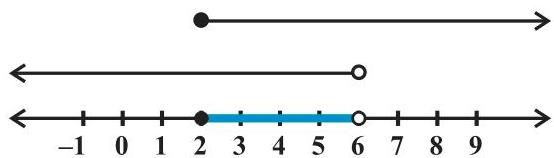 Fig 5.3
Therefore, the solution to this system comprises all real numbers $x$ that are between 2 and 6, inclusive of 2 but not 6; specifically, $2 \leq x < 6$.
Example 12 In a laboratory procedure, a hydrochloric acid solution must be maintained at a temperature between $30^{\circ}$ and $35^{\circ}$ Celsius. Determine the corresponding temperature range in degrees Fahrenheit, given the conversion formula $\mathrm{C} = \frac{5}{9}$ (F - 32), where C denotes temperature in degrees Celsius and F denotes temperature in degrees Fahrenheit.
Solution We are given that the temperature in Celsius, C, satisfies $30 < \mathrm{C} < 35$.
By substituting the conversion formula $\mathrm{C} = \frac{5}{9}$ (F - 32) into the inequality, we obtain:
$ 3 0 < \frac {5}{9} (F - 3 2) < 3 5, $
To isolate (F - 32), we multiply all parts of the inequality by $\frac{9}{5}$:
$ \frac{9}{5} \times (30) < (\mathrm{F} - 32) < \frac{9}{5} \times (35) $
This simplifies to $54 < (\mathrm{F} - 32) < 63$.
Adding 32 to all parts yields $86 < \mathrm{F} < 95$.
Consequently, the required temperature range is between $86^{\circ}$ F and $95^{\circ}$ F.
Example 13 A manufacturer possesses 600 litres of an acid solution with a $12%$ concentration. How many litres of a $30%$ acid solution must be integrated into this existing quantity such that the acid concentration in the resultant mixture falls between $15%$ and $18%$ (exclusive of $18%$)?
Solution Let $x$ represent the volume in litres of the $30%$ acid solution that needs to be added. The total volume of the resulting mixture will then be $(x + 600)$ litres.
For the acid content in the final mixture to exceed $15%$, the following inequality must hold: $30% x + 12%$ of $600 > 15%$ of $(x + 600)$.
and $ 30% x + 12% \text{ of } 600 < 18% \text{ of } (x + 600) $
or $ \frac{30x}{100} +\frac{12}{100} (600) > \frac{15}{100
} (x +
$
and $ \frac{30x}{100} +\frac{12}{100} (600) < \frac{18}{100} (x + 600)
$
or $ 30x + 7200 > 15x + 9000 $
and $ 30x + 7200 < 18x + 10800 $
or $ 15x > 1800 \quad \text{and} \quad 12x < 3600 $
or $ x > 120 \quad \text{and} \quad x < 300 $
i.e. $ 120 < x < 300 $
Therefore, the quantity of the $30%$ acid solution, in litres, must exceed 120 litres but remain below 300 litres.
Miscellaneous Exercise on Chapter 5
Solve the inequalities in Exercises 1 to 6.
- $2 \leq 3x - 4 \leq 5$
- $6 \leq -3(2x - 4) < 12$
- $-3\leq 4 - \frac{7x}{2}\leq 18$
- $-15 < \frac{3(x - 2)}{5} \leq 0$
- $-12 < 4 - \frac{3x}{-5} \leq 2$
- $7 \leq \frac{(3x + 11)}{2} \leq 11$ .
Solve the inequalities in Exercises 7 to 10 and represent the solution graphically on number line.
- $5x + 1 > -24, \quad 5x - 1 < 24$
- $2(x - 1) < x + 5, \quad 3(x + 2) > 2 - x$
- $3x - 7 > 2(x - 6), \quad 6 - x > 11 - 2x$
- $5(2x - 7) - 3(2x + 3) \leq 0, \quad 2x + 19 \leq 6x + 47$ .
- A specific solution's temperature must be maintained within the range of $68^{\circ}\mathrm{F}$ to $77^{\circ}\mathrm{F}$ . Determine the equivalent temperature range in degrees Celsius (C), given the conversion formula between Celsius and Fahrenheit (F):
$ \mathrm {F} = \frac {9}{5} \mathrm {C} + 3 2? $
To dilute an $8%$ boric acid solution, a $2%$ boric acid solution is introduced. The final mixture's boric acid concentration must fall between $4%$ and $6%$ (exclusive). If 640 litres of the $8%$ solution are available, calculate the volume, in litres, of the $2%$ solution that needs to be incorporated.
Determine the volume of water, in litres, required to be combined with 1125 litres of a $45%$ acid solution such that the acid concentration in the resultant mixture is greater than $25%$ but less than $30%$ .
An individual's Intelligence Quotient (IQ) is defined by the following formula:
$ \mathrm{IQ} = \frac{\mathrm{MA}}{\mathrm{CA}} \times 100, $
where MA denotes mental age and CA signifies chronological age. For a cohort of children aged 12 years, if their IQ falls within the interval $80 \leq \mathrm{IQ} \leq 140$ , ascertain the corresponding range for their mental age.
Summary
- An inequality is established when two real numbers or algebraic expressions are connected through the use of relational symbols such as
Personal 1:1 AI Tutor for CBSE, JEE & NEET Students
YoLearn.AI is India's #1 AI tutoring platform for Class 1 to 12, JEE, and NEET preparation. Students talk to expert AI tutors in real time through live voice calls, solve doubts instantly on an interactive sketch board, and practice with mock tests, flashcards, quizzes, and slide decks. Learn from top educators including DC Pandey and other verified teachers who create AI avatars of themselves.
Live voice tutoring and doubt solving
Unlike text-only chatbots, YoLearn.AI lets you speak naturally to your AI tutor — just like a real one-on-one session. Get step-by-step explanations for Physics, Chemistry, Maths, and Biology for board exams, JEE Main, JEE Advanced, and NEET.
Mock tests, flashcards, and exam prep
Prepare for JEE 2026, NEET 2026, and CBSE board exams with personalized mock tests, AI-generated quizzes, and flashcard makers. Build daily study habits with an AI study buddy designed for Indian students.
For school, JEE, and NEET
Whether you need a Class 10 CBSE tutor, Class 12 board exam help, or full JEE and NEET coaching online, YoLearn.AI adapts to your grade, syllabus, and learning pace. Start free today on web, iOS, and Android.
- The addition or subtraction of identical numerical values to both sides of an inequality does not alter its validity.
- Multiplication or division of both sides of an inequality by an equivalent positive number preserves the direction of the inequality. However, if both sides are subjected to multiplication or division by a negative number, the direction of the inequality symbol must be inverted.
- Solutions to an inequality are defined as the specific values of $x$ that render the inequality a correct assertion.
- For the graphical depiction of $x < a$ (or $x > a$) on a number line, an open circle should be placed at point $a$, with a darkened line extending to the left (or right) of $a$.
- When illustrating $x \leq a$ (or $x \geq a$) on a number line, a solid circle is positioned at point $a$, and a darkened line is drawn to the left (or right) of $a$.