CHAPTER SEVEN
GRAVITATION
7.1 Introduction
7.2 Kepler's laws
7.3 Universal law of gravitation
7.4 The gravitational constant
7.5 Acceleration due to gravity of the earth
7.6 Acceleration due to gravity below and above the surface of earth
7.7 Gravitational potential energy
7.8 Escape speed
7.9 Earth satellites
7.10 Energy of an orbiting satellite
Summary
Points to ponder
Exercises
7.1 INTRODUCTION
From an early age, we observe the inclination of all physical entities to be drawn towards the Earth. Objects propelled upwards invariably descend Earthward; ascending an incline demands considerably more effort than descending; precipitation from atmospheric formations descends to the planet's surface, alongside numerous comparable occurrences. Historically, the Italian physicist Galileo Galilei (1564-1642) was instrumental in establishing that all physical bodies, irrespective of their inherent mass, experience an identical, constant acceleration towards the Earth. Accounts suggest he publicly demonstrated this principle. His pursuit of this truth involved conducting experiments with objects traversing inclined planes, from which he deduced an acceleration due to gravity remarkably close to the refined measurements subsequently achieved.
Separately, the study of celestial bodies—stars, planets, and their trajectories—has captivated observers across diverse cultures since antiquity. Ancient observations distinguished stars by their seemingly immutable positions in the celestial sphere over successive years. Of greater intrigue were the planets, exhibiting predictable movements against this backdrop of fixed stars. Approximately two millennia ago, Ptolemy advanced the earliest documented model of planetary motion, a 'geocentric' construct positing that all heavenly entities—including stars, the Sun, and planets—orbited the Earth. Celestial bodies were then believed to be capable only of circular motion. Ptolemy devised intricate orbital patterns to account for the observed planetary trajectories. His theory posited planets moving in smaller circles, the centers of which themselves traced larger circular paths. Analogous cosmological theories were subsequently proposed by Indian astronomers roughly four centuries later. Nevertheless, a more refined 'heliocentric' paradigm, placing the Sun at the orbital center for planets, had been articulated by Aryabhatta (5th century A.D.) within his scholarly works. A millennium hence, the Polish cleric Nicolas Copernicus (1473-1543
) presented a comprehensive model asserting that planets orbited a stationary central sun in circular paths.
Copernicus's theory encountered ecclesiastical condemnation; however, Galileo, a prominent proponent, faced state prosecution for endorsing these views. Contemporaneously with Galileo, a Danish nobleman, Tycho Brahe (1546-1601), dedicated his life to meticulously documenting planetary movements through unaided visual observation. His extensive astronomical records were subsequently scrutinized by his assistant, Johannes Kepler (1571-1640). From this empirical evidence, Kepler derived three sophisticated principles, now universally recognized as Kepler's laws. Newton, conversant with these laws, was thereby empowered to achieve a monumental scientific breakthrough by formulating his universal law of gravitation.
7.2 KEPLER'S LAWS
The three laws of Kepler can be stated as follows:
- Law of orbits: All planets traverse elliptical paths, with the Sun positioned at one of the foci of these ellipses.
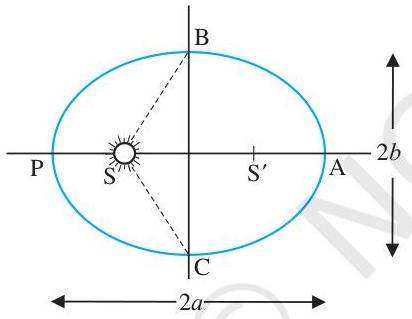 Fig. 7.1(a) An ellipse traced out by a planet around the sun. The closest point is $P$ and the farthest point is $A$. $P$ is called the perihelion and $A$ the aphelion. The semimajor axis is half the distance $AP$.
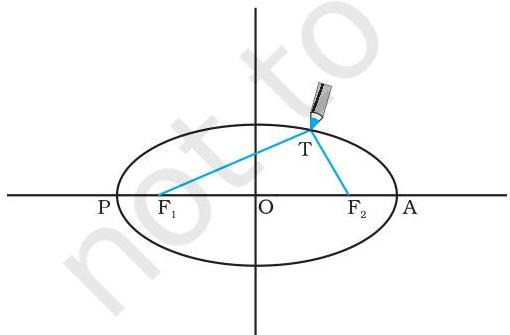 Fig. 7.1(b) Drawing an ellipse. A string has its ends fixed at $F_{1}$ and $F_{2}$. The tip of a pencil holds the string taut and is moved around.
(Fig. 7.1a). This principle represented a departure from the Copernican model, which exclusively posited circular orbital trajectories. An ellipse, which includes the circle as a specific instance, is a closed geometric shape whose construction can be demonstrated quite simply.
To illustrate, designate two distinct points, $\mathbf{F}_1$ and $\mathbf{F}_2$. Secure the extremities of a piece of string at these points using fasteners. By maintaining tension on the string with a pencil tip, one can trace a continuous curve as the pencil moves, resulting in the formation of an ellipse (Fig. 7.1(b)). A fundamental characteristic of any point $\mathbf{T}$ on this ellipse is that the sum of its distances from $\mathbf{F}_1$ and $\mathbf{F}_2$ remains invariant. These points, $\mathbf{F}_1$ and $\mathbf{F}_2$, are termed the foci. If a line segment connects $\mathbf{F}_1$ and $\mathbf{F}_2$ and is extended to intersect the ellipse at points $\mathbf{P}$ and $\mathbf{A}$ (as depicted in Fig. 7.1(b)), the midpoint of segment PA defines the ellipse's center, O. The distance PO (or AO) is designated as the semi-major axis. In the specific instance of a circle, the two foci coalesce into a single point, and the semi-major axis is equivalent to the circle's radius.
- Law of areas: The line segment connecting any planet to the Sun sweeps out equivalent areas within identical temporal intervals (Fig. 7.2). This law is derived from empirical observations indicating that planetary velocities are reduced when their orbital positions are more distant from the Sun, in contrast to when they are in closer proximity.
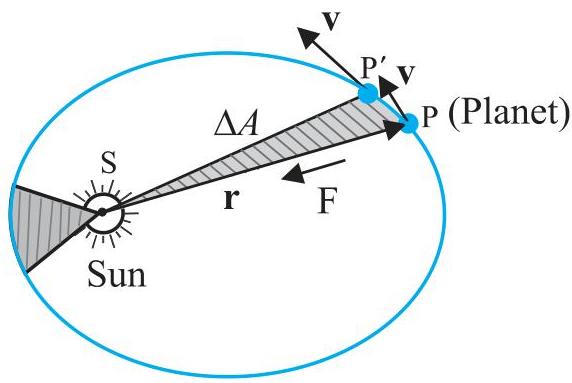 Fig. 7.2 The planet $P$ moves around the sun in an elliptical orbit. The shaded area is the area $\Delta A$ swept out in a small interval of time $\Delta t$.
- Law of periods: The square of a planet's orbital period bears a direct proportionality to the cube of the semi-major axis of its elliptical trajectory.
Table 7.1 presents the approximate orbital periods and corresponding semi-major axis values for the eight* planets orbiting the Sun.
Table 7.1 Data from measurement of planetary motions given below confirm Kepler's Law of Periods
(a = Semi-major axis in units of $10^{10}$ m. T = Time period of revolution of the planet in years(y). Q = The quotient $(T^2 / a^3)$ in units of $10^{-34} , \text{y}^2 , \text{m}^{-3}$.
| Planet | a | T | Q |
|---|---|---|---|
| Mercury | 5.79 | 0.24 | 2.95 |
| Venus | 10.8 | 0.615 | 3.00 |
| Earth | 15.0 | 1 | 2.96 |
| Mars | 22.8 | 1.88 | 2.98 |
| Jupiter | 77.8 | 11.9 | 3.01 |
| Saturn | 143 | 29.5 | 2.98 |
| Uranus | 287 | 84 | 2.98 |
| Neptune | 450 | 165 | 2.99 |
Kepler's law of areas can be conceptualized as a direct outcome of the principle of angular momentum conservation, a principle applicable to any system influenced by a central force. A central force is characterized by its action along the line connecting the two interacting bodies, specifically, the force on a planet is directed along the vector from the Sun to the planet. Consider the Sun positioned at the origin, with the planet's location and momentum represented by $\mathbf{r}$ and $\mathbf{p}$ respectively. The infinitesimal area $\Delta \mathbf{A}$ traced by a planet of mass $m$ over a time interval $\Delta t$ is given by (refer to Fig. 7.2):
$ \Delta \mathbf{A} = \frac{1}{2} (\mathbf{r} \times \mathbf{v} \Delta t) \tag{7.1} $
Consequently, the rate at which area is swept is expressed as:
$ \begin{array}{l} \Delta \mathbf{A} / \Delta t = \frac{1}{2} (\mathbf{r} \times \mathbf{p}) / m, \text{ (since } \mathbf{v} = \mathbf{p} / m) \ = L / (2 m) \tag{7.2} \end{array} $
Here, $\mathbf{v}$ denotes the planet's velocity, and $\mathbf{L}$ signifies its angular momentum, defined as $(\mathbf{r} \times \mathbf{p})$. In the presence of a central force, which consistently acts along the radial vector $\mathbf{r}$, the angular momentum $\mathbf{L}$ remains invariant throughout the planet's orbit. Thus, from the preceding equation, the rate of area sweeping, $\Delta \mathbf{A} / \Delta t$, is a constant. This constancy is precisely what constitutes the law of areas. Given that gravitational force is inherently a central force, the law of areas is a direct consequence of gravitational dynamics.
Example 7.1 Consider the planet's speed at perihelion $P$ in Fig. 7.1(a) as $v_{p}$ and the Sun-planet distance SP as $r_{p}$. Establish a relationship between these parameters ${r_{p}, v_{p}}$ and their counterparts at aphelion, ${r_{A}, v_{A}}$. Furthermore, determine if the planet requires equivalent durations to traverse the orbital segments BAC and CPB.
Answer The magnitude of the angular momentum at the perihelion point $P$ is $L_{p} = m_{p} r_{p} v_{p}$, because a visual inspection indicates that the position vector $\mathbf{r}{p}$ and the velocity vector $\mathbf{v}{p}$ are mutually orthogonal at this specific point. Similarly, at aphelion, the angular momentum $L_{A} = m_{p} r_{A} v_{A}$. By applying the principle of angular momentum conservation, we have:
$ m_{p} r_{p} v_{p} = m_{p} r_{A} v_{A} $
which simplifies to:
$ \frac{v_{p}}{v_{A}} = \frac{r_{A}}{r_{p}} $
As $r_{A}$ is greater than $r_{p}$, it follows that $v_{p}$ must be greater than $v_{A}$.
The elliptical area SBAC, delimited by the ellipse and the radius vectors $SB$ and $SC$ in Fig. 7.1, is observably larger than the area SBPC. According to Kepler's second law, a planet sweeps out equal areas in equal time intervals. Therefore, the planet will necessitate a greater duration to traverse the path BAC compared to CPB.
7.3 UNIVERSAL LAW OF GRAVITATION
The popular anecdote posits that an apple's descent prompted Newton to formulate a universal law of gravitation, which subsequently elucidated both terrestrial gravity and Kepler's planetary laws. Newton posited that the Moon, orbiting at a radius $R_m$, experiences a centripetal acceleration from Earth's gravity, quantified as:
$ a_{m} = \frac{V^{2}}{R_{m}} = \frac{4 \pi^{2} R_{m}}{T^{2}} \tag{7.3} $
Here, $V$ denotes the Moon's orbital speed, linked to its orbital period $T$ by $V = 2\pi R_{m} / T$. The period $T$ is approximately 27.3 days, and $R_m$ was already established as roughly $3.84 \times 10^8 \mathrm{m}$ at that time. Substituting these figures into Eq. (7.3) yields an $a_m$ value significantly less than the gravitational acceleration $g$ observed at Earth's surface, which also stems from Earth's gravitational pull.
This observation unequivocally demonstrates that the Earth's gravitational influence diminishes with increasing distance. Postulating that Earth's gravitational force attenuates inversely with the square of the distance from its center leads to the relationships $a_m \propto R_m^{-2}$ and $g \propto R_E^{-2}$, from which we derive:
$ \frac {g}{a _ {m}} = \frac {R _ {m} ^ {2}}{R _ {E} ^ {2}} \simeq 3 6 0 0 \tag {7.4} $
This aligns well with an approximate value of $g \simeq 9.8 , \text{m} , \text{s}^{-2}$ and the $a_m$ value derived from Eq. (7.3). These findings prompted Newton to articulate the subsequent Universal Law of Gravitation:
Every body in the universe attracts every other body with a force which is directly proportional to the product of their masses and inversely proportional to the square of the distance between them.
This statement is largely drawn from Newton's renowned work, 'Mathematical Principles of Natural Philosophy' (commonly referred to as Principia).
Expressed mathematically, Newton's law of gravitation specifies that the magnitude of the force $\mathbf{F}$ exerted on a point mass $m_2$ by another point mass $m_1$ is given by:
$ | \mathbf {F} | = G \frac {m _ {1} m _ {2}}{r ^ {2}} \tag {7.5} $
Equation (7.5) can be represented in its vector form as:
$ \begin{array}{l} \mathbf {F} = G \frac {m _ {1} m _ {2}}{r ^ {2}} (- \hat {\boldsymbol {\tau}}) = - G \frac {m _ {1} m _ {2}}{r ^ {2}} \hat {\boldsymbol {\tau}} \ = - G \frac {m _ {1} m _ {2}}{| \boldsymbol {\tau} | ^ {3}} \hat {\boldsymbol {\tau}} \ \end{array} $
Here, $G$ represents the universal gravitational constant, $\hat{\boldsymbol{\tau}}$ is the unit vector pointing from $m_1$ to $m_2$, and $\pmb{\tau} = \pmb{\tau}_2 - \pmb{\tau}_1$, as illustrated in Fig. 7.3.
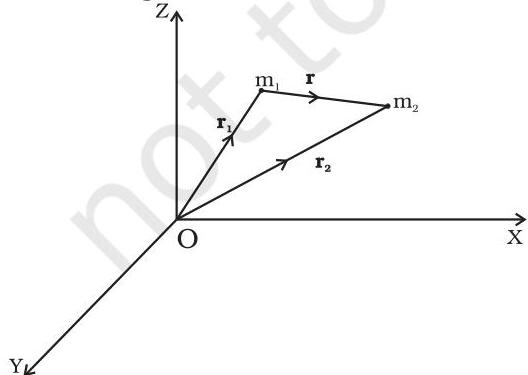 Fig. 7.3 Gravitational force on $m_{1}$ due to $m_{2}$ is along $\pmb{\tau}$ where the vector $\pmb{\tau}$ is $(\pmb{\tau}{2} - \pmb{\tau}{1})$ .
The gravitational force is inherently attractive, meaning the force $\mathbf{F}$ acts in the direction of $-\boldsymbol{\tau}$. By Newton's third law, the force exerted on point mass $m_1$ by $m_2$ is, naturally, $-\mathbf{F}$. Consequently, the gravitational force $\mathbf{F}{12}$ on body 1 due to body 2 and $\mathbf{F}{21}$ on body 2 due to body 1 are related by $\mathbf{F}{12} = -\mathbf{F}{21}$.
Prior to employing Eq. (7.5) for the analysis of objects, it is essential to exercise caution, as this particular law is formulated for point masses, whereas our typical scenarios involve extended objects possessing finite dimensions. In a configuration comprising multiple point masses, the resultant force acting upon any individual mass is determined by the vector summation of the gravitational forces exerted by all other constituent point masses, as illustrated in Fig 7.4.
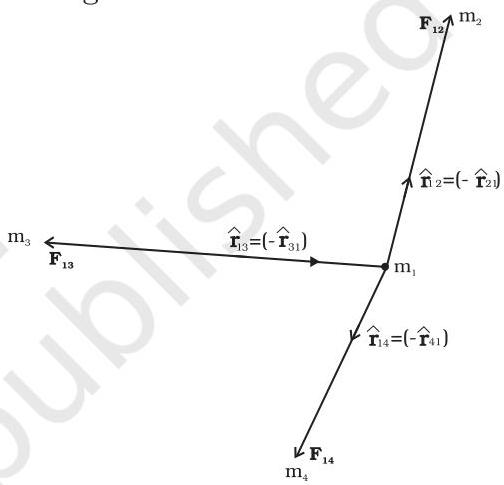 Fig. 7.4 Gravitational force on point mass $m_{1}$ is the vector sum of the gravitational forces exerted by $m_{2}, m_{3}$ and $m_{4}$ .
The aggregate force acting on $m_1$ is expressed as:
$ \mathbf {F} _ {1} = \frac {G m _ {2} m _ {1}}{r _ {2 1} ^ {2}} \hat {\boldsymbol {\tau}} _ {2 1} + \frac {G m _ {3} m _ {1}}{r _ {3 1} ^ {2}} \hat {\boldsymbol {\tau}} _ {3 1} + \frac {G m _ {4} m _ {1}}{r _ {4 1} ^ {2}} \hat {\boldsymbol {\tau}} _ {4 1} $
Example 7.2 Consider an equilateral triangle ABC, at whose vertices three identical masses, each of $m$ kg, are positioned.
(a) Determine the gravitational force exerted on a mass $2m$ situated at the centroid $G$ of this triangle. (b) Calculate the force if the mass located at vertex A is subsequently doubled.
Assume $\mathrm{AG} = \mathrm{BG} = \mathrm{CG} = 1\mathrm{m}$ (refer to Fig. 7.5)
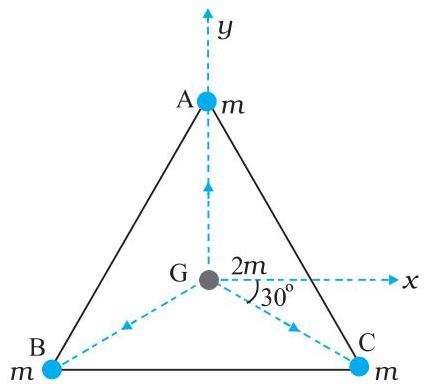
Fig. 7.5 Three equal masses are placed at the three vertices of the $\Delta ABC$ . A mass $2m$ is placed at the centroid $G$ .
Answer (a) The angle formed by GC with the positive $x$-axis measures $30^{\circ}$, and similarly, the angle between GB and the negative $x$-axis is also $30^{\circ}$. The individual force contributions, expressed in vector notation, are as follows:
$ \mathbf {F} _ {\mathrm {G A}} = \frac {G m (2 m)}{1} \hat {\mathbf {j}} $
$ \mathbf {F} _ {\mathrm {G B}} = \frac {G m (2 m)}{1} \left(- \hat {\mathbf {i}} \cos 3 0 ^ {o} - \hat {\mathbf {j}} \sin 3 0 ^ {o}\right) $
$ \mathbf {F} _ {\mathrm {G C}} = \frac {G m (2 m)}{1} \left(+ \hat {\mathbf {i}} \cos 3 0 ^ {o} - \hat {\mathbf {j}} \sin 3 0 ^ {o}\right) $
Applying the principle of superposition and the rule of vector addition, the net gravitational force $\mathbf{F}_{\mathrm{R}}$ acting on the mass $(2m)$ is determined as:
$ \mathbf {F} _ {\mathrm {R}} = \mathbf {F} _ {\mathrm {G A}} + \mathbf {F} _ {\mathrm {G B}} + \mathbf {F} _ {\mathrm {G C}} $
$ \begin{array}{l} \mathbf {F} _ {\mathrm {R}} = 2 G m ^ {2} \hat {\mathbf {j}} + 2 G m ^ {2} \left(- \hat {\mathbf {i}} \cos 3 0 ^ {o} - \hat {\mathbf {j}} \sin 3 0 ^ {o}\right) \
- 2 G m ^ {2} \left(\hat {\mathbf {i}} \cos 3 0 ^ {o} - \hat {\mathbf {j}} \sin 3 0 ^ {o}\right) = 0 \ \end{array} $
Alternatively, an expectation arises from the inherent symmetry of the configuration that the net force should logically resolve to zero.
(b) Should the mass at vertex A be subsequently doubled, the situation changes as follows:
$ \begin{array}{l} \mathrm {F} _ {G A} ^ {\cdot} = \frac {\mathrm {G} 2 m . 2 m}{1} \hat {\mathrm {j}} = 4 \mathrm {G m} ^ {2} \hat {\mathrm {j}} \ \mathrm {F} _ {G B} ^ {\cdot} = \mathrm {F} _ {G B} \text { and } \mathrm {F} _ {G C} ^ {\cdot} = \mathrm {F} _ {G C} \ \mathrm {F} _ {R} ^ {\cdot} = \mathrm {F} _ {G A} ^ {\cdot} + \mathrm {F} _ {G B} ^ {\cdot} + \mathrm {F} _ {G C} ^ {\cdot} \ \mathrm {F} _ {\mathrm {R}} ^ {\cdot} = 2 G m ^ {2} \hat {\mathrm {j}} \ \end{array} $
When analyzing the gravitational force between an extended body (such as Earth) and a point mass, Equation (7.5) is not directly applicable. This is because each infinitesimal mass element within the extended object exerts a gravitational force on the given point mass, and these individual forces do not all act in the same direction. Consequently, determining the total force necessitates the vectorial summation of these contributions from all point masses comprising the extended body. This analytical process is readily accomplished through the application of calculus. Such calculations yield simplified laws for two specific scenarios:
(1) For a point mass situated externally to a hollow spherical shell of uniform density, the attractive gravitational force is precisely equivalent to that which would arise if the shell's entire mass were hypothetically concentrated at its geometric center. A qualitative understanding of this phenomenon is as follows: The gravitational forces originating from different sections of the shell possess components both along the radial line connecting the point mass to the shell's center and perpendicular to this line. Upon integration (or summation) across all regions of the shell, these perpendicular components mutually annul each other, leaving solely a net force directed along the line joining the external point to the center. The computation of this force's magnitude corroborates the aforementioned principle.
(2) Conversely, a point mass positioned within a hollow spherical shell of uniform density experiences no net force of gravitational attraction. This outcome can also be comprehended through qualitative reasoning. The diverse regions of the spherical shell exert gravitational pulls on the internal point mass in multiple, opposing directions. These individual forces undergo complete mutual cancellation.
7.4 THE GRAVITATIONAL CONSTANT
The gravitational constant, denoted as $G$, which is a fundamental parameter in the Universal Law of Gravitation, is amenable to experimental determination. Its initial measurement was successfully conducted by the English scientist Henry Cavendish in 1798. A schematic representation of the experimental setup he employed is presented in Fig. 7.6.
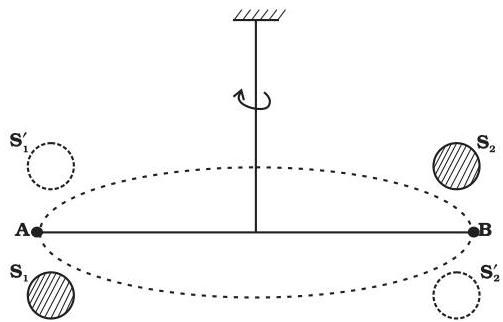 Fig. 7.6 A diagrammatic illustration of Cavendish's experimental apparatus. Large spheres, designated $S_{1}$ and $S_{2}$, are positioned adjacent to the masses at points A and B, respectively, depicted by shaded regions. Upon repositioning these larger spheres to the opposing side of the masses (indicated by dotted circles), the bar AB undergoes a slight rotational displacement due to the reversal of the applied torque. This angular displacement is quantifiable through experimental observation.
A horizontal bar, labeled AB, is equipped with two small lead spheres affixed at its extremities. This bar is precisely suspended from a fixed overhead support by means of a delicate wire. Subsequently, two substantially larger lead spheres are introduced into proximity with the smaller ones, positioned on opposing sides as illustrated. These larger spheres exert an attractive force on their adjacent smaller counterparts; these forces are equal in magnitude and opposite in direction. Consequently, while the net force acting on the bar remains zero, a resultant torque is generated. This torque is precisely the product of the attractive force $F$ (between a large sphere and its proximate small sphere) and the length of the bar. This applied torque induces a twisting deformation in the suspension wire until an equilibrium state is achieved where the wire's inherent restoring torque counterbalances the gravitational torque. Should $\theta$ represent the angular twist of the suspended wire, the restoring torque is directly proportional to $\theta$, expressed as $\tau \theta$. Here, $\tau$ signifies the restoring couple per unit angular displacement. The value of $\tau$ can be independently ascertained, for instance, by subjecting the wire to a known torque and measuring the resultant twist angle. For the purpose of calculating gravitational interaction, the force between the spherical masses can be treated as if their entire masses were concentrated at their respective geometric centers. Thus, if $d$ denotes the center-to-center separation between a large sphere and its adjacent small sphere, and $M$ and $m$ are their respective masses, the gravitational attractive force between them is given by:
$ F = G \frac {M m}{d ^ {2}} \tag {7.6} $
Considering $L$ as the total length of the bar AB, the torque generated by the force $F$ is calculated as the product of $F$ and $L$. In an equilibrium condition, this gravitational torque is precisely balanced by the restoring torque, leading to the following equality:
$ G \frac {M m}{d ^ {2}} L = \tau \theta \tag {7.7} $
Therefore, by experimentally observing the angle of twist $\theta$, one can deduce the value of the gravitational constant $G$ using this established relationship.
Subsequent to Cavendish's pioneering work, the precision in measuring $G$ has undergone significant enhancements. The value presently adopted as standard is:
$ G = 6.67 \times 10 ^ {11} \mathrm{N m} ^ {2} / \mathrm{kg} ^ {2} \tag {7.8} $
7.5 ACCELERATION DUE TO GRAVITY OF THE EARTH
One can conceptualize the Earth as comprising numerous concentric spherical layers, ranging from the innermost at its core to the outermost at its periphery. For any location external to the Earth, this point naturally lies beyond all these constituent shells. Consequently, each of these shells contributes to a gravitational force on the external point, behaving precisely as if their collective mass were aggregated at their shared central origin, consistent with principles established in Section 7.3. The sum of the masses of all these shells constitutes the Earth's total mass. Therefore, for an observer positioned outside the Earth, the gravitational influence is indistinguishable from that which would arise if the Earth's entire mass were condensed into its geometric center.
Conversely, the scenario differs significantly for a point situated within the Earth's interior. This distinction is visually represented in Fig. 7.7.
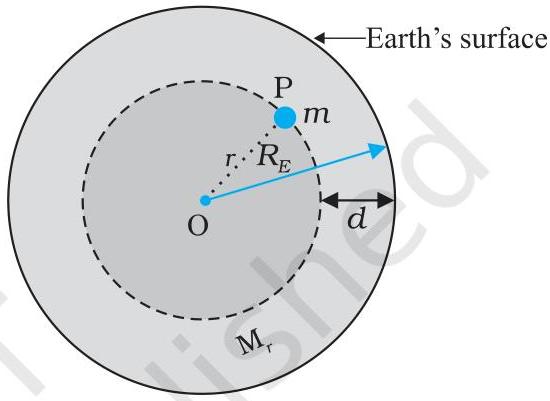 Fig. 7.7 The mass $m$ is in a mine located at a depth $d$ below the surface of the Earth of mass $M_E$ and radius $R_E$. We treat the Earth to be spherically symmetric.
Let us once more conceptualize the Earth as composed of concentric shells, with a point mass $m$ positioned at a radial distance $r$ from the Earth's center. The point $P$ (where mass $m$ is located) is external to any sphere having a radius less than $r$. Conversely, for all spherical shells possessing a radius greater than $r$, the point $P$ lies within them. Consequently, based on the principle articulated in the preceding section, these larger shells exert no net gravitational influence on the mass $m$ situated at $P$. The shells whose radii are less than or equal to $r$ collectively form a sphere of radius $r$, for which the point $P$ is effectively on its surface. This smaller, interior sphere thus exerts a gravitational force on the mass $m$ at $P$, precisely as if its total mass, denoted $M_r$, were concentrated at the common center. Therefore, the magnitude of the force acting on mass $m$ at point $P$ is given by:
$ F = \frac {G m \left(M _ {r}\right)}{r ^ {2}} \tag {7.9} $
Under the premise that the Earth possesses a uniform density throughout, its total mass, $M_E$, can be expressed as $M_{\mathrm{E}} = \frac{4\pi}{3} R_{E}^{3}\rho$. Here, $M_E$ represents the Earth's mass, $R_E$ denotes its radius, and $\rho$ signifies its uniform density. Correspondingly, the mass of the spherical region $M_r$ with radius $r$ is given by $\frac{4\pi}{3}\rho r^3$, and consequently:
$ \begin{array}{l} F = G m \left(\frac {4 \pi \rho}{3}\right) \frac {r ^ {3}}{r ^ {2}} = G m \left(\frac {M _ {E}}{R _ {E} ^ {3}}\right) \frac {r ^ {3}}{r ^ {2}} \ = \frac {G m M _ {E}}{R _ {E} ^ {3}} r \tag {7.10} \end{array} $
Should the mass $m$ be positioned precisely at the Earth's surface, then the radial distance $r$ becomes equal to the Earth's radius $R_E$. In this specific case, the gravitational force exerted upon it, derived directly from Eq. (7.10), is given by:
$ F = G \frac {M _ {E} m}{R _ {E} ^ {2}} \tag {7.11} $
The acceleration experienced by mass $m$, conventionally represented by the symbol $g$, is linked to the force $F$ through Newton's Second Law of Motion, expressed as $F = mg$. Consequently:
$ g = \frac {F}{m} = \frac {G M _ {E}}{R _ {E} ^ {2}} \tag {7.12} $
The acceleration $g$ is empirically quantifiable. The Earth's radius, $R_E$, is a well-established parameter. By combining the experimental determination of the gravitational constant $G$ (for instance, through the Cavendish experiment or alternative methods) with the known values of $g$ and $R_E$, one can ascertain the Earth's mass, $M_E$, using Eq. (7.12). This practical application underpins the well-known assertion concerning Cavendish: "Cavendish weighed the Earth".
7.6 ACCELERATION DUE TO GRAVITY BELOW AND ABOVE THE SURFACE OF EARTH
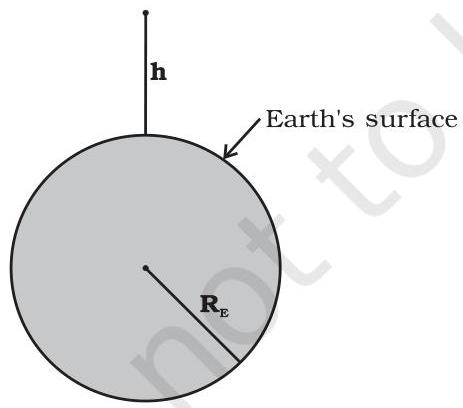
Let us examine a point mass $m$ situated at an altitude $h$ above the Earth's surface, as depicted in Fig. 7.8(a). The Earth's radius is designated as $R_E$. Given that this point lies external to the Earth,
 (a)
Fig. 7.8 (a) $g$ at a height $h$ above the surface of the earth.
(a)
Fig. 7.8 (a) $g$ at a height $h$ above the surface of the earth.
its radial separation from the Earth's center is $(R_E + h)$. If $F(h)$ represents the scalar value of the gravitational force exerted on the point mass $m$, we derive from Eq. (7.5):
$ F (h) = \frac {G M _ {E} m}{\left(R _ {E} + h\right) ^ {2}} \tag {7.13} $
The gravitational acceleration encountered by the point mass is defined as $F(h) / m \equiv g(h)$, yielding
$ g (h) = \frac {F (h)}{m} = \frac {G M _ {E}}{\left(R _ {E} + h\right) ^ {2}}. \tag {7.14} $
Evidently, this magnitude is inferior to the gravitational acceleration $g$ at the Earth's surface, where $g = \frac{GM_E}{R_E^2}$. For instances where $h \ll R_E$, the right-hand side of Eq. (7.14) can be expanded:
$ g (h) = \frac {G M _ {E}}{R _ {E} ^ {2} \left(1 + h / R _ {E}\right) ^ {2}} = g \left(1 + h / R _ {E}\right) ^ {- 2} $
When $\frac{h}{R_E} \ll 1$, employing the binomial expansion,
$ g (h) \equiv g \left(1 - \frac {2 h}{R _ {E}}\right). \tag {7.15} $
Consequently, Equation (7.15) demonstrates that for modest altitudes $h$, the magnitude of $g$ diminishes by a factor of $(1 - 2h / R_E)$.
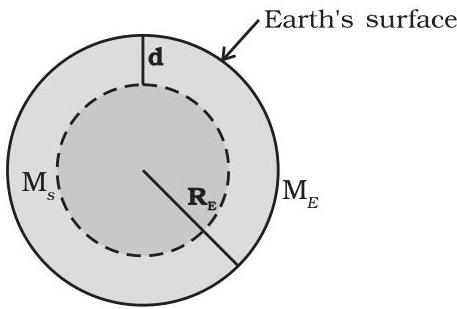
Next, let us analyze a point mass $m$ positioned at a depth $d$ beneath the Earth's surface (Fig. 7.8(b)), such that its radial distance from the Earth's core is $(R_E - d)$, as illustrated. The Earth can be conceptualized as comprising an inner sphere with radius $(R_E - d)$ and an encompassing spherical shell of thickness $d$. The gravitational force exerted on $m$ by this outer shell of thickness $d$ is nullified, consistent with the principle established in the preceding section. Regarding the inner sphere of radius $(R_E - d)$, the point mass lies external to it; thus, in accordance with the previously cited result, the force attributable to this smaller sphere acts as if its entire mass were concentrated at its center. If $M_e$ denotes the mass of this inner sphere, then,
$ M _ {e} / M _ {E} = \left(R _ {E} - d\right) ^ {3} / R _ {E} ^ {3} \tag {7.16} $
Given that the mass of a sphere is directly proportional to the cube of its radius.
 (b)
Fig. 7.8 (b) $g$ at a depth $d$. In this case only the smaller sphere of radius $(R_E - d)$ contributes to $g$.
(b)
Fig. 7.8 (b) $g$ at a depth $d$. In this case only the smaller sphere of radius $(R_E - d)$ contributes to $g$.
Consequently, the force acting on the point mass is given by
$ F (d) = G M _ {e} m / \left(R _ {E} - d\right) ^ {2} \tag {7.17} $
By substituting the expression for $\mathbf{M}_{\mathrm{e}}$ derived previously, we obtain
$ F (d) = G M _ {E} m \left(R _ {E} - d\right) / R _ {E} ^ {3} \tag {7.18} $
Therefore, the acceleration due to gravity at a specific depth $d$ is,
$ \begin{array}{l} g (d) = \frac {F (d)}{m} \text { is } \ g (d) = \frac {F (d)}{m} = \frac {G M _ {E}}{R _ {E} ^ {3}} \left(R _ {E} - d\right) \ = g \frac {R _ {E} - d}{R _ {E}} = g \left(1 - d / R _ {E}\right) \tag {7.19} \ \end{array} $
Consequently, upon descending beneath the Earth's surface, the acceleration caused by gravity diminishes proportionally by a factor of $(1 - d / R_{E})$ . A notable characteristic of the Earth's gravitational acceleration is its peak value at the surface, from which it continuously lessens whether one moves upward or downward.
7.7 GRAVITATIONAL POTENTIAL ENERGY
Previously, we explored the concept of potential energy, defining it as the energy inherent in an object due to its specific configuration or location. Should a particle's position be altered by the influence of acting forces, the corresponding variation in its potential energy precisely equals the work performed on the particle by that force. As established earlier, forces for which the work expended is not contingent on the trajectory taken are classified as conservative forces.
Given that the gravitational force is a conservative force, it is possible to determine the potential energy associated with it, which is termed gravitational potential energy. Let us examine locations in close proximity to the Earth's surface, where the distances from the surface are considerably less than the Earth's radius. Under these conditions, the gravitational force can be regarded as essentially constant, equivalent to $mg$, and oriented toward the Earth's core. If we delineate a starting point at a height $h_1$ above the Earth's surface and a subsequent point directly above it at a height $h_2$ from the surface, the work, $W_{12}$, required to elevate a particle of mass $m$ from the initial to the final position is expressed as:
$ \begin{array}{l} W _ {1 2} = \text {Force} \times \text {displacement} \ = m g \left(h _ {2} - h _ {1}\right) \tag {7.20} \ \end{array} $
If we correlate a potential energy, denoted as $W(h)$, with a specific height $h$ above the surface, such that:
$ W (h) = m g h + W _ {0} \tag {7.21} $
(where $W_{0}$ represents a constant);
it then follows that:
$ W _ {1 2} = W \left(h _ {2}\right) - W \left(h _ {1}\right) \tag {7.22} $
The work expended in displacing the particle corresponds precisely to the disparity in potential energy between its terminal and initial configurations. It can be noted that the constant $W_{0}$ is eliminated in Equation (7.22). By substituting $h = 0$ into the preceding equation, we obtain $W(h = 0) = W_{0}$. The condition $h = 0$ signifies locations on the Earth's surface. Consequently, $W_{0}$ denotes the potential energy at the Earth's surface.
When considering points situated at arbitrary distances from the Earth's surface, the previously derived outcome becomes inapplicable, as the premise that the gravitational force, $mg$, remains constant is no longer tenable. Nevertheless, based on our prior discourse, we understand that for a point external to the Earth, the gravitational force exerted on a particle, directed towards the Earth's center, is given by:
$ F = \frac {G M _ {E} m}{r ^ {2}} \tag {7.23} $
where $M_{E}$ denotes the mass of the Earth, $m$ represents the mass of the particle, and $r$ signifies its distance from the Earth's core. If we proceed to compute the work required to elevate a particle from an initial radial position $r = r_{1}$ to a final radial position $r = r_{2}$ (with $r_{2} > r_{1}$) along a radial trajectory, the result, superseding Equation (7.20), is:
$ \begin{array}{l} W _ {1 2} = \int_ {r _ {1}} ^ {r _ {2}} \frac {G M m}{r ^ {2}} d r \ = - G M _ {E} m \left(\frac {1}{r _ {2}} - \frac {1}{r _ {1}}\right) \tag {7.24} \ \end{array} $
Correspondingly, a potential energy, denoted as $W(r)$, may be ascribed to a body at a radial distance $r$, serving as an alternative formulation to Eq. (7.21). This is expressed as:
$
W(r) = - \frac{G M_E m}{r} + W_1, \tag{7.25} $
This expression holds true for distances $r$ greater than $R$. Consequently, the change in potential energy between two points, $W_{12}$, is equivalent to $W(r_2) - W(r_1)$. If we evaluate this equation at $r = \text{infinity}$, we find that $W(r = \text{infinity}) = W_1$. Therefore, $W_1$ represents the potential energy at an infinite separation. It is crucial to recognize that, as indicated by Eqs. (7.22) and (7.24), only the difference in potential energy between any two points possesses physical significance. By common convention, $W_1$ is assigned a value of zero, thereby defining the potential energy at a specific point as the work required to move the particle from infinity to that particular location.
Our previous calculations determined the potential energy experienced by a particle at a given point due to the Earth's gravitational field, demonstrating its direct proportionality to the particle's mass. The gravitational potential, arising from the Earth's gravitational influence, is subsequently defined as the potential energy per unit mass of a particle situated at that specific point. Building upon our prior discourse, the gravitational potential energy corresponding to two particles, with masses $m_1$ and $m_2$, separated by a distance $r$, is mathematically expressed as:
$ V = - \frac{G m_1 m_2}{r} \quad \text{(if we choose } V = 0 \text{ as } r \to \infty\text{)} $
It is important to observe that the aggregate potential energy within an isolated system comprising multiple particles is obtained by summing the potential energies (as defined by the preceding equation) for every distinct pair of particles within the system. This methodology exemplifies the principle of superposition.
Example 7.3 Find the potential energy of a system of four particles placed at the vertices of a square of side $l$. Also obtain the potential at the centre of the square.
Answer Let's consider a configuration where four particles, each possessing mass $m$, are positioned at the corners of a square with side length $l$, as illustrated in Fig. 7.9. For the purpose of calculating the total potential energy, we identify four pairs of masses separated by a distance $l$ (along the sides) and two pairs of masses separated by a diagonal distance of $\sqrt{2} l$.
Hence,
$ \begin{aligned} W(r) &= - 4 \frac{G m^2}{l} - 2 \frac{G m^2}{\sqrt{2} l} \ &= - \frac{2 G m^2}{l} \left(2 + \frac{1}{\sqrt{2}}\right) = - 5.41 \frac{G m^2}{l} \end{aligned} $
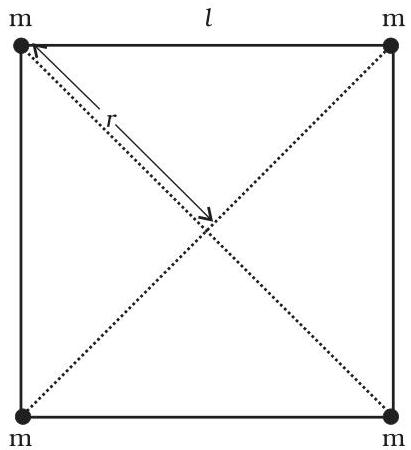 Fig. 7.9
The gravitational potential at the geometric center of the square, where the distance from each mass is $\left(r = \sqrt{2} l / 2\right)$, is given by:
$ U(r) = - 4 \sqrt{2} \frac{G m}{l}. $
7.8 ESCAPE SPEED
When an object is propelled manually, its trajectory invariably leads it back to the Earth's surface. Employing mechanical devices allows for projectiles to be launched at significantly higher velocities, and as the initial speed increases, so does the maximum altitude attained. This naturally prompts an inquiry: is it feasible to launch an object with an initial velocity sufficiently high that it permanently departs from Earth's gravitational influence?
The fundamental principle of energy conservation provides the means to address this inquiry. Let us postulate that the object achieves an infinite distance from the Earth, possessing a final velocity $V_f$ at that point. An object's total energy is constituted by the sum of its potential and kinetic energies. Consistent with previous conventions, $W_1$ represents the gravitational potential energy of the object at an infinite separation. Consequently, the total energy of the projectile at infinity is expressed as:
$ E(\infty) = W_1 + \frac{m V_f^2}{2} \tag{7.26} $
Conversely, if the object commenced its trajectory with an initial velocity $V_i$ from a location situated at a distance $(h + R_E)$ from the Earth's geocenter ($R_E$ signifying the Earth's radius), its initial total energy was:
$ E(h + R_E) = \frac{1}{2} m V_i^2 - \frac{G m M_E}{(h + R_E)} + W_1 \tag{7.27} $
In accordance with the principle of energy conservation, the expressions in Eqs. (7.26) and (7.27) must be equivalent. Therefore:
$ \frac {m V _ {i} ^ {2}}{2} - \frac {G m M _ {E}}{(h + R _ {E})} = \frac {m V _ {f} ^ {2}}{2} \tag {7.28} $
Given that the right-hand side (R.H.S.) of this equation is inherently a non-negative quantity, possessing a minimum value of zero, the left-hand side (L.H.S.) must similarly conform to this condition. Consequently, an object is capable of attaining an infinite distance provided that its initial velocity $\mathbf{V}_i$ satisfies the following criterion:
$ \frac {m V _ {i} ^ {2}}{2} - \frac {G m M _ {E}}{(h + R _ {E})} \geq 0 \tag {7.29} $
The lowest possible value for $\mathrm{V}_i$ is observed when the L.H.S. of Eq. (7.29) evaluates to zero. This condition, therefore, defines the minimum speed necessary for an object to achieve an infinite separation (i.e., to escape Earth's gravitational field), which is given by:
$ \frac {1}{2} m \left(V _ {i} ^ {2}\right) _ {\min } = \frac {G m M _ {E}}{h + R _ {E}} \tag {7.30} $
Should the object be launched directly from the Earth's surface, where $h = 0$, the expression simplifies to:
$ \left(V _ {i}\right) _ {\min } = \sqrt {\frac {2 G M _ {E}}{R _ {E}}} \tag {7.31} $
By employing the relationship $g = GM_{E} / R_{E}^{2}$, the equation transforms into:
$ \left(V _ {i}\right) _ {\min } = \sqrt {2 g R _ {E}} \tag {7.32} $
Substituting the established values for $g$ and $R_{E}$, the numerical approximation for $(V)_{\min}$ is approximately $11.2 , \mathrm{km/s}$. This particular speed is designated as the escape speed, occasionally referred to somewhat imprecisely as the escape velocity.
The applicability of Equation (7.32) extends equivalently to an object launched from the lunar surface, provided that $g$ is substituted with the acceleration due to the Moon's gravity at its surface, and $r_{E}$ is replaced by the Moon's radius. Both of these lunar parameters are considerably less than their terrestrial counterparts, resulting in a lunar escape speed of approximately $2.3\mathrm{km / s}$, which is roughly one-fifth of Earth's. This disparity accounts for the absence of a substantial atmosphere on the Moon; gas molecules generated on its surface that achieve velocities exceeding this threshold will overcome the Moon's gravitational attraction.
Example 7.4 Two uniform solid spheres of equal radii $R$, but mass $M$ and $4M$ have a centre to centre separation $6R$, as shown in Fig. 7.10. The two spheres are held fixed. A projectile of mass $m$ is projected from the surface of the sphere of mass $M$ directly towards the centre of the second sphere. Obtain an expression for the minimum speed $v$ of the projectile so that it reaches the surface of the second sphere.
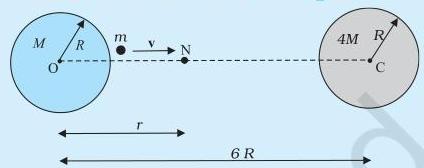 Fig. 7.10
The projectile experiences two gravitational forces exerted by the spheres, which act in opposition to each other. The neutral point, denoted as N (refer to Fig. 7.10), is defined as the location where these two forces precisely nullify one another. If the distance from point O to N is represented by $r$, the following relationship holds:
$ \begin{array}{l} \frac {G M m}{r ^ {2}} = \frac {4 G M m}{(6 R - r) ^ {2}} \ (6 R - r) ^ {3} = 4 r ^ {2} \ 6 R - r = \pm 2 r \ r = 2 R \quad \text {or} - 6 R. \ \end{array} $
The solution $r = -6R$ for the neutral point is not physically relevant in this context. Consequently, $\mathrm{ON} = r = 2R$. It is only necessary to launch the particle with a velocity adequate for it to reach point N. Subsequent to this, the more substantial gravitational attraction of the $4M$ sphere will be sufficient to draw the projectile in. The initial mechanical energy of the system at the surface of sphere $M$ is given by:
$ E _ {i} = \frac {1}{2} m v ^ {2} - \frac {G M m}{R} - \frac {4 G M m}{5 R}. $
Upon reaching the neutral point $\mathbf{N}$, the projectile's velocity effectively diminishes to zero. At this specific location, the mechanical energy is exclusively potential in nature.
$ E _ {N} = - \frac {G M m}{2 R} - \frac {4 G M m}{4 R}. $
Applying the principle of mechanical energy conservation,
$ \frac {1}{2} v ^ {2} - \frac {G M}{R} - \frac {4 G M}{5 R} = - \frac {G M}{2 R} - \frac {G M}{R} $
or
$
v^{2} = \frac{2 G M}{R} \left(\frac{4}{5} - \frac{1}{2}\right) $
$ v = \left(\frac{3 G M}{5 R}\right)^{1/2} $
It is important to observe that while the projectile's speed is zero at point N, it will possess a non-zero velocity upon impact with the more massive $4M$ sphere. Determining this impact speed is presented as an exercise for the students.
7.9 EARTH SATELLITES
Objects that orbit the Earth are known as Earth satellites. Their trajectories bear a strong resemblance to the orbital paths of planets around the Sun, making Kepler's laws of planetary motion fully applicable to them. Specifically, these satellites follow either circular or elliptical paths around our planet. The Moon stands as Earth's sole natural satellite, possessing an orbit that is nearly circular and a period of approximately 27.3 days, which closely matches its rotational period around its own axis. Beginning in 1957, technological progress has allowed numerous nations, including India, to deploy artificial Earth satellites for various practical applications, such as telecommunications, geophysics, and meteorology.
Let us analyze a satellite orbiting circularly at a distance $(R_E + h)$ from the Earth's center, where $R_E$ denotes the Earth's radius. For a satellite of mass $m$ moving at a speed $V$, the centripetal force necessary to maintain this orbit is given by:
$ F(\text{centripetal}) = \frac{m V^{2}}{(R_{E} + h)} \tag{7.33} $
This force is inherently directed towards the orbital center. The gravitational attraction between the Earth and the satellite supplies this required centripetal force, expressed as:
$ F(\text{gravitation}) = \frac{G m M_{E}}{(R_{E} + h)^{2}} \tag{7.34} $
Here, $M_{E}$ represents the mass of the Earth.
By equating the right-hand sides of Equations (7.33) and (7.34) and subsequently canceling the mass $m$, we arrive at:
$ V^{2} = \frac{G M_{E}}{(R_{E} + h)} \tag{7.35} $
This relationship indicates that the orbital speed $V$ diminishes as the altitude $h$ increases. Evaluating Equation (7.35) for the case where $h = 0$ (i.e., at the Earth's surface), the speed $V$ is:
$ V^{2} \quad (h = 0) = G M / R_{E} = g R_{E} \tag{7.36} $
Here, we have utilized the fundamental relationship $g = G M / R_{E}^{2}$. During each complete orbit, the satellite covers a distance of $2\pi (R_{E} + h)$ at a constant speed $V$. Consequently, its orbital period $T$ is determined by:
$ T = \frac{2 \pi (R_{E} + h)}{V} = \frac{2 \pi (R_{E} + h)^{3/2}}{\sqrt{G M_{E}}} \tag{7.37} $
This result is obtained by substituting the expression for $V$ from Equation (7.35). Squaring both sides of Equation (7.37) yields:
$ T^{2} = k \left(R_{E} + h\right)^{3} \quad \text{(where } k = 4\pi^{2} / GM_{E}\text{)} \tag{7.38} $
This equation represents Kepler's third law, specifically adapted for the motion of satellites orbiting the Earth. For satellites situated very near the Earth's surface, the altitude $h$ can be considered negligible compared to $R_{E}$ in Equation (7.38). Under these conditions, the period $T$ simplifies to $T_{0}$, defined as:
$ T_{0} = 2 \pi \sqrt{R_{E} / g} \tag{7.39} $
Upon substituting the numerical constants $g \simeq 9.8 , \text{m} , \text{s}^{-2}$ and $R_{E} = 6400 , \text{km}$ into the expression, we obtain:
$ T_{0} = 2 \pi \sqrt{\frac{6.4 \times 10^{6}}{9.8}} \text{ s} $
This calculation yields an approximate value of 85 minutes.
Example 7.5 The planet Mars has two moons, Phobos and Deimos. (i) Phobos has a period of 7 hours, 39 minutes and an orbital radius of $9.4 \times 10^{3} , \text{km}$. Calculate the mass of Mars. (ii) Assume that Earth and Mars move in circular orbits around the Sun, with the Martian orbit being 1.52 times the orbital radius of the Earth. What is the length of the Martian year in days?
Answer (i) To solve this, we utilize Equation (7.38), adapting it by substituting the mass of Mars, $M_{m}$, in place of the Sun's mass.
$ \begin{array}{l} T^{2} = \frac{4 \pi^{2}}{G M_{m}} R^{3} \ M_{m} = \frac{4 \pi^{2}}{G} \frac{R^{3}}{T^{2}} \ = \frac{4 \times (3.14)^{2} \times (9.4)^{3} \times 10^{18}}{6.67 \times 10^{-11} \times (459 \times 60)^{2}} \ M_{m} = \frac{4 \times (3.14)^{2} \times (9.4)^{3} \times 10^{18}}{6.67 \times (4.59 \times 6)^{2} \times 10^{-5}} \ = 6.48 \times 10^{23} , \text{kg}. \end{array} $
(ii) Utilizing Kepler's third law once more,
$ \frac{T_{M}^{2}}{T_{E}^{2}} = \frac{R_{MS}^{3}}{R_{EN}^{3}} $
where $R_{MS}$ denotes the distance between the mass and the Sun, and $R_{ES}$ represents the Earth-Sun distance.
$ \begin{array}{l} \therefore T_{M} = (1.52)^{3/2} \times 365 \ = 684 \text{ days} \end{array} $
It is observed that the orbital paths of all planets, with the exceptions of Mercury and Mars, approximate a circular form closely. For instance, the Earth's orbit exhibits a semi-minor to semi-major axis ratio, $b/a$, of $0.99986$.
Example 7.6 Determining Earth's Mass: Provided with the following parameters: $g = 9.81 , \mathrm{ms}^{-2}$, Earth's radius $R_{E} = 6.37 \times 10^{6} , \mathrm{m}$, the lunar distance $R = 3.84 \times 10^{8} , \mathrm{m}$, and the Moon's sidereal period of 27.3 days. Compute the Earth's mass, $M_{E}$, using two distinct methodologies.
Answer Utilizing Equation (7.12), we derive:
$ \begin{array}{l} M_{E} = \frac{g R_{E}^{2}}{G} \ = \frac{9.81 \times \left(6.37 \times 10^{6}\right)^{2}}{6.67 \times 10^{-11}} \ = 5.97 \times 10^{24} , \mathrm{kg}. \end{array} $
Considering the Moon as an Earth satellite, and referring to the derivation of Kepler's third law [cf. Equation (7.38)], it follows that:
$ \begin{array}{l} T^{2} = \frac{4 \pi^{2} R^{3}}{G M_{E}} \ M_{E} = \frac{4 \pi^{2} R^{3}}{G T^{2}} \ = \frac{4 \times 3.14 \times 3.14 \times (3.84)^{3} \times 10^{24}}{6.67 \times 10^{-11} \times (27.3 \times 24 \times 60 \times 60)^{2}} \ = 6.02 \times 10^{24} , \mathrm{kg} \end{array} $
The results obtained from both approaches are in close agreement, with their discrepancy falling below $1%$.
Example 7.7 Conversion of Constant $k$: Convert the constant $k$ from Equation (7.38) into units of days and kilometers. Given $k = 10^{-13} , \mathrm{s}^2 , \mathrm{m}^{-3}$. The Moon's orbital radius from Earth is $3.84 \times 10^{8} , \mathrm{km}$. Determine its period of revolution in days.
Answer Provided with:
$ k = 10^{-13} , \mathrm{s}^2 , \mathrm{m}^{-3} $
$ \begin{array}{l} = 10^{-13} \left[ \frac{1}{(24 \times 60 \times 60)^{2}} , \mathrm{d}^{2} \right] \left[ \frac{1}{(1 / 1000)^{3} , \mathrm{km}^{3}} \right] \ = 1.33 \times 10^{-14} , \mathrm{d}^{2} , \mathrm{km}^{-3} \end{array} $
By applying Equation (7.38) in conjunction with the provided value of $k$, the Moon's period of revolution is calculated as:
$ \begin{array}{l} T^{2} = (1.33 \times 10^{-14}) (3.84 \times 10^{8})^{3} \ T = 27.3 , \mathrm{d} \end{array} $
It is important to recognize that Equation (7.38) remains valid for elliptical trajectories, provided that $(R_{E} + h)$ is substituted with the ellipse's semi-major axis. In such configurations, the Earth would be situated at one of the foci of this elliptical path.
7.10 ENERGY OF AN ORBITING SATELLITE
The kinetic energy of a satellite, specifically one in a circular orbit traveling at speed $\nu$, can be derived using Eq. (7.35) as follows:
$ \begin{array}{l} K.E. = \frac{1}{2} m v^{2} \ = \frac{G m M_{E}}{2 (R_{E} + h)}. \end{array} \tag{7.40} $
Assuming the gravitational potential energy is zero at an infinite distance, the potential energy at a separation of $(R + h)$ from the Earth's center is calculated as:
$ P.E. = \frac{G m M_{E}}{(R_{E} + h)} \tag{7.41} $
While the kinetic energy (K.E.) is inherently positive, the potential energy (P.E.) is negative. Notably, the magnitude of the K.E. is precisely half that of the P.E., leading to the following expression for the total energy (E):
$ E = K.E. + P.E. = - \frac{G m M_{E}}{2 (R_{E} + h)} \tag{7.42} $
Consequently, the total energy of a satellite in a circular orbit is negative. This arises because the potential energy, which is negative, has a magnitude that is twice the magnitude of the positive kinetic energy.
Should a satellite's orbit transition to an elliptical path, both its kinetic energy (K.E.) and potential energy (P.E.) will exhibit variations at different points along the trajectory. Nevertheless, the total energy remains constant and, similar to the circular orbit scenario, is negative. This outcome aligns with theoretical expectations, as previously established: an object possessing positive or zero total energy would achieve escape velocity and move to infinite distances. Given that satellites invariably maintain a finite distance from Earth, their energy states cannot be positive or zero.
Example 7.8 A 400 kg satellite orbits the Earth in a circular path with a radius of $2R_{E}$. Determine the energy necessary to relocate this satellite to a new circular orbit with a radius of $4R_{E}$. Additionally, calculate the corresponding changes in its kinetic and potential energies.
Answer Initially,
$ E _ {t} = - \frac {G M _ {E} m}{4 R _ {E}} $
While finally
$ E _ {f} = - \frac {G M _ {E} m}{8 R _ {E}} $
The change in the total energy is
$ \Delta E = E _ {f} - E _ {t} $
$ = \frac {G M _ {E} m}{8 R _ {E}} = \left(\frac {G M _ {E}}{R _ {E} ^ {2}}\right) \frac {m R _ {E}}{8} $
$ \Delta E = \frac {g m R _ {E}}{8} = \frac {9.81 \times 400 \times 6.37 \times 10^{6}}{8} = 3.13 \times 10^{9} \mathrm{J} $
The kinetic energy experiences a reduction, mirroring the change in total energy, specifically, $\Delta K = K_{t} - K_{i} = -3.13 \times 10^{9} \mathrm{J}$.
The modification in potential energy is observed to be double the alteration in the total energy, expressed as:
$ \Delta V = V _ {f} - V _ {i} = - 6.25 \times 10^{9} \mathrm{J} $
SUMMARY
Newton's universal law of gravitation posits that the attractive gravitational force between any two particles, possessing masses $m_1$ and $m_2$ and separated by a distance $r$, exhibits a magnitude expressed as:
$ F = G \frac {m _ {1} m _ {2}}{r ^ {2}} $
Here, $G$ signifies the universal gravitational constant, which has an established value of $6.672 \times 10^{-11} \mathrm{Nm}^2 \mathrm{kg}^{-2}$.
To determine the resultant gravitational force acting upon a particle $m$ due to the presence of multiple masses, such as $M_1, M_2, \ldots, M_n$, the principle of superposition is applied. Let $F_1, F_2, \ldots, F_n$ represent the individual forces exerted by $M_1, M_2, \ldots, M_n$, respectively, each quantifiable by the law of gravitation. According to the principle of superposition, each force operates independently, unaffected by the other bodies. The aggregate force, denoted as $F_R$, is subsequently derived through vector addition:
$ F _ {R} = F _ {1} + F _ {2} + \dots \dots + F _ {n} = \sum_ {j = 1} ^ {n} F _ {j} $
where the symbol $\Sigma$ denotes summation.
Kepler's laws pertaining to planetary motion articulate the following:
(a) All planets traverse elliptical orbits, with the Sun situated at one of the focal points of the ellipse. (b) The radius vector extending from the Sun to a planet sweeps out equivalent areas during equivalent temporal intervals. This outcome arises from the gravitational force acting on the planet being a central force, thereby ensuring the conservation of angular momentum. (c) The square of a planet's orbital period is directly proportional to the cube of the semi-major axis of its elliptical trajectory.
For a planet orbiting the Sun in a circular path, its period $T$ and orbital radius $R$ are interconnected by the relation:
$ T ^ {2} = \left(\frac {4 \pi^ {2}}{G M _ {s}}\right) R ^ {3} $
In this equation, $M_s$ represents the mass of the Sun. While the orbits of most planets around the Sun are nearly circular, for elliptical orbits, the aforementioned equation remains valid if $R$ is substituted with the semi-major axis, $a$.
The acceleration influenced by gravity.
(a) At an altitude $h$ above the Earth's surface:
$ \begin{array}{l} g (h) = \frac {G M _ {E}}{\left(R _ {E} + h\right) ^ {2}} \ = \frac {G M _ {E}}{R _ {E} ^ {2}} \left(1 - \frac {2 h}{R _ {E}}\right) \text{ for } h << R _ {E} \ \end{array} $
$
g(h) = g(0)\left(1 - \frac{2h}{R_E}\right) \quad \text{where} \quad g(0) = \frac{G M_E}{R_E^2} $
(b) At a subterranean depth $d$ below the Earth's surface:
$ g(d) = \frac{G M_E}{R_E^2} \left(1 - \frac{d}{R_E}\right) = g(0) \left(1 - \frac{d}{R_E}\right) $
Given that the gravitational force is a conservative force, a potential energy function can be defined. The gravitational potential energy associated with two particles separated by a distance $r$ is given by:
$ V = - \frac{G m_1 m_2}{r} $
Here, $V$ is conventionally set to zero as $r$ approaches infinity. For a system composed of multiple particles, the total potential energy is the summation of the energies for all distinct pairs of particles, with each pair's contribution adhering to the form presented in the equation above. This computational methodology is consistent with the principle of superposition.
If an isolated system comprises a particle of mass $m$ moving with a speed $v$ in the vicinity of a massive body of mass $M$, the total mechanical energy of the particle is defined as:
$ E = \frac{1}{2} m v^2 - \frac{G M m}{r} $
This equation illustrates that the total mechanical energy is composed of the kinetic and potential energies combined. This total energy value remains invariant over time.
When a mass $m$ executes a circular orbit of radius $a$ around a much larger mass $M$ ($M \gg m$), the aggregate energy of this system is expressed as:
$ E = - \frac{G M m}{2a} $
This formulation assumes the arbitrary constant for potential energy as specified in point 5. A negative total energy signifies a bound system, characterized by a closed trajectory such as an elliptical path. The kinetic and potential energy components are given by:
$ K = \frac{G M m}{2a} $
$ V = - \frac{G M m}{a} $
The velocity required for an object to escape Earth's gravitational field from its surface is calculated as:
$ v_e = \sqrt{\frac{2 G M_E}{R_E}} = \sqrt{2 g R_E} $
This escape velocity is numerically equal to $11.2\ \mathrm{km\ s^{-1}}$.
Should a particle be situated externally to either a uniform spherical shell or a solid sphere possessing a spherically symmetric internal mass distribution, the gravitational influence exerted by the sphere on the particle is identical to that which would occur if the entirety of the body's mass were consolidated at its geometrical center.
In the scenario where a particle is located within a uniform spherical shell, the gravitational force acting upon it is null. Conversely, if a particle resides within a homogeneous solid sphere, the force it experiences is directed towards the sphere's central point. This particular force originates solely from the spherical mass enclosed within the particle's radial position.
| Physical Quantity | Symbol | Dimensions | Unit | Remarks |
|---|---|---|---|---|
| Gravitational Constant | G | [M⁻¹ L³T⁻²] | N m² kg⁻² | 6.67×10⁻¹¹ |
| Gravitational Potential Energy | V(r) | [M L²T⁻²] | J | -GMm/r (scalar) |
| Gravitational Potential | U(r) | [L²T⁻²] | J kg⁻¹ | -GM/r (scalar) |
| Gravitational Intensity | E or g | [LT⁻²] | m s⁻² | GM r²/r (vector) |
POINTS TO PONDER
When considering the motion of an object under the gravitational influence of another body, the following physical quantities are conserved: (a) Angular momentum (b) Total mechanical energy Conversely, linear momentum is not conserved in this context.
The conservation of angular momentum directly accounts for Kepler's second law. This principle, however, is not exclusive to gravitational forces, which follow an inverse-square law. Instead, it is applicable to any force that is central in nature.
In relation to Kepler's third law (as presented in Eq. (7.1)), the expression $T^2 = K_{\mathrm{S}}R^2$ holds true. The constant $K_{\mathrm{S}}$ maintains an identical value for all planets orbiting in circular paths. This principle also extends to satellites in orbit around Earth, as demonstrated in Eq. (7.38).
An astronaut aboard a space satellite experiences a state of weightlessness. This sensation does not arise from a diminished gravitational force at that particular location in space. Rather, it occurs because both the astronaut and the satellite are continuously undergoing "free fall" towards the Earth.
The gravitational potential energy associated with two particles separated by a distance $r$ is defined by:
$ V = - \frac {G m _ {1} m _ {2}}{r} + \text{constant} $
This constant can be assigned any arbitrary value. The most straightforward convention is to set it to zero. With this particular choice, the potential energy becomes:
$ V = - \frac {G m _ {1} m _ {2}}{r} $
This selection implies that $V \to 0$ as $r \to \infty$. The act of defining the zero point for gravitational energy is equivalent to choosing the arbitrary constant within the potential energy formulation. It is important to note that the gravitational force itself remains unaffected by the specific value assigned to this constant.
An object's total mechanical energy is the sum of its kinetic energy (which is inherently positive) and its potential energy. When referenced against infinity (i.e., assuming the object's potential energy at an infinite separation is zero), the gravitational potential energy of an object is negative. Consequently, the total energy of a satellite is also negative.
The commonly encountered formula $mgh$ for potential energy is, in fact, an approximation representing the difference in gravitational potential energy, as elaborated in the preceding point (point 6).
While the gravitational force between two individual particles is central, the force acting between two extended, rigid bodies does not necessarily align along the line connecting their respective centers of mass. However, for a body possessing spherical symmetry, the force exerted upon an external particle behaves precisely as if the entirety of the body's mass were concentrated at its geometric center, thereby rendering this force central.
The gravitational force acting on a particle situated inside a spherical shell is zero. Nevertheless, unlike a metallic shell which provides shielding against electrical forces, a spherical shell does not prevent other external bodies from exerting gravitational forces upon an enclosed particle. Therefore, gravitational shielding is not feasible.
EXERCISES
7.1 Address the subsequent inquiries:
(a) A charged entity can be isolated from electrical forces by enclosing it within a hollow conductor. Is it feasible to isolate an object from the gravitational influence of proximate matter by placing it inside a hollow sphere or through any alternative method?
(b) An individual aboard a compact spacecraft orbiting Earth perceives no gravitational pull. Should the orbital space station be of substantial dimensions, would the individual then be able to discern gravity?
(c) Upon comparing the Earth's gravitational interaction with the Sun to that with the Moon, one observes that the Sun's attractive force surpasses that of the Moon. (This can be verified using data provided in subsequent problems). Nevertheless, the Moon's tidal effect is more pronounced than the Sun's tidal effect. Elucidate why this disparity exists.
7.2 Select the appropriate alternative:
(a) Gravitational acceleration intensifies/diminishes with an increment in altitude. (b) Gravitational acceleration intensifies/diminishes with an increment in depth (assuming Earth possesses a uniform density and is spherical). (c) Gravitational acceleration is independent of the mass of the Earth/mass of the body. (d) The expression $-G M m (1 / r_{2} - 1 / r_{1})$ offers greater/lesser precision than the expression $m g (r_{2} - r_{1})$ for quantifying the potential energy difference between two points located $r_{2}$ and $r_{1}$ distances from Earth's core.
7.3 Envision a hypothetical planet that completes its orbit around the Sun at twice the speed of Earth. Determine its orbital radius relative to that of Earth. 7.4 Io, one of Jupiter's natural satellites, exhibits an orbital period of 1.769 days, and its orbital radius measures $4.22 \times 10^{8} \mathrm{~m}$ . Demonstrate that Jupiter's mass approximates one-thousandth of the Sun's mass. 7.5 Let us posit that our galaxy comprises $2.5 \times 10^{11}$ stars, each possessing a mass equivalent to one solar mass. Calculate the duration required for a star situated 50,000 ly from the galactic core to complete a single revolution. Assume the Milky Way's diameter to be $10^{5}$ ly. 7.6 Choose the correct option:
(a) If the reference point for zero potential energy is established at infinity, the total energy of an orbiting satellite corresponds to the negative of its kinetic/potential energy. (b) The energy expenditure required to propel an orbiting satellite beyond Earth's gravitational domain is greater/lesser than the energy needed to project a stationary object, at the identical height (as the satellite), beyond Earth's influence.
7.7 Does the requisite escape velocity for an object departing Earth vary based on (a) the object's mass, (b) the point of projection, (c) the trajectory of projection, (d) the elevation of the launch site? 7.8 A comet traverses a highly elliptical path around the Sun. Does the comet maintain a constant (a) linear velocity, (b) angular velocity, (c) angular momentum, (d) kinetic energy, (e) potential energy, (f) total energy throughout its orbital journey? Disregard any mass depletion experienced by the comet during its close approach to the Sun. 7.9 Which of the subsequent physiological manifestations is an astronaut likely to experience in the space environment: (a) pedal edema (swollen feet), (b) facial edema (swollen face), (c) cephalalgia (headache), (d) spatial disorientation? 7.10 In the ensuing exercise, select the most appropriate response from the provided choices: The gravitational field strength at the geometric center of a hemispherical shell of uniform mass density possesses a directional orientation as depicted by the arrow (refer to Fig 7.11) (i) a, (ii) b, (iii) c, (iv) 0.
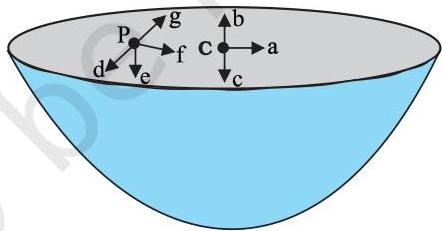 Fig. 7.11
7.11 Referring to the preceding problem, which arrow—(i) d, (ii) e, (iii) f, or (iv) g—correctly depicts the gravitational intensity's direction at an arbitrary point $\mathbf{P}$? 7.12 Consider a rocket launched from Earth in the direction of the Sun. Determine the specific distance from Earth's center where the net gravitational force acting on this rocket becomes null. Utilize the given values: solar mass $= 2 \times 10^{30} , \mathrm{kg}$, terrestrial mass $= 6 \times 10^{24} , \mathrm{kg}$, and the Earth-Sun orbital radius $= 1.5 \times 10^{11} , \mathrm{m}$. Disregard the gravitational influences of any other celestial bodies. 7.13 Explain the methodology for 'weighing the sun,' which implies determining its mass. The average orbital radius of Earth around the Sun is provided as $1.5 \times 10^{8} , \mathrm{km}$. 7.14 Given that a Saturnian year is 29.5 times the duration of an Earth year, calculate Saturn's distance from the Sun, assuming Earth's orbital distance from the Sun is $1.50 \times 10^{8} , \mathrm{km}$. 7.15 An object exhibits a weight of $63\mathrm{N}$ when situated on Earth's surface. Determine the gravitational force exerted on this object by the Earth when it is positioned at an altitude equivalent to half of Earth's radius.
7.16 If Earth is modeled as a sphere possessing uniform mass density, calculate the weight of an object located halfway towards its center, given that its weight on the surface is $250,\mathrm{N}$.
7.17 A rocket is launched perpendicularly from Earth's surface with an initial velocity of $5,\mathrm{km,s^{-1}}$. Determine the maximum altitude the rocket attains from Earth before its trajectory reverses, causing it to return. Use the following constants: Earth's mass $= 6.0 \times 10^{24},\mathrm{kg}$; Earth's mean radius $= 6.4 \times 10^{6},\mathrm{m}$; gravitational constant $G = 6.67 \times 10^{-11},\mathrm{N,m^2,kg^{-2}}$.
7.18 Given that the escape velocity for a projectile originating from Earth's surface is $11.2,\mathrm{km,s^{-1}}$, calculate the ultimate speed of an object launched at three times this velocity, once it is significantly distant from Earth. Assume no gravitational influence from the Sun or other planetary bodies.
7.19 A satellite is in orbit around Earth at an altitude of $400,\mathrm{km}$ above its surface. Determine the total energy required to propel this satellite beyond Earth's gravitational field. The following parameters are provided: satellite mass $= 200,\mathrm{kg}$; Earth's mass $= 6.0 \times 10^{24},\mathrm{kg}$; Earth's radius $= 6.4 \times 10^{6},\mathrm{m}$; and the gravitational constant $G = 6.67 \times 10^{-11},\mathrm{N,m^2,kg^{-2}}$.
7.20 Consider two stars, each possessing a mass equivalent to one solar mass ($= 2 \times 10^{30},\mathrm{kg}$), on a trajectory leading to a head-on collision. At a separation of $10^{9},\mathrm{km}$, their relative velocities are considered negligible. Calculate the impact speed at which these stars collide. Each star has a radius of $10^{4},\mathrm{km}$. For this calculation, assume the stellar bodies maintain their original spherical integrity until the moment of collision. (Employ the standard value of the gravitational constant, $G$).
7.21 Two substantial spheres, each with a mass of $100,\mathrm{kg}$ and a radius of $0.10,\mathrm{m}$, are positioned $1.0,\mathrm{m}$ apart on a level surface. Determine both the net gravitational force and the gravitational potential at the exact midpoint of the line segment connecting their centers. Subsequently, evaluate whether an object situated at this midpoint would be in equilibrium, and if so, characterize the stability of this equilibrium.
Reprint 2025-26