CHAPTER TEN
THERMAL PROPERTIES OF MATTER
10.1 Introduction
10.2 Temperature and heat
10.3 Measurement of temperature
10.4 Ideal-gas equation and absolute temperature
10.5 Thermal expansion
10.6 Specific heat capacity
10.7 Calorimetry
10.8 Change of state
10.9 Heat transfer
10.10 Newton's law of cooling
Summary
Points to ponder
Exercises
Additional Exercises
10.1 INTRODUCTION
Our everyday understanding of heat and temperature is generally intuitive. Specifically, temperature quantifies the degree of 'hotness' or 'coldness' of an object. For instance, a vessel holding boiling water possesses a higher temperature than a container filled with ice. Within the realm of physics, it becomes necessary to establish more precise definitions for concepts such as heat and temperature. This chapter will elucidate the nature of heat, its quantification, and the diverse mechanisms through which thermal energy is transferred between different entities. Furthermore, we will explore the underlying reasons behind practices such as a blacksmith heating an iron band prior to its attachment to a wooden cartwheel, and the phenomenon of coastal winds frequently altering their direction post-sunset. Additionally, an examination will be made of the phase transitions of water, specifically boiling and freezing, noting how its temperature remains constant throughout these processes despite significant thermal energy input or output.
10.2 TEMPERATURE AND HEAT
Our exploration of the thermal characteristics of matter commences with the precise definitions of temperature and heat. Temperature serves as a comparative metric, signaling the degree of warmth or coolness. For instance, a heated utensil is characterized by an elevated temperature, while an ice cube exhibits a diminished temperature. An entity possessing a higher temperature than another is consequently described as being hotter. It is crucial to recognize that descriptors such as "hot" and "cold" are inherently relative, akin to "tall" and "short." While humans can sense temperature through touch, this sensory input is frequently imprecise and lacks the necessary range for rigorous scientific application.
Empirical observations demonstrate that a container of ice-cold water, when situated in a warm environment on a summer day, progressively gains warmth, whereas a vessel of hot tea placed similarly will gradually cool. This phenomenon indicates that when a discrepancy exists between the temperature of an object—such as the ice-cold water or hot tea in these examples—and its ambient surroundings, an exchange of thermal energy, or heat transfer, occurs. This transfer persists until the object and its environment attain thermal equilibrium, reaching an identical temperature. Furthermore, it is observed that for the ice-cold water in a glass, thermal energy migrates from the surroundings towards the glass, while for the hot tea, this energy flows from the
cup of hot tea into the environment. Consequently, heat can be defined as the form of energy that is conveyed between two (or more) systems, or between a system and its surroundings, solely due to a difference in their temperatures. The standard international (SI) unit for transferred heat energy is the joule (J), whereas the SI unit for temperature is the Kelvin (K), with the degree Celsius $(^{\circ}\mathrm{C})$ also being a widely employed unit for temperature measurement. When an object absorbs heat, various transformations can ensue. Its temperature may increase, its volume may expand, or it may undergo a change of state. The specific impacts of heat on different materials will be examined in subsequent sections.
10.3 MEASUREMENT OF TEMPERATURE
The quantification of temperature is achieved through the use of a thermometer. Numerous physical characteristics of materials exhibit sufficient variation in response to temperature changes. Certain of these properties serve as the foundational principle for the construction of thermometers. A frequently utilized property is the alteration in a liquid's volume with temperature. For instance, in conventional liquid-in-glass thermometers, substances like mercury or alcohol are employed, as their volume demonstrates a linear change across a substantial temperature range.
Thermometers are subjected to calibration to enable the assignment of a numerical value to a specific temperature on an appropriate scale. For the establishment of any standard scale, two invariant reference points are requisite. Given that all substances undergo dimensional changes with temperature, an absolute reference for expansion is not available. Nevertheless, the necessary fixed points can be correlated with physical phenomena that invariably occur at the same temperature. The ice point and the steam point of water represent two practical fixed points, also known as the freezing and boiling points, respectively. These two points denote the temperatures at which pure water freezes and boils under standard pressure. The Fahrenheit temperature scale and the Celsius temperature scale are two widely recognized temperature systems. On the Fahrenheit scale, the ice and steam points correspond to $32^{\circ}\mathrm{F}$ and $212^{\circ}\mathrm{F}$, respectively, while on the Celsius scale, these are $0^{\circ}\mathrm{C}$ and $100^{\circ}\mathrm{C}$. The Fahrenheit scale incorporates 180 equal divisions between these two reference points, whereas the Celsius scale comprises 100 such divisions.
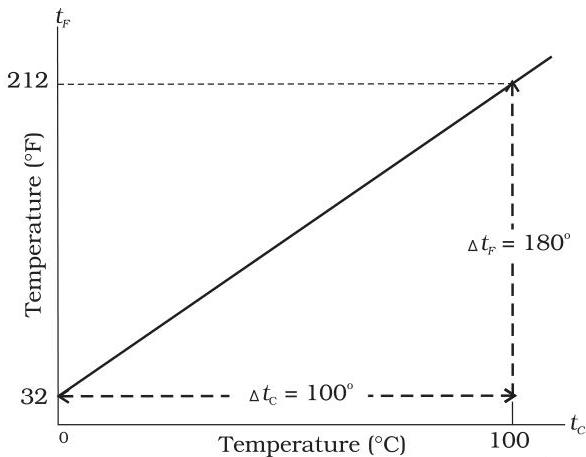 Fig. 10.1 A plot of Fahrenheit temperature $(t_{\mathrm{F}})$ versus Celsius temperature $(t_{\mathrm{C}})$.
A formula facilitating the interconversion between these two scales can be derived from a linear graphical representation of Fahrenheit temperature $(t_{\mathrm{F}})$ against Celsius temperature $(t_{\mathrm{C}})$ (refer to Fig. 10.1). The mathematical expression for this relationship is:
$ \frac {t _ {F} - 3 2}{1 8 0} = \frac {t _ {C}}{1 0 0} \tag {10.1} $
10.4 IDEAL-GAS EQUATION AND ABSOLUTE TEMPERATURE
Liquid-in-glass thermometers exhibit varying readings for temperatures beyond their designated fixed points, attributable to their distinct thermal expansion characteristics. In contrast, a gas-based thermometer yields consistent measurements irrespective of the specific gas employed. Empirical observations indicate that all gases, when at low densities, manifest identical expansion behaviors. The state of a specific quantity (mass) of gas is characterized by its pressure, volume, and temperature $(P,V,$ and $T)$, where $T = t + 273.15$ and $t$ denotes the temperature in $^\circ \mathrm{C}$. With temperature maintained constant, the pressure and volume of a given gas quantity are inversely proportional, expressed as $PV =$ constant. This principle is recognized as Boyle's law, named after its discoverer, the English chemist Robert Boyle (1627-1691). Conversely, when pressure is kept constant, the volume of a gas quantity is directly proportional to its temperature, represented by $V / T =$ constant. This relationship is termed Charles' law, in honor of the French scientist Jacques Charles (1747-1823). These laws are obeyed by low-density gases and can be unified into a singular
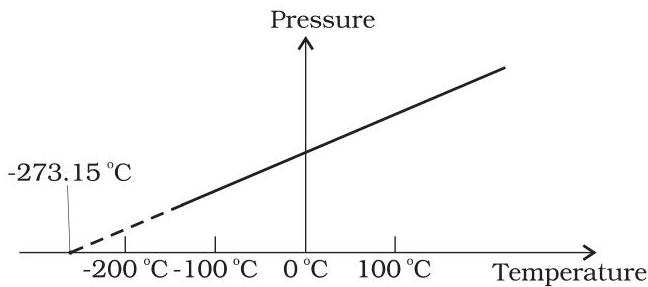 Fig. 10.2 Pressure versus temperature of a low density gas kept at constant volume.
relationship. It is observed that if $PV =$ constant and $V / T =$ constant for a fixed amount of gas, then their combination, $PV / T$, must also be a constant. This combined principle is referred to as the ideal gas law. This can be expressed in a more generalized form, applicable not merely to a specific quantity of a single gas but to any amount of any low-density gas, and is termed the ideal-gas equation:
$ \frac {P V}{T} = \mu R $
$ \text {or} P V = \mu R T \tag {10.2} $
In these equations, $\mu$ signifies the molar quantity of the gas sample, and $R$ is designated as the universal gas constant:
$ R = 8.31 \mathrm{J} \mathrm{mol}^{-1} \mathrm{K}^{-1} $
From Equation 10.2, it is evident that pressure and volume are directly proportional to temperature: $PV \propto T$. This proportionality enables the utilization of a gas for temperature measurement within a constant-volume gas thermometer. By maintaining the gas volume constant, the relation simplifies to $P \propto T$. Consequently, a constant-volume gas thermometer infers temperature based on pressure readings. Under these conditions, a graph illustrating pressure against temperature yields a linear plot, as depicted in Fig. 10.2.
Nevertheless, experimental data for real gases diverge from the predictions of the ideal gas law, particularly at lower temperatures. Despite this, the relationship exhibits linearity across a substantial temperature interval, suggesting that pressure would approach zero as temperature decreases, assuming the substance remained gaseous. The theoretical absolute minimum temperature for an ideal gas is thus deduced by extrapolating this linear relationship to the temperature axis, as illustrated in Fig. 10.3. This extrapolated temperature is determined to be $-273.15^{\circ}\mathrm{C}$ and is termed absolute zero. Absolute zero serves as the fundamental reference point for the Kelvin temperature scale, also known as the absolute temperature scale.
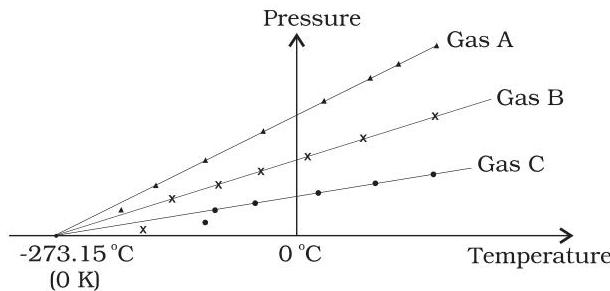 Fig. 10.3 A plot of pressure versus temperature and extrapolation of lines for low density gases indicates the same absolute zero temperature.
The Kelvin scale, named in honor of the British scientist Lord Kelvin, establishes its zero point, $0\mathrm{K}$, at an equivalent temperature of $-273.15^{\circ}\mathrm{C}$ (Fig. 10.4).
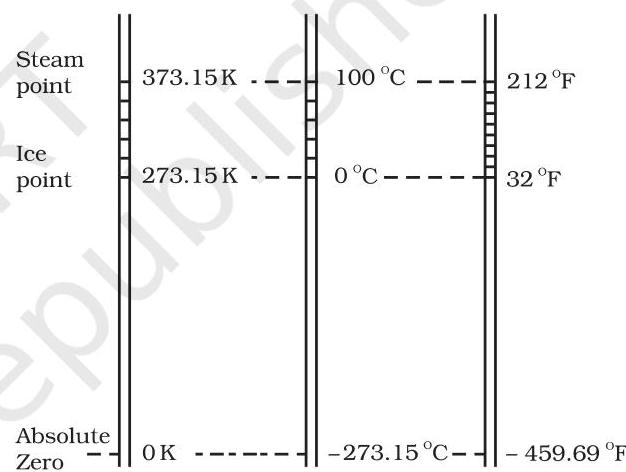 Fig. 10.4 Comparison of the Kelvin, Celsius and Fahrenheit temperature scales.
The magnitude of a single unit increment is identical for both the Kelvin and Celsius temperature scales. Consequently, the relationship between temperatures expressed in these scales is given by:
$ T = t _ {\mathrm {C}} + 273.15 \tag {10.3} $
10.5 THERMAL EXPANSION
It is a common observation that hermetically sealed bottles with metal caps can become so tightly affixed that immersion of the lid in hot water is often necessary for a period to facilitate opening. This procedure enables the metallic lid to undergo expansion, thereby loosening its grip and simplifying the unscrewing process. Regarding liquids, one might notice the ascent of mercury within a thermometer when it is placed in moderately warm water. Conversely, upon removal of the thermometer from the warm
environment, the mercury level recedes. Analogously, a balloon partially inflated in a cool environment will expand to its full capacity when introduced to warm water. Conversely, a fully inflated balloon, when submerged in cold water, will exhibit shrinkage due to the contraction of the internal air.
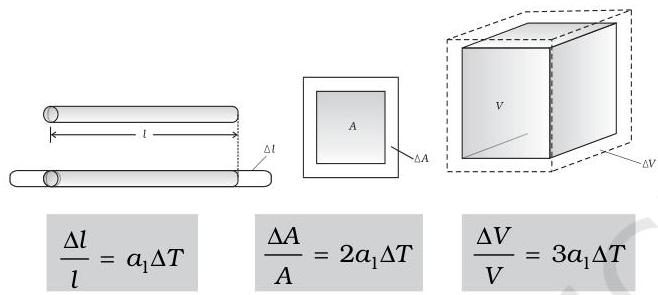
Our everyday experience confirms that the majority of materials enlarge when heated and diminish when cooled. A modification in a body's temperature invariably induces a corresponding alteration in its physical dimensions. The phenomenon where a body's dimensions increase as a consequence of elevated temperature is termed thermal expansion. Specifically, an increase along a single dimension is designated as linear expansion. An expansion affecting two dimensions is referred to as area expansion. An increase across all three dimensions is known as volume expansion (Fig. 10.5).
 (a) Linear expansion
(b) Area expansion
(c) Volume expansion
(a) Linear expansion
(b) Area expansion
(c) Volume expansion
For a substance structured as an elongated rod, a modest alteration in temperature, $\Delta T$, results in a fractional change in length, $\Delta l / l$, which exhibits direct proportionality to $\Delta T$.
$ \frac {\Delta l}{l} = \alpha_ {1} \Delta T \tag {10.4} $
Here, $\alpha_{1}$ is identified as the coefficient of linear expansion (alternatively, linear expansivity), a property intrinsic to the specific material comprising the rod. Table 10.1 presents representative average magnitudes for the coefficient of linear expansion for selected materials within the temperature spectrum of $0^{\circ}\mathrm{C}$ to $100^{\circ}\mathrm{C}$. A comparative analysis of $\alpha_{1}$ values for glass and copper from this table reveals that copper undergoes approximately five times greater expansion than glass when subjected to an identical temperature increase. Generally, metallic substances demonstrate a more pronounced expansion, possessing comparatively elevated $\alpha_{1}$ values.
Table 10.1 Values of coefficient of linear expansion for some material
| Material | α_{1} (10^{-6} K^{-1}) |
|---|---|
| Aluminium | 2.5 |
| Brass | 1.8 |
| Iron | 1.2 |
| Copper | 1.7 |
| Silver | 1.9 |
| Gold | 1.4 |
| Glass (pyrex) | 0.32 |
| Lead | 0.29 |
In an analogous manner, we examine the proportional alteration in volume, $\frac{\Delta V}{V}$, experienced by a material due to a temperature variation $\Delta T$. This allows us to define the coefficient of volume expansion (also known as volume expansivity), $\alpha_{\mathrm{V}}$, which is expressed as:
$ \alpha_ {\mathrm {V}} = \left(\frac {\Delta V}{V}\right) \frac {1}{\Delta T} \tag {10.5} $
This coefficient, $\alpha_{\mathrm{V}}$, while inherent to a given substance, is not truly invariant. Its value typically varies with temperature (refer to Fig 10.6). It is observed that $\alpha_{\mathrm{V}}$ approaches a constant value only when subjected to elevated temperatures.
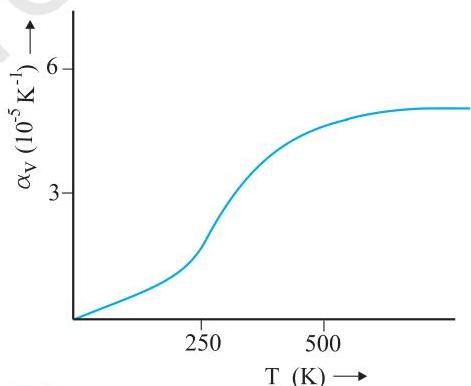 Fig. 10.5 Thermal Expansion.
Fig. 10.6 Coefficient of volume expansion of copper as a function of temperature.
Fig. 10.5 Thermal Expansion.
Fig. 10.6 Coefficient of volume expansion of copper as a function of temperature.
Table 10.2 presents the coefficient of volume expansion for several common materials within the temperature interval of $0 - 100^{\circ}\mathrm{C}$. It is evident that the thermal expansion exhibited by these substances (both solid and liquid phases) is generally quite limited. Certain materials, such as
pyrex glass and invar (a specific iron-nickel alloy), notably display exceptionally low $\alpha_{\mathrm{v}}$ values. An examination of this table reveals that alcohol (ethanol) possesses a higher $\alpha_{\mathrm{v}}$ value compared to mercury, indicating that it undergoes greater expansion than mercury for an equivalent temperature increase.
Table 10.2 Values of coefficient of volume expansion for some substances
| Material | α_{v} (K^{-1}) |
|---|---|
| Aluminium | 7 × 10^{-5} |
| Brass | 6 × 10^{-5} |
| Iron | 3.55 × 10^{-5} |
| Paraffin | 58.8 × 10^{-5} |
| Glass (ordinary) | 2.5 × 10^{-5} |
| Glass (pyrex) | 1 × 10^{-5} |
| Hard rubber | 2.4 × 10^{-4} |
| Invar | 2 × 10^{-6} |
| Mercury | 18.2 × 10^{-5} |
| Water | 20.7 × 10^{-5} |
| Alcohol (ethanol) | 110 × 10^{-5} |
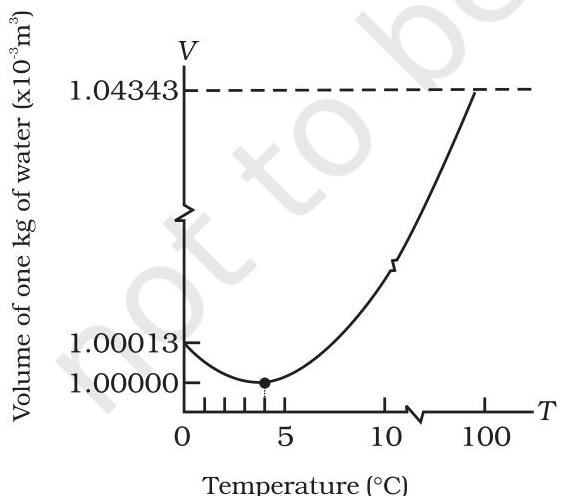
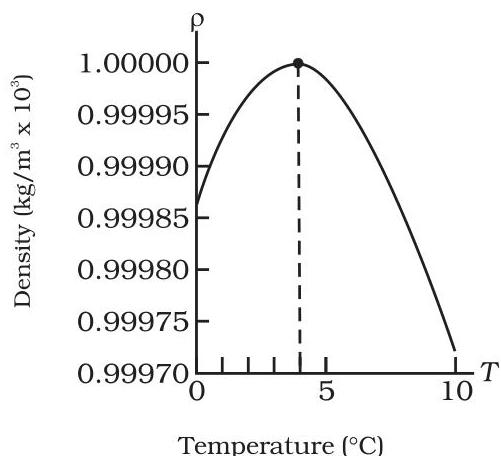
Water displays an atypical characteristic: it undergoes contraction when heated within the temperature range of $0^{\circ}\mathrm{C}$ to $4^{\circ}\mathrm{C}$. As a specific quantity of water is cooled from ambient temperature, its volume diminishes until it reaches $4^{\circ}\mathrm{C}$ [Fig. 10.7(a)]. Subsequently, when the temperature falls below $4^{\circ}\mathrm{C}$, the volume expands, leading to a corresponding reduction in density [Fig. 10.7(b)].
Consequently, water attains its highest density at $4^{\circ}\mathrm{C}$. This particular characteristic carries significant environmental implications: aquatic environments like lakes and ponds commence freezing from their surface downwards. When a lake undergoes cooling and approaches $4^{\circ}\mathrm{C}$, the surface water releases thermal energy to the surrounding atmosphere, increases in density, and descends; concurrently, warmer, less dense water from the deeper regions ascends. Nevertheless, once the superficial water drops below $4^{\circ}\mathrm{C}$, its density decreases, causing it to stay at the surface, where ice formation then occurs. Without this unique property, lakes and ponds would freeze from the base upwards, which would severely jeopardize a substantial portion of their faunal and floral populations.
At typical temperatures, the volumetric expansion of gases significantly exceeds that of solids and liquids. While the volume expansion coefficient for liquids remains largely unaffected by temperature variations, this is not the case for gases, where it exhibits temperature dependence. For an ideal gas under constant pressure conditions, its coefficient of volume expansion can be derived from the ideal gas law:
$ PV = \mu RT $
At constant pressure
$ P\Delta V = \mu R \Delta T $
$ \frac{\Delta V}{V} = \frac{\Delta T}{T} $
$ \text{i.e., } \alpha_{\mathrm{v}} = \frac{1}{T} \text{ for ideal gas} \tag{10.6} $
At $0^{\circ}\mathrm{C}$, the coefficient of volume expansion, $\alpha_{\mathrm{v}}$, for a gas is $3.7 \times 10^{-3} \mathrm{K}^{-1}$, a value substantially greater than those observed for solids and liquids. As indicated by Equation (10.6), $\alpha_{\mathrm{v}}$ for gases is inversely proportional to temperature, meaning it diminishes as the temperature rises. At ambient temperature and constant pressure, the value of $\alpha_{\mathrm{v}}$ for a gas is approximately $3300 \times 10^{-6} \mathrm{K}^{-1}$, which represents a magnitude orders of magnitude higher than the volumetric expansion coefficients of characteristic liquids.
 (a)
(a)
 (b)
Fig. 10.7 Thermal expansion of water.
(b)
Fig. 10.7 Thermal expansion of water.
A straightforward relationship exists between the coefficient of volume expansion $(\alpha_{\mathrm{v}})$ and the coefficient of linear expansion $(\alpha_{\mathrm{l}})$. To illustrate this, consider a cube with side length $l$ that undergoes uniform expansion in all dimensions when its temperature increases by $\Delta T$. In this scenario, we can state:
$ \Delta l = \alpha_{\mathrm{l}} l \Delta T $
$ \text{so, } \Delta V = (l + \Delta l)^{3} - l^{3} \simeq 3l^{2} \Delta l \tag{10.7} $
In Equation (10.7), terms involving $(\Delta l)^2$ and $(\Delta l)^3$ have been disregarded due to the negligible size of $\Delta l$ relative to $l$. Consequently, we find:
$ \Delta V = \frac{3V \Delta l}{l} = 3V \alpha_{\mathrm{l}} \Delta T \tag{10.8} $
which gives
$ \alpha_{\mathrm{v}} = 3 \alpha_{\mathrm{l}} \tag{10.9} $
What occurs if the thermal expansion of a rod is inhibited by rigidly securing its extremities? Evidently, the rod experiences a compressive strain, a consequence of the external forces exerted by the fixed supports at its ends. The resulting internal stress within the rod is termed thermal stress. As an illustration, consider a steel railway track, $5,\mathrm{m}$ in length and possessing a cross-sectional area of $40,\mathrm{cm}^2$, which is restrained from expanding as its temperature increases by $10^{\circ}\mathrm{C}$. Given that the linear expansion coefficient for steel is $\alpha_{\mathrm{l(steel)}} = 1.2 \times 10^{-5},\mathrm{K}^{-1}$, the induced compressive strain is therefore computed as $\frac{\Delta l}{l} = \alpha_{\mathrm{l(steel)}} \Delta T = 1.2 \times 10^{-5} \times 10 = 1.2 \times 10^{-4}$.
The Young's modulus for steel is given as $Y_{\mathrm{(steel)}} = 2 \times 10^{11},\mathrm{N},\mathrm{m}^{-2}$. Consequently, the thermal stress that arises is:
$ \frac{\Delta F}{A} = Y_{\mathrm{steel}} \left(\frac{\Delta l}{l}\right) = 2.4 \times 10^{7},\mathrm{N},\mathrm{m}^{-2}, $
This value corresponds to an external force calculated as:
$ \Delta F = A Y_{\mathrm{steel}} \left(\frac{\Delta l}{l}\right) = 2.4 \times 10^{7} \times 40 \times 10^{-4} \simeq 10^{5},\mathrm{N}. $
Should two such steel rails, secured at their distal ends, come into contact at their proximate ends, a force of this magnitude is fully capable of inducing significant deformation in the rails.
Example 10.1 Show that the coefficient of area expansion, $(\Delta A / A) / \Delta T$, of a rectangular sheet of the solid is twice its linear expansivity, $\alpha_{1}$.
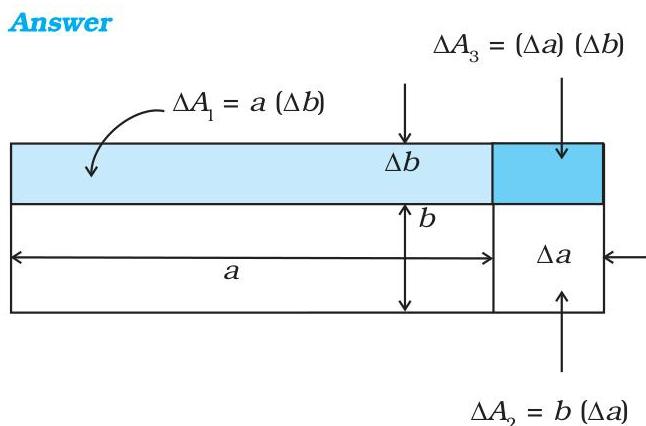 Fig. 10.8
Consider a rectangular solid sheet possessing an initial length $a$ and breadth $b$ (as depicted in Fig. 10.8). Upon an increase in temperature by $\Delta T$, the length $a$ undergoes an expansion of $\Delta a = \alpha_{1} a \Delta T$, and similarly, the breadth $b$ expands by $\Delta b = \alpha_{1} b \Delta T$. Referring to Fig. 10.8, the resultant increase in the sheet's area is given by:
$ \begin{aligned} \Delta A &= \Delta A_{1} + \Delta A_{2} + \Delta A_{3} \ \Delta A &= a \Delta b + b \Delta a + (\Delta a) (\Delta b) \ &= a \alpha_{1} b \Delta T + b \alpha_{1} a \Delta T + (\alpha_{1})^{2} a b (\Delta T)^{2} \ &= \alpha_{1} a b \Delta T (2 + \alpha_{1} \Delta T) = \alpha_{1} A \Delta T (2 + \alpha_{1} \Delta T) \end{aligned} $
Given that $\alpha_{1}$ is approximately $10^{-5},\mathrm{K}^{-1}$, as indicated in Table 10.1, the product $\alpha_{1} \Delta T$ (representing fractional temperature change) is considerably smaller than 2 and can therefore be disregarded. Consequently, we arrive at the relationship:
$ \left(\frac{\Delta A}{A}\right) \frac{1}{\Delta T} = 2 \alpha_{1} $
Example 10.2 A blacksmith fixes iron ring on the rim of the wooden wheel of a horse cart. The diameter of the rim and the iron ring are $5.243,\mathrm{m}$ and $5.231,\mathrm{m}$, respectively at $27^{\circ}\mathrm{C}$. To what temperature should the ring be heated so as to fit the rim of the wheel?
Given, $ T_{1} = 27^{\circ}\mathrm{C} $
$ L_{T1} = 5.231,\mathrm{m} $
$ L_{T2} = 5.243,\mathrm{m} $
So, $ L_{T2} = L_{T1} \left[1 + \alpha_{1} (T_{2} - T_{1})\right] $
$ 5.243,\mathrm{m} = 5.231,\mathrm{m} \left[1 + 1.20 \cdot 10^{-5},\mathrm{K}^{-1} (T_{2} - 27^{\circ}\mathrm{C})\right] $ or $T_{2} = 218^{\circ}\mathrm{C}$.
10.6 SPECIFIC HEAT CAPACITY
Consider heating water in a container using a burner. Initially, one observes bubbles ascending as the water warms. As the temperature rises, the kinetic energy of the water molecules increases, leading to more vigorous movement, eventually becoming turbulent as boiling commences. This prompts the question: what variables govern the amount of thermal energy necessary to elevate a substance's temperature? To explore this, first, heat a specific volume of water to increase its temperature by, for instance, $20^{\circ}\mathrm{C}$, recording the duration required. Subsequently, take an identical volume of water and elevate its temperature by $40^{\circ}\mathrm{C}$ using the same heat source, noting the new duration. The observation will reveal that approximately twice the time is needed, indicating that doubling the temperature increase for the same mass of water necessitates roughly double the thermal energy.
Proceeding to a second experimental phase, if one heats twice the initial quantity of water with the same heating apparatus, aiming for a $20^{\circ}\mathrm{C}$ temperature rise, the duration observed will again be approximately twice that recorded in the initial phase.
For the third step, substitute water with an equivalent mass of a different liquid, such as mustard oil, and apply heat to achieve the same $20^{\circ}\mathrm{C}$ temperature increment. Recording the time with the same instrument will show a shorter duration, signifying that less thermal energy is needed compared to heating an identical mass of water by the same temperature difference.
These experimental findings collectively demonstrate that the thermal energy necessary to raise the temperature of a specific material is contingent upon its mass, $m$, the magnitude of the temperature alteration, $\Delta T$, and the intrinsic properties of the material itself. The extent to which a substance's temperature changes, in response to a specified absorption or rejection of heat, is quantified by a property known as its heat capacity. We formally define the heat capacity, $S$, of a substance as:
$ S = \frac{\Delta Q}{\Delta T} \tag{10.10} $
where $\Delta Q$ represents the thermal energy transferred to the substance to effect a temperature transition from $T$ to $T + \Delta T$.
It has been established through observation that when identical quantities of heat are supplied to equivalent masses of distinct materials, the consequent temperature variations are not uniform. This phenomenon indicates that each substance possesses a characteristic value for the thermal energy required to alter the temperature of a unit mass by a single unit. This particular metric is termed the specific heat capacity of the material.
Should $\Delta Q$ denote the thermal energy absorbed or released by a substance of mass $m$ during a temperature shift of $\Delta T$, then the specific heat capacity of that substance is expressed as:
$ s = \frac{S}{m} = \frac{1}{m} \frac{\Delta Q}{\Delta T} \tag{10.11} $
Specific heat capacity represents an intrinsic characteristic of a material that dictates its temperature alteration (assuming no phase transition occurs) upon the absorption or release of a specified thermal energy quantity. It is quantitatively defined as the thermal energy required per unit mass to effect a one-unit change in the substance's temperature. This property is contingent upon both the material's composition and its prevailing temperature. The standard international unit for specific heat capacity is $\mathrm{J,kg^{-1},K^{-1}}$.
When the quantity of a substance is expressed in terms of moles, denoted by $\mu$, rather than in kilograms as mass $m$, the heat capacity per mole of the substance can be established through the following relation:
$ C = \frac{S}{\mu} = \frac{1}{\mu} \frac{\Delta Q}{\Delta T} \tag{10.12} $
Here, $C$ is designated as the molar specific heat capacity of the material. Analogous to $S$, $C$ is also influenced by the inherent properties of the substance and its thermal state. The SI unit for molar specific heat capacity is $\mathrm{J,mol^{-1},K^{-1}}$.
Nonetheless, when considering the specific heat capacity of gases, supplementary conditions are often requisite for the precise definition of $C$. In such instances, thermal energy exchange can occur either by maintaining constant pressure or by keeping the volume invariant. If heat is transferred while the gas is kept at a constant pressure, this quantity is termed the molar specific heat capacity at constant pressure, represented as $C_{\mathrm{p}}$. Conversely, if the gas's volume is held constant during the heat transfer process, the associated molar specific heat capacity is referred to as the molar specific heat capacity at constant volume, symbolized by $C_{\mathrm{v}}$. Table 10.3 presents the experimentally determined specific heat capacities for various substances under atmospheric pressure and ambient temperature, whereas Table 10.4 provides molar specific heat capacities for selected gases. An examination of Table 10.3 reveals that water
Table 10.3 Specific heat capacity of some substances at room temperature and atmospheric pressure
| Substance | Specific heat capacity (J kg^{-1} K^{-1}) | Substance | Specific heat capacity (J kg^{-1} K^{-1}) |
|---|---|---|---|
| Aluminium | 900.0 | Ice | 2060 |
| Carbon | 506.5 | Glass | 840 |
| Copper | 386.4 | Iron | 450 |
| Lead | 127.7 | Kerosene | 2118 |
| Silver | 236.1 | Edible oil | 1965 |
| Tungesten | 134.4 | Mercury | 140 |
| Water | 4186.0 |
possesses the highest specific heat capacity among the listed materials. This characteristic makes water an ideal medium for heat regulation; it serves as an effective coolant in automotive radiators and as a heat source in hot water bags. Due to its substantial specific heat capacity, water exhibits a more gradual temperature increase than landmasses during warmer months, leading to a cooling sensation from sea breezes. This principle also elucidates why arid terrestrial regions experience rapid heating during daylight hours and swift cooling after sunset.
Table 10.4 Molar specific heat capacities of some gases
| Gas | C_{p} (J mol^{-1}K^{-1}) | C_{s} (J mol^{-1}K^{-1}) |
|---|---|---|
| He | 20.8 | 12.5 |
| H_{2} | 28.8 | 20.4 |
| N_{2} | 29.1 | 20.8 |
| O_{2} | 29.4 | 21.1 |
| CO_{2} | 37.0 | 28.5 |
10.7 CALORIMETRY
An isolated system is defined as one where no thermal energy is exchanged or transferred between the system and its external environment. Within such a system, if distinct components possess varying temperatures, thermal energy will naturally migrate from the region of elevated temperature to the region of reduced temperature. Crucially, the thermal energy relinquished by the warmer component precisely balances the thermal energy acquired by the cooler component.
Calorimetry refers to the process of quantifying thermal energy. When two objects at dissimilar temperatures are brought into thermal contact, the thermal energy dissipated by the warmer object is equivalent to the thermal energy absorbed by the cooler object, assuming no heat exchange with the external environment occurs. A calorimeter is an apparatus specifically designed for conducting thermal measurements. Typically, it comprises a metallic container and a stirring implement, both constructed from the same conductive material, such as copper or aluminum. This inner vessel is encased within an outer wooden jacket, which is filled with thermal insulation material, such as glass wool. The external jacket serves as a thermal barrier, minimizing heat dissipation from the internal container. An aperture is present in the outer jacket to allow for the insertion of a mercury thermometer into the calorimeter (Fig. 10.20). The subsequent illustrative example demonstrates a technique for ascertaining the specific heat capacity of a particular solid, employing the fundamental principle that heat gained equals heat lost.
Example 10.3 A sphere of 0.047 kg aluminium is placed for sufficient time in a vessel containing boiling water, so that the sphere is at 100 °C. It is then immediately transferred to 0.14 kg copper calorimeter containing 0.25 kg water at 20 °C. The temperature of water rises and attains a steady state at 23 °C. Calculate the specific heat capacity of aluminium.
Answer To address this problem, we will apply the principle that, upon reaching thermal equilibrium, the thermal energy relinquished by the aluminium sphere must precisely correspond to the thermal energy absorbed by the water and the calorimeter combined.
Mass of the aluminium sphere (m1) = 0.047 kg Initial temperature of the aluminium sphere = 100 °C Final temperature achieved = 23 °C Temperature change (ΔT) = (100 °C - 23 °C) = 77 °C Let the specific heat capacity of aluminium be sAl.
The quantity of heat energy lost by the aluminium sphere is given by: $ m_{1} s_{\mathrm{Al}} \Delta T = 0.047 , \mathrm{kg} \times s_{\mathrm{Al}} \times 77^{\circ} , \mathrm{C} $
Mass of water $(m_2) = 0.25,\mathrm{kg}$
Mass of calorimeter $(m_3) = 0.14,\mathrm{kg}$
Initial temperature of water and calorimeter = $20^{\circ}\mathrm{C}$
Final temperature of the mixture $= 23^{\circ}\mathrm{C}$
Change in temperature $(\Delta T_2) = 23^{\circ}\mathrm{C} - 20^{\circ}\mathrm{C} = 3^{\circ}\mathrm{C}$
Specific heat capacity of water $(s_w)$
$ = 4.18 \times 10^{3} , \mathrm{J} , \mathrm{kg}^{-1} , \mathrm{K}^{-1} $
Specific heat capacity of copper calorimeter
$ = 0.386 \times 10^{3} , \mathrm{J} , \mathrm{kg}^{-1} , \mathrm{K}^{-1} $
The quantity of heat energy absorbed by the water and calorimeter is calculated as: $ = m_2 s_w \Delta T_2 + m_3 s_{\mathrm{cu}} \Delta T_2 $
$ \begin{array}{l} = (m_2 s_w + m_3 s_{\mathrm{cu}}) (\Delta T_2) \ = (0.25 , \mathrm{kg} \times 4.18 \times 10^{3} , \mathrm{J} , \mathrm{kg}^{-1} , \mathrm{K}^{-1} + 0.14 , \mathrm{kg} \times \ 0.386 \times 10^{3} , \mathrm{J} , \mathrm{kg}^{-1} , \mathrm{K}^{-1}) (23^{\circ} \mathrm{C} - 20^{\circ} \mathrm{C}) \end{array} $
In the steady state heat lost by the aluminium sphere = heat gained by water + heat gained by calorimeter.
$ \begin{array}{l} \text{So, } 0.047 , \mathrm{kg} \times s_{\mathrm{Al}} \times 77^{\circ} , \mathrm{C} \ = (0.25 , \mathrm{kg} \times 4.18 \times 10^{3} , \mathrm{J} , \mathrm{kg}^{-1} , \mathrm{K}^{-1} + 0.14 , \mathrm{kg} \times \ 0.386 \times 10^{3} , \mathrm{J} , \mathrm{kg}^{-1} , \mathrm{K}^{-1}) (3^{\circ} \mathrm{C}) \end{array} $
$ s_{\mathrm{Al}} = 0.911 , \mathrm{kJ} , \mathrm{kg}^{-1} , \mathrm{K}^{-1} $
10.8 CHANGE OF STATE
Typically, matter manifests in three fundamental phases: solid, liquid, and gaseous. The process by which a substance alters its phase from one of these forms to another is termed a change of state. Prevalent examples of phase transitions include the conversion of a solid to a liquid, and a liquid to a gas, alongside their respective inverse processes. These transformations are contingent upon the transfer of thermal energy between the material and its ambient environment. To empirically examine phase changes induced by thermal input or extraction, we shall undertake the subsequent experimental procedure.
Place a quantity of ice cubes into a beaker and record their initial temperature. Initiate gradual heating of the beaker's contents using a consistent thermal source, monitoring and documenting the temperature at one-minute intervals. Maintain continuous agitation of the ice-water mixture. Subsequently, construct a graphical representation plotting temperature against time, as depicted in Fig. 10.9. It will be observed that the temperature remains invariant for the duration that ice persists within the beaker. In this process, the system's temperature does not fluctuate, notwithstanding the uninterrupted supply of thermal energy. The thermal energy introduced is exclusively employed in facilitating the phase transition from the solid (ice) to the liquid (water) state.
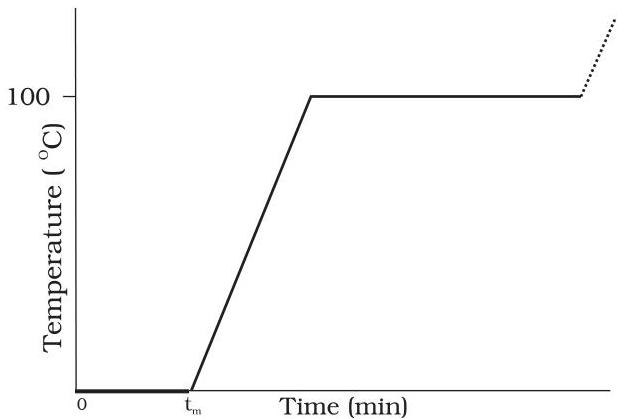 Fig. 10.9 A plot of temperature versus time showing the changes in the state of ice on heating (not to scale).
The transformation of a substance from its solid phase to its liquid phase is termed melting or fusion, while the reverse process, from liquid to solid, is known as freezing. A key observation is that the temperature holds steady until the complete quantity of the solid material has undergone liquefaction. This implies that during the solid-to-liquid phase transition, both phases of the substance exist simultaneously in a state of thermal equilibrium. The specific temperature at which the solid and liquid forms of a substance achieve mutual thermal equilibrium is defined as its melting point. This value is intrinsic to the particular substance and, furthermore, exhibits a dependence on ambient pressure. When determined under standard atmospheric pressure, a substance's melting point is referred to as its normal melting point. To further elucidate the mechanism of ice melting, let us proceed with the subsequent demonstration.
Obtain a block of ice. Secure two masses, for instance $5,\mathrm{kg}$ each, to the extremities of a metallic wire. Position this loaded wire atop the ice block, as illustrated in Fig. 10.10. It will be noted that the wire progressively penetrates the ice slab. This occurrence is attributable to the localized pressure increase directly beneath the wire, which depresses the melting point of ice, causing it to liquefy at a lower temperature. Subsequent to the wire's passage, the water produced refreezes in its wake. Consequently, the wire traverses the entire slab without causing it to fracture. This particular phenomenon of melting under pressure and subsequent refreezing is termed regelation. The feasibility of ice skating on snow is similarly facilitated by the ephemeral formation of a water layer beneath the skate blades. This water layer results from the elevated pressure exerted by the skates and serves as an effective lubricant.
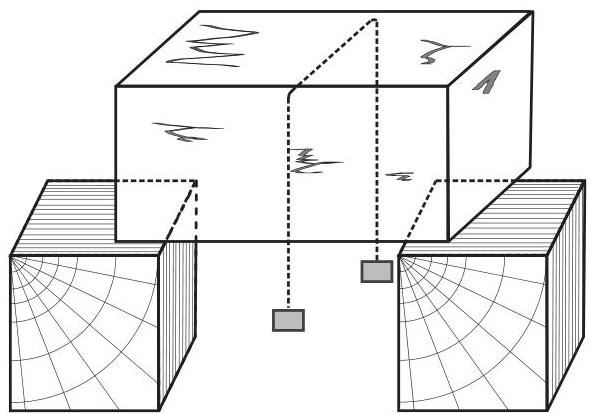 Fig. 10.10
Once all the ice has transformed into liquid water, continued application of heat will cause the temperature to increase (refer to Fig. 10.9). This temperature elevation persists until it
approaches $100^{\circ}\mathrm{C}$, at which point it stabilizes once more. At this stage, the energy being supplied is actively facilitating the transition of water from its liquid form to a vaporous or gaseous state.
The transformation of a substance from its liquid phase to its vaporous (or gaseous) phase is termed vaporization. A consistent observation is that the temperature holds steady until the entirety of the liquid has been converted into vapor. This implies that, throughout the phase change from liquid to vapor, both the liquid and vapor states of the material exist simultaneously in a condition of thermal equilibrium. The specific temperature at which these liquid and vapor states of a substance are in coexistence is defined as its boiling point. To comprehend the process of water boiling, let us undertake the subsequent experiment.
Take a round-bottom flask, more than half filled with water. Keep it over a burner and fix a
Triple Point
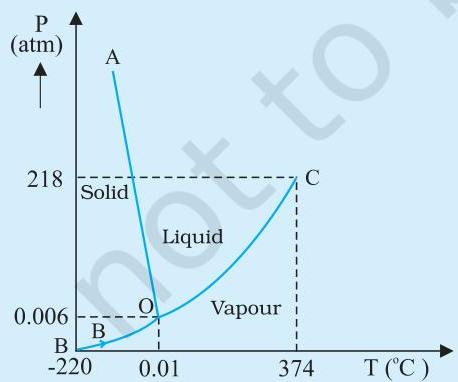
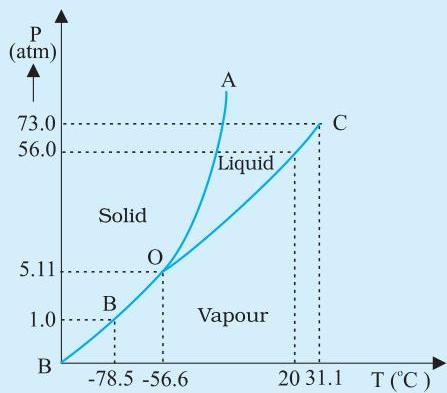
A substance maintains a constant temperature throughout its phase transition (change of state). The graphical representation illustrating the relationship between a substance's temperature ($T$) and pressure ($P$) is known as a phase diagram or a $P - T$ diagram. As depicted in the subsequent illustration, phase diagrams for water and $\mathrm{CO}_{2}$ exemplify how the $P - T$ plane is partitioned into distinct domains: a solid region, a vapor region, and a liquid region. These regions are delineated by characteristic curves, specifically the sublimation curve (BO), the fusion curve (AO), and the vaporization curve (CO). States where solid and vapor phases exist simultaneously are indicated by points along the sublimation curve BO. Similarly, the fusion curve AO signifies states where solid and liquid phases coexist, while the vaporization curve CO marks conditions where liquid and vapor phases are in equilibrium. The specific temperature and pressure at which the fusion curve, the vaporization curve, and the sublimation curve intersect, thereby allowing all three phases of a substance to coexist in equilibrium, is termed the triple point of that substance. For instance, water's triple point is characterized by a temperature of 273.16 K and a pressure of $6.11 \times 10^{-3}$ Pa.
 (a)
(a)
 (b)
Figure : Pressure-temperature phase diagrams for (a) water and (b) $\mathrm{CO}_{2}$ (not to the scale).
(b)
Figure : Pressure-temperature phase diagrams for (a) water and (b) $\mathrm{CO}_{2}$ (not to the scale).
Consider a setup where a thermometer and a steam outlet are passed through the cork of a flask (Fig. 10.11). When water within this flask is heated, the initial observation is the egress of dissolved air as small bubbles. Subsequently, steam bubbles originate at the bottom; however, these condense and dissipate as they ascend into the cooler water towards the top. Eventually, when the bulk temperature of the water reaches 100 °C, steam bubbles successfully reach the surface, signifying the commencement of boiling. While the steam inside the flask itself might be imperceptible, its exit from the flask causes it to condense into minute water droplets, creating a foggy visual effect.
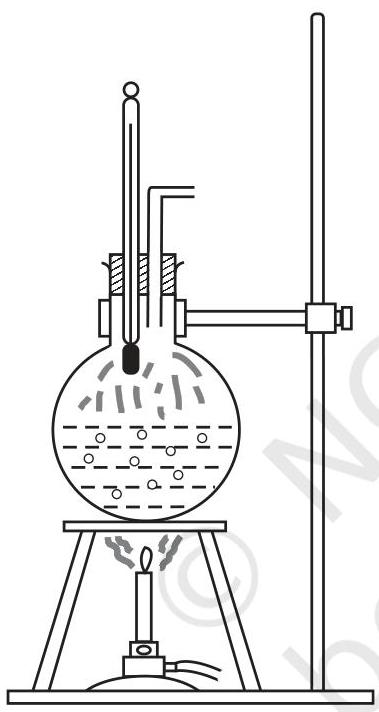 Fig. 10.11 Boiling process.
Should the steam outlet now be sealed temporarily to elevate the internal pressure of the flask, it will be observed that boiling ceases. A greater thermal input would then be necessary to achieve a higher temperature (contingent on the pressure increment) before boiling resumes. Consequently, the boiling point rises proportionally with an increase in pressure.
Next, remove the heat source, permitting the water to cool to approximately 80 °C. Disengage the thermometer and steam outlet. Securely seal the flask with an airtight stopper. Invert the flask onto its stand. Apply ice-cold water to the exterior of the flask. This action causes the water vapor within the flask to condense, thereby lowering the pressure exerted on the water's surface inside. As a result, the water recommences boiling, but at a reduced temperature. This demonstrates that the boiling point diminishes as pressure decreases.
This elucidates the challenges encountered in cooking at elevated altitudes. In such environments, reduced atmospheric pressure causes water's boiling point to decrease compared to its value at sea level. Conversely, a pressure cooker facilitates faster cooking by elevating the boiling point through an increase in internal pressure. The specific temperature at which a substance boils under standard atmospheric pressure is defined as its normal boiling point.
It is important to note, however, that not all substances traverse through the conventional three states of matter: solid, liquid, and gas. Certain materials are known to transition directly from the solid phase to the vapor phase, and vice versa, under normal conditions. This process, where a substance shifts from its solid form to its gaseous form without first becoming a liquid, is termed sublimation, and the substance exhibiting this behavior is said to sublime. Notable examples include dry ice (solid CO₂) and iodine. Throughout the sublimation process, both the solid and vapor phases of the substance maintain a state of thermal equilibrium.
10.8.1 Latent Heat
As discussed in Section 10.8, a specific quantity of thermal energy is exchanged between a material and its environment during a phase transition. The quantity of heat energy absorbed or released per unit mass when a substance changes its state is defined as its latent heat for that particular process. Consider, for instance, the scenario where heat is supplied to a given mass of ice at -10 °C; its temperature will incrementally rise until it reaches its melting point of 0 °C. At this precise temperature, further heat input does not elevate the temperature but instead facilitates the phase change of the ice into water. Once all the ice has liquefied, additional heat will then result in an increase in the water's temperature. An analogous phenomenon is observed during the liquid-to-gas phase transition at the boiling point, where supplying more heat to boiling water induces vaporization without an accompanying temperature increase.
| Substance | Melting Point (℃) | L_{f} (10^{5} J kg^{-1}) | Boiling Point (℃) | L (10^{6} J kg^{-1}) |
|---|---|---|---|---|
| Ethanol | -114 | 1.0 | 78 | 8.5 |
| Gold | 1063 | 0.645 | 2660 | 15.8 |
| Lead | 328 | 0.25 | 1744 | 8.67 |
| Mercury | -39 | 0.12 | 357 | 2.7 |
| Nitrogen | -210 | 0.26 | -196 | 2.0 |
| Oxygen | -219 | 0.14 | -183 | 2.1 |
| Water | 0 | 3.33 | 100 | 22.6 |
The thermal energy necessary for a phase transition is contingent upon both the heat of transformation and the mass of the material undergoing the alteration in state. Consequently, for a substance of mass $m$ transitioning from one state to another, the requisite amount of heat is expressed by:
$ Q = m L $
$ \text {Alternatively, } L = Q / m \tag {10.13} $
Here, $L$ denotes the latent heat, a specific property inherent to the substance. Its standard international (SI) unit is $J , \mathrm{kg}^{-1}$. It is important to note that the magnitude of $L$ is also influenced by pressure, and its reported values typically correspond to standard atmospheric pressure. The latent heat associated with a solid-to-liquid phase change is termed the latent heat of fusion $(L_{\mathrm{f}})$, while that for a liquid-to-gas phase change is known as the latent heat of vaporization $(L_{\mathrm{v}})$. These terms are frequently shortened to heat of fusion and heat of vaporization, respectively. A graphical representation illustrating the temperature-heat relationship for a specific quantity of water is presented in Fig. 10.12. The latent heats, along with the freezing and boiling points, for various substances are enumerated in Table 10.5.
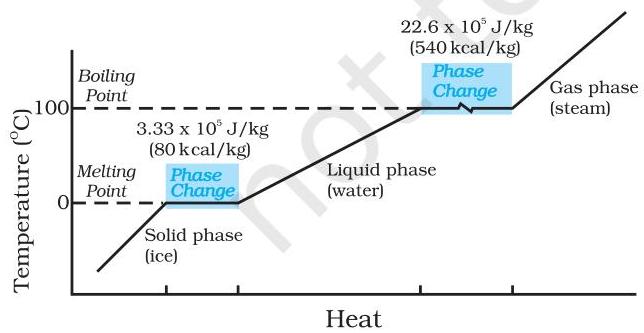 Fig. 10.12 Temperature versus heat for water at 1 atm pressure (not to scale).
It is important to recognize that during a phase transition, the temperature of a substance remains invariant despite the continuous addition or removal of thermal energy. Figure 10.12 illustrates that the varying gradients of the phase lines signify dissimilar specific heat capacities across different physical states of the substance. Specifically for water, the latent heats associated with fusion and vaporization are quantified as $L_{\mathrm{f}} = 3.33 \times 10^{5} , \mathrm{J} , \mathrm{kg}^{-1}$ and $L_{\mathrm{v}} = 22.6 \times 10^{5} , \mathrm{J} , \mathrm{kg}^{-1}$, respectively. This implies that a thermal input of $3.33 \times 10^{5} , \mathrm{J}$ is requisite to convert $1 , \mathrm{kg}$ of ice at $0^{\circ} \mathrm{C}$ into liquid water, while $22.6 \times 10^{5} , \mathrm{J}$ of energy is necessary to transform $1 , \mathrm{kg}^{-1}$ water into steam at $100^{\circ} \mathrm{C}$. Consequently, steam at $100^{\circ} \mathrm{C}$ possesses $22.6 \times 10^{5} , \mathrm{J} , \mathrm{kg}^{-1}$ more thermal energy compared to water at the same temperature. This substantial energy difference elucidates why steam burns are typically more severe than those inflicted by boiling water.
Example 10.4 A quantity of $0.15 , \mathrm{kg}$ of ice, initially at $0^{\circ} \mathrm{C}$, is combined with $0.30 , \mathrm{kg}$ of water at $50^{\circ} \mathrm{C}$ within an insulated vessel. The final equilibrium temperature attained by the mixture is $6.7^{\circ} \mathrm{C}$. Determine the latent heat of fusion for ice. $(s_{\text{water}} = 4186 , \mathrm{J} , \mathrm{kg}^{-1} , \mathrm{K}^{-1})$
Answer To address this problem, we will apply the principle that, upon reaching thermal equilibrium, the thermal energy relinquished by the aluminium sphere must precisely correspond to the thermal energy absorbed by the water and the calorimeter combined.
Mass of the aluminium sphere (m1) = 0.047 kg Initial temperature of the aluminium sphere = 100 °C Final temperature achieved = 23 °C Temperature change (ΔT) = (100 °C - 23 °C) = 77 °C Let the specific heat capacity of aluminium be sAl.
The quantity of heat energy lost by the aluminium sphere is given by: $ m_{1} s_{\mathrm{Al}} \Delta T = 0.047 , \mathrm{kg} \times s_{\mathrm{Al}} \times 77^{\circ} , \mathrm{C} $
Mass of water $(m_2) = 0.25,\mathrm{kg}$
Mass of calorimeter $(m_3) = 0.14,\mathrm{kg}$
Initial temperature of water and calorimeter = $20^{\circ}\mathrm{C}$
Final temperature of the mixture $= 23^{\circ}\mathrm{C}$
Change in temperature $(\Delta T_2) = 23^{\circ}\mathrm{C} - 20^{\circ}\mathrm{C} = 3^{\circ}\mathrm{C}$
Specific heat capacity of water $(s_w)$
$ = 4.18 \times 10^{3} , \mathrm{J} , \mathrm{kg}^{-1} , \mathrm{K}^{-1} $
Specific heat capacity of copper calorimeter
$ = 0.386 \times 10^{3} , \mathrm{J} , \mathrm{kg}^{-1} , \mathrm{K}^{-1} $
The quantity of heat energy absorbed by the water and calorimeter is calculated as: $ = m_2 s_w \Delta T_2 + m_3 s_{\mathrm{cu}} \Delta T_2 $
$ \begin{array}{l} = (m_2 s_w + m_3 s_{\mathrm{cu}}) (\Delta T_2) \ = (0.25 , \mathrm{kg} \times 4.18 \times 10^{3} , \mathrm{J} , \mathrm{kg}^{-1} , \mathrm{K}^{-1} + 0.14 , \mathrm{kg} \times \ 0.386 \times 10^{3} , \mathrm{J} , \mathrm{kg}^{-1} , \mathrm{K}^{-1}) (23^{\circ} \mathrm{C} - 20^{\circ} \mathrm{C}) \end{array} $
In the steady state heat lost by the aluminium sphere = heat gained by water + heat gained by calorimeter.
$ \begin{array}{l} \text{So, } 0.047 , \mathrm{kg} \times s_{\mathrm{Al}} \times 77^{\circ} , \mathrm{C} \ = (0.25 , \mathrm{kg} \times 4.18 \times 10^{3} , \mathrm{J} , \mathrm{kg}^{-1} , \mathrm{K}^{-1} + 0.14 , \mathrm{kg} \times \ 0.386 \times 10^{3} , \mathrm{J} , \mathrm{kg}^{-1} , \mathrm{K}^{-1}) (3^{\circ} \mathrm{C}) \end{array} $
$ s_{\mathrm{Al}} = 0.911 , \mathrm{kJ} , \mathrm{kg}^{-1} , \mathrm{K}^{-1} $
Example 10.5
Determine the total thermal energy necessary to transform $3\mathrm{kg}$ of ice initially at $-12^{\circ}\mathrm{C}$, contained within a calorimeter, into steam at $100^{\circ}\mathrm{C}$ under atmospheric pressure. Provided with the following thermodynamic parameters: specific heat capacity of ice $= 2100\mathrm{Jkg^{-1}K^{-1}}$, specific heat capacity of water $= 4186\mathrm{Jkg^{-1}K^{-1}}$, latent heat of fusion of ice $= 3.35\times 10^{5}\mathrm{Jkg^{-1}}$, and latent heat of vaporization of steam $= 2.256\times 10^{6}\mathrm{Jkg^{-1}}$.
Answer We have
The initial mass of the ice specimen, $m = 3\mathrm{kg}$
The specific heat capacity of ice, $s_{\mathrm{ice}}$
$ = 2100 \mathrm{J} \mathrm{kg}^{-1} \mathrm{K}^{-1} $
The specific heat capacity of water, $s_{\mathrm{water}}$
$ = 4186 \mathrm{J} \mathrm{kg}^{-1} \mathrm{K}^{-1} $
The latent heat of fusion for ice, $L_{\mathrm{fice}}$
$ = 3.35 \times 10^{5} \mathrm{J} \mathrm{kg}^{-1} $
The latent heat of vaporization for steam, $L_{\mathrm{steam}}$
$ = 2.256 \times 10^{6} \mathrm{J} \mathrm{kg}^{-1}
$
Subsequently, the cumulative thermal energy, $Q$, mandated for the conversion of $3\mathrm{kg}$ of ice at $-12^{\circ}\mathrm{C}$ to steam at $100^{\circ}\mathrm{C}$ is calculated in distinct stages:
The thermal energy, $Q_{1}$, necessary to elevate the temperature of the ice from $-12^{\circ}\mathrm{C}$ to its melting point of $0^{\circ}\mathrm{C}$:
$ = m s_{\mathrm{ice}} \Delta T_{1} = (3\mathrm{kg}) (2100\mathrm{Jkg}^{-1}\mathrm{K}^{-1}) [0 - (-12)]^{\circ}\mathrm{C} = 75600\mathrm{J} $
The latent heat, $Q_{2}$, absorbed during the phase transition of ice at $0^{\circ}\mathrm{C}$ to liquid water at $0^{\circ}\mathrm{C}$:
$ = m L_{\mathrm{fice}} = (3\mathrm{kg}) (3.35 \times 10^{5} \mathrm{J} \mathrm{kg}^{-1}) = 1005000\mathrm{J} $
The thermal energy, $Q_{3}$, expended to raise the temperature of the liquid water from $0^{\circ}\mathrm{C}$ to its boiling point of $100^{\circ}\mathrm{C}$:
$ = m s_{w} \Delta T_{2} = (3\mathrm{kg}) (4186\mathrm{J} \mathrm{kg}^{-1} \mathrm{K}^{-1}) (100^{\circ}\mathrm{C}) = 1255800\mathrm{J} $
Finally, the latent heat, $Q_{4}$, required for the complete vaporization of water at $100^{\circ}\mathrm{C}$ into steam at $100^{\circ}\mathrm{C}$:
$ = m L_{\mathrm{steam}} = (3\mathrm{kg}) (2.256 \times 10^{6} \mathrm{J} \mathrm{kg}^{-1}) = 6768000\mathrm{J} $
Therefore, the total thermal energy, $Q$, is the summation of these individual energy components: $ Q = Q_{1} + Q_{2} + Q_{3} + Q_{4} $
$ \begin{array}{l} = 75600 \mathrm{J} + 1005000 \mathrm{J} \
- 1255800 \mathrm{J} + 6768000 \mathrm{J} \ = 9.1 \times 10^{6} \mathrm{J} \ \end{array} $
10.9 HEAT TRANSFER
As previously established, heat represents the transference of energy either between distinct systems or within segments of a single system, a phenomenon driven by variations in temperature. This prompts an inquiry into the various mechanisms through which such energy transfer manifests. Fundamentally, there exist three principal modalities for heat transmission: conduction, convection, and radiation (Fig. 10.13).
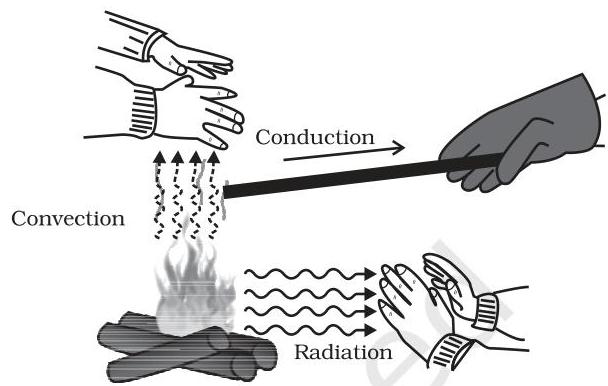 Fig. 10.13 Heating by conduction, convection and radiation.
10.9.1 Conduction
Conduction constitutes the process by which thermal energy is transmitted between contiguous regions of a physical body, driven by a disparity in their respective temperatures. For instance, if one extremity of a metallic rod is subjected to a heat source, the opposing extremity will rapidly attain a temperature precluding manual contact without protection. In this scenario, the transfer of thermal energy occurs through conduction, propagating from the heated terminus along the rod's constituent sections to its cooler counterpart. Gaseous substances exhibit low thermal conductivity, whereas liquids possess thermal conductivities that lie between those of solids and gases.
Quantitatively, the phenomenon of heat conduction can be characterized by the temporal rate at which thermal energy traverses a material under a specified temperature gradient. Let us examine a metallic bar possessing a length $L$ and a uniform cross-sectional area $A$, where its two terminal points are sustained at distinct temperatures. Such a configuration can be realized, for instance, by placing the extremities into thermal communication with extensive thermal reservoirs maintained at temperatures designated as $T_{\mathrm{C}}$ and $T_{\mathrm{D}}$, respectively (Fig. 10.14). For analytical purposes, we posit the ideal condition wherein the lateral surfaces of the bar are perfectly insulated, thereby precluding any thermal exchange between these surfaces and the ambient environment.
Subsequent to an initial transient period, a steady state condition is established; under this condition, the temperature along the bar diminishes linearly with increasing distance, transitioning from $T_{\mathrm{C}}$ to $T_{\mathrm{D}}$, where $(T_{\mathrm{C}} > T_{\mathrm{D}})$ is assumed. The thermal reservoir situated at point C continuously furnishes heat at a constant flux, which subsequently propagates through the bar and is dissipated at an equivalent rate to the reservoir located at point D.
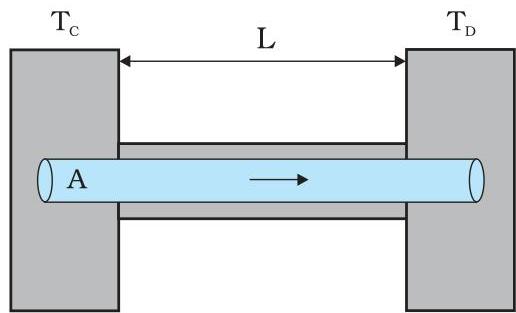 Fig. 10.14 Steady state heat flow by conduction in a bar with its two ends maintained at temperatures $T_{\mathrm{C}}$ and $T_{\mathrm{D}}$ : $(T_{\mathrm{C}} > T_{\mathrm{D}})$ .
Empirical observations indicate that within this established steady state, the rate of thermal energy flow, denoted as the heat current $H$, exhibits a direct proportionality to both the temperature differential $(T_{C} - T_{D})$ and the cross-sectional area $A$, while simultaneously demonstrating an inverse proportionality to the length $L$:
$ H = K A \frac {T _ {C} - T _ {D}}{L} \tag {10.14} $
The coefficient of proportionality, $K$, is designated as the thermal conductivity intrinsic to the material. A higher magnitude of $K$ for a given substance signifies a more efficient and rapid transmission of thermal energy through it. The standard international (SI) unit for $K$ is expressed as $\mathrm{J} , \mathrm{s}^{-1} , \mathrm{m}^{-1} , \mathrm{K}^{-1}$ or, equivalently, as $\mathrm{W} , \mathrm{m}^{-1} , \mathrm{K}^{-1}$. Table 10.6 provides a compilation of thermal conductivities for diverse materials. While these magnitudes exhibit minor fluctuations with temperature variations, they are generally regarded as constant within typical operational temperature intervals.
Contrast the comparatively high thermal conductivities exhibited by effective thermal conductors, specifically metals, with the notably low thermal conductivities characteristic of certain proficient thermal insulators, such as wood and glass wool. You might have observed that some culinary vessels incorporate a copper layer on their base. Given its excellent thermal conductivity, copper facilitates the uniform distribution of heat across the pot's bottom, leading to consistent cooking. Conversely, plastic foams function as strong insulators, primarily owing to their encapsulated air pockets. It is noteworthy that gases are inherently poor conductors, a fact underscored by the low thermal conductivity value for air presented in Table 10.5. Thermal retention and transmission are pivotal in numerous other contexts. Structures with concrete roofs often become excessively warm during summer days because, despite being significantly lower than that of metals, concrete's thermal conductivity is still not sufficiently minimal. Consequently, it is customary to apply an insulating layer of earth or foam to ceilings to impede heat transfer and maintain cooler indoor temperatures. In certain scenarios, heat transfer is of critical importance. For example, within a nuclear reactor, sophisticated heat transfer systems must be implemented to ensure that the immense energy generated by nuclear fission in the core is evacuated rapidly enough to prevent the core from overheating.
Table 10.6 Thermal conductivities of some material
| Material | Thermal conductivity (J s-1m-1K-1) |
|---|---|
| Metals | |
| Silver | 406 |
| Copper | 385 |
| Aluminium | 205 |
| Brass | 109 |
| Steel | 50.2 |
| Lead | 34.7 |
| Mercury | 8.3 |
| Non-metals | |
| Insulating brick | 0.15 |
| Concrete | 0.8 |
| Body fat | 0.20 |
| Felt | 0.04 |
| Glass | 0.8 |
| Ice | 1.6 |
| Glass wool | 0.04 |
| Wood | 0.12 |
| Water | 0.8 |
| Gases | |
| Air | 0.024 |
| Argon | 0.016 |
| Hydrogen | 0.14 |
Example 10.6 Determine the temperature at the steel-copper junction when the system illustrated in Fig. 10.15 achieves a steady state. The steel rod has a length of 15.0 cm, and the copper rod is 10.0 cm long. The furnace temperature is 300 °C, and the opposing end is maintained at 0 °C. The cross-sectional area of the steel rod is twice that of the copper rod. (Thermal conductivity of steel = 50.2 J s $^{-1}$ m $^{-1}$ K $^{-1}$ ; and of copper = 385 J s $^{-1}$ m $^{-1}$ K $^{-1}$ ).
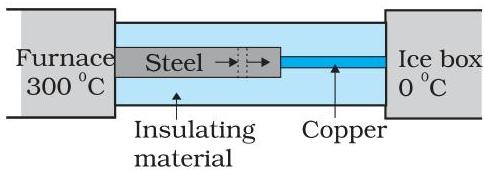 Fig. 10.15
Answer The insulating material encasing the rods minimizes lateral heat loss, ensuring that heat flow occurs exclusively along the longitudinal axis of the rods. Consider any cross-section of the rod. In a steady state, the thermal energy entering an elemental volume must precisely balance the thermal energy exiting it; otherwise, there would be a net gain or loss of heat within the element, preventing its temperature from stabilizing. Thus, under steady-state conditions, the rate of heat flow across any cross-section of the composite steel-copper rod remains uniform throughout its entire length. Let $T$ represent the temperature of the steel-copper junction in the steady state. Then,
$ \frac {K _ {1} A _ {1} (3 0 0 - T)}{L _ {1}} = \frac {K _ {2} A _ {2} (T - 0)}{L _ {2}} $
Here, the subscripts 1 and 2 denote the steel and copper rods, respectively. Substituting the given parameters: $A_{1} = 2A_{2}$ , $L_{1} = 15.0\mathrm{cm}$ , $L_{2} = 10.0\mathrm{cm}$ , $K_{1} = 50.2\mathrm{J}\mathrm{s}^{-1}\mathrm{m}^{-1}\mathrm{K}^{-1}$ , and $K_{2} = 385\mathrm{J}\mathrm{s}^{-1}\mathrm{m}^{-1}\mathrm{K}^{-1}$ , into the preceding equation yields:
$ \frac {5 0 . 2 \times 2 (3 0 0 - T)}{1 5} = \frac {3 8 5 T}{1 0} $
Solving this equation for $T$ results in a value of $44.4^{\circ}\mathrm{C}$.
Example 10.7 Consider a composite system comprising an iron bar (characterized by $L_{1} = 0.1\mathrm{m}$, $A_{1} = 0.02\mathrm{m}^{2}$, $K_{1} = 79\mathrm{Wm}^{-1}\mathrm{K}^{-1}$) and a brass bar (with $L_{2} = 0.1\mathrm{m}$, $A_{2} = 0.02\mathrm{m}^{2}$, $K_{2} = 109\mathrm{Wm}^{-1}\mathrm{K}^{-1}$), joined end-to-end as depicted in Fig. 10.16. The terminal ends of the iron and brass components are held at constant temperatures of $373\mathrm{K}$ and $273\mathrm{K}$, respectively. Derive the requisite expressions and subsequently calculate: (i) the temperature at the interface of the two bars, (ii) the effective thermal conductivity of the combined assembly, and (iii) the steady-state heat current traversing the composite structure.
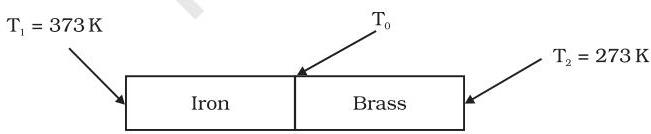 Fig 10.16
Answer
The following parameters are provided for the system: $L_{1} = L_{2} = L = 0.1\mathrm{m}$, $A_{1} = A_{2} = A = 0.02\mathrm{m}^{2}$, $K_{1} = 79\mathrm{Wm}^{-1}\mathrm{K}^{-1}$, $K_{2} = 109\mathrm{Wm}^{-1}\mathrm{K}^{-1}$, $T_{1} = 373\mathrm{K}$, and $T_{2} = 273\mathrm{K}$.
Under steady-state conditions, the heat current through the first bar ($H_1$) is equal to the heat current through the second bar ($H_2$). Thus, the overall heat current $H$ is represented by: $ H = H_{1} = H_{2} = \frac {K _ {1} A _ {1} \left(T _ {1} - T _ {0}\right)}{L _ {1}} = \frac {K _ {2} A _ {2} \left(T _ {0} - T _ {2}\right)}{L _ {2}} $
Given the conditions where the cross-sectional areas are identical ($A_{1} = A_{2} = A$) and the lengths are equal ($L_{1} = L_{2} = L$), the preceding equation simplifies to: $ K _ {1} \left(T _ {1} - T _ {0}\right) = K _ {2} \left(T _ {0} - T _ {2}\right) $
Consequently, the temperature at the interface ($T_{0}$) between the two bars can be determined as: $ T _ {0} = \frac {\left(K _ {1} T _ {1} + K _ {2} T _ {2}\right)}{\left(K _ {1} + K _ {2}\right)} $
By applying this derived expression, the heat current ($H$) flowing through either of the bars can be calculated as: $ \begin{array}{l} H = \frac {K _ {1} A (T _ {1} - T _ {0})}{L} = \frac {K _ {2} A (T _ {0} - T _ {2})}{L} \ = \left(\frac {K _ {1} K _ {2}}{K _ {1} + K _ {2}}\right) \frac {A (T _ {1} - T _ {0})}{L} = \frac {A (T _ {1} - T _ {2})}{L \left(\frac {1}{K _ {1}} + \frac {1}{K _ {2}}\right)} \ \end{array} $
Utilizing these formulations, the heat current ($H'$) traversing the compound bar, which has a total length of $L_1 + L_2 = 2L$, along with its equivalent thermal conductivity ($K'$), can be expressed as: $ H ^ {\prime} = \frac {K ^ {\prime} A (T _ {1} - T _ {2})}{2 L} = H $
$ K ^ {\prime} = \frac {2 K _ {1} K _ {2}}{K _ {1} + K _ {2}} $
(i) The calculation for the junction temperature $T_0$ is performed as follows: $ \begin{array}{l} T_{0} = \frac{\left(K_{1}T_{1} + K_{2}T_{2}\right)}{\left(K_{1} + K_{2}\right)} \ = \frac {\left(7 9 \mathrm {W m} ^ {- 1} \mathrm {K} ^ {- 1}\right) \left(3 7 3 \mathrm {K}\right) + \left(1 0 9 \mathrm {W m} ^ {- 1} \mathrm {K} ^ {- 1}\right) \left(2 7 3 \mathrm {K}\right)}{7 9 \mathrm {W m} ^ {- 1} \mathrm {K} ^ {- 1} + 1 0 9 \mathrm {W m} ^ {- 1} \mathrm {K} ^ {- 1}} \ = 3 1 5 \mathrm {K} \ \end{array} $
(ii) The equivalent thermal conductivity $K'$ is computed as: $ \begin{array}{l} K^{\prime} = \frac{2K_{1}K_{2}}{K_{1} + K_{2}} \ = \frac {2 \times (7 9 \mathrm {W m} ^ {- 1} \mathrm {K} ^ {- 1}) \times (1 0 9 \mathrm {W m} ^ {- 1} \mathrm {K} ^ {- 1})}{7 9 \mathrm {W m} ^ {- 1} \mathrm {K} ^ {- 1} + 1 0 9 \mathrm {W m} ^ {- 1} \mathrm {K} ^ {- 1}} \ = 9 1. 6 \mathrm {W m} ^ {- 1} \mathrm {K} ^ {- 1} \ \end{array}
$
(iii) The heat current $H'$ through the composite system, which is equivalent to $H$, is determined by: $ \begin{array}{l} H^{\prime} = H = \frac{K^{\prime}A(T_{1} - T_{2})}{2L} \ = \frac {\left(9 1 . 6 \mathrm {W m} ^ {- 1} \mathrm {K} ^ {- 1}\right) \times \left(0 . 0 2 \mathrm {m} ^ {2}\right) \times \left(3 7 3 \mathrm {K} - 2 7 3 \mathrm {K}\right)}{2 \times (0 . 1 \mathrm {m})} \ = 9 1 6. 1 \mathrm {W} \ \end{array} $
10.9.2 Convection
Heat transfer through the physical displacement of material is termed convection. This phenomenon exclusively occurs within fluids. Convection can manifest as either natural or forced. In natural convection, gravitational forces exert a significant influence. When a fluid undergoes heating from its lower region, the warmed portion expands, consequently decreasing in density. Due to buoyancy, this less dense fluid ascends, and the cooler fluid from above descends to take its place. This descending fluid, in turn, becomes heated, rises, and is again replaced by relatively colder fluid. This iterative cycle continues. Distinct from conduction, this mechanism is characterized by the macroscopic movement of fluid parcels.
In the context of forced convection, the material is compelled into motion by an external agent, such as a pump or other mechanical apparatus. Illustrative examples of forced convective systems include forced-air heating installations in residential settings, the human circulatory system, and the cooling mechanism of an automotive engine. Within the human body, the heart functions as the pump, circulating blood throughout various regions of the body. This process facilitates heat transfer via forced convection, thereby regulating the body's thermal equilibrium.
Numerous common occurrences are attributable to natural convection. During daylight hours, land masses absorb heat more rapidly than extensive bodies of water. This differential heating arises from water's higher specific heat capacity and the distributive action of mixing currents throughout its substantial volume. Air adjacent to the warmed ground absorbs heat via conduction, leading to expansion and a reduction in density relative to the surrounding cooler air. This less dense air ascends (forming air currents), prompting cooler air to flow in to occupy the void, thus generating a sea breeze in coastal regions. Subsequently, cooler air descends, establishing a thermal convection cycle that dissipates heat from the land. Conversely, at night, the ground loses thermal energy more quickly, rendering the water surface warmer than the land. Consequently, this cycle reverses (Fig. 10.17).
Another instance of natural convection is the persistent surface wind on Earth, known as the trade wind, which blows from the northeast towards the equator. A plausible explanation is as follows: the equatorial and polar regions of the Earth receive disparate amounts of solar radiation. Air at the Earth's surface near the equator is warm, while air in the upper atmosphere over the poles is cool. Were no other factors at play, a direct convective circulation would establish itself, with air ascending at the equatorial surface, migrating poleward in the upper atmosphere, descending at the poles, and then returning toward the equator along the surface. However, the Earth's rotation modifies this convective current. As a consequence, air in proximity to the equator possesses an eastward velocity of $1600\mathrm{km / h}$, whereas this velocity approaches zero near the poles. This rotational effect causes the air to descend not at the poles, but at approximately $30^{\circ}\mathrm{N}$ (North) latitude, subsequently returning to the equator. This phenomenon constitutes the trade wind.
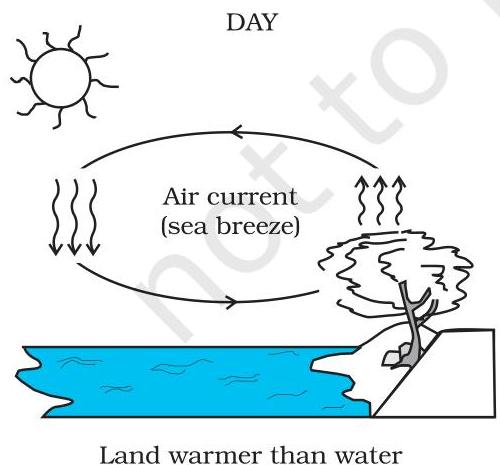 Fig. 10.17 Convection cycles.
10.9.3 Radiation
Unlike conduction and convection, which necessitate a material medium for the conveyance of heat, these mechanisms are inoperative in the void between spatially separated entities. Nevertheless, Earth receives thermal energy from the Sun across an immense expanse. Similarly, one perceives the warmth emanating from a nearby fire almost instantaneously, despite air being a poor thermal conductor and convection requiring a discernible duration to become effective. The third principal mode of heat transfer operates independently of any intervening medium; this process is termed radiation, and the energy thus transmitted, carried by electromagnetic waves, is referred to as radiant energy. Within an electromagnetic wave, electric and magnetic fields undergo oscillations in both spatial and temporal dimensions. Consistent with wave phenomena generally, electromagnetic waves exhibit varying wavelengths and propagate through a vacuum at a constant velocity, specifically the speed of light, which is $3 \times 10^{8} \mathrm{m} \mathrm{s}^{-1}$. While comprehensive details will be covered in subsequent studies, this explanation elucidates why heat transfer via radiation requires no medium and proceeds with such rapidity. This is precisely how thermal energy traverses empty space from the Sun to Earth. All substances, irrespective of their state (solid, liquid, or gas), emit radiant energy. The electromagnetic radiation generated by a body solely due to its temperature, exemplified by the glow of a red-hot iron object or the illumination from a filament lamp, is designated as thermal radiation.
Upon impinging on other objects, this thermal radiation is partially reflected and partially absorbed. The quantity of heat that an object can absorb through radiation is contingent upon its surface coloration.
It is observed that objects with dark, particularly black, surfaces exhibit superior capabilities in absorbing and emitting radiant energy compared to those with lighter hues. This principle finds numerous practical applications in daily existence. During the summer months, individuals opt for white or light-colored attire to minimize the absorption of solar heat. Conversely, in winter, dark-colored garments are preferred as they more readily absorb solar radiation, thereby assisting in maintaining body warmth. The undersides of cooking vessels are typically blackened to maximize heat absorption from the flame, facilitating its efficient transfer to the food being prepared.
In a similar vein, a Dewar flask, commonly known as a thermos bottle, is engineered to diminish heat exchange between its contents and the external environment. It comprises a double-walled glass container where both the inner and outer surfaces are coated with silver. Radiant energy originating from the inner wall is reflected back into the bottle's contents. Correspondingly, the outer silvered surface reflects any incident external radiation. The inter-wall space is evacuated to mitigate heat losses through conduction and convection, and the flask itself is supported by an insulating material, such as cork. Consequently, this device proves effective for preventing hot substances (e.g., milk) from cooling, or, alternatively, for preserving the low temperature of cold contents (e.g., ice).
10.9.4 Blackbody Radiation
Up to this point, our discussion of thermal radiation has not delved into its spectral composition. A crucial characteristic of thermal radiation, irrespective of temperature, is its continuous spectrum, encompassing a broad range of wavelengths from short to long, rather than being confined to a single or a few discrete wavelengths. However, the energy distributed across this spectrum varies with wavelength. Figure 10.18 illustrates experimental data showing the radiant energy per unit area per unit wavelength emitted by a blackbody as a function of wavelength, presented for various temperatures.
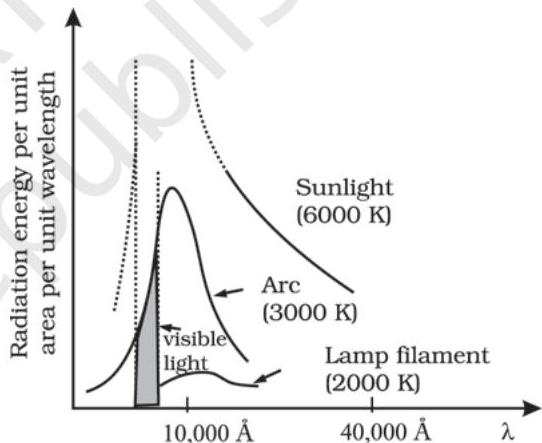 Fig. 10.18: Energy emitted versus wavelength for a blackbody at different temperatures
It can be observed that $\lambda_{m}$, the wavelength at which the emitted energy reaches its maximum, decreases as the temperature rises. This relationship between $\lambda_{m}$ and $T$ is articulated by Wien's Displacement Law:
$ \lambda_{m} T = \text{constant} \tag{10.15} $
The numerical value of this constant, known as Wien's constant, is $2.9 \times 10^{-3} \mathrm{m} \mathrm{K}$. This law provides an explanation for the observed color changes when a piece of iron is intensely heated: it initially glows dull red, progresses to reddish-yellow, and eventually becomes white hot. Wien's law proves valuable for estimating the surface temperatures of
astronomical bodies such as the Moon, the Sun, and other stars. For instance, the Moon's emitted light exhibits maximum intensity around a wavelength of $14,\mu\mathrm{m}$. Applying Wien's law, the Moon's surface temperature is estimated to be approximately $200,\mathrm{K}$. Similarly, solar radiation peaks at $\lambda_{\mathrm{m}} = 4753,\mathrm{\AA}$, which corresponds to a surface temperature of $T = 6060,\mathrm{K}$. It is important to note that this temperature pertains to the Sun's surface, not its internal regions.
A particularly noteworthy aspect of the blackbody radiation curves shown in Fig. 10.18 is their inherent universality. These curves are solely dependent on the temperature and are independent of the blackbody's size, geometric configuration, or material composition. Theoretical endeavors to elucidate blackbody radiation in the early twentieth century served as a catalyst for the quantum revolution in physics, a topic that will be explored in subsequent academic courses.
Energy can propagate over considerable distances via radiation, even in the absence of a medium (i.e., through a vacuum). The total electromagnetic energy radiated by an object at an absolute temperature $T$ is directly proportional to its surface area, its capacity to radiate (termed emissivity), and most significantly, to the fourth power of its absolute temperature. For an ideal radiator, also known as a perfect blackbody, the energy emitted per unit time $(H)$ is given by:
$ H = A \sigma T^{4} \tag{10.16} $
In this equation, $A$ represents the surface area and $T$ is the absolute temperature of the body. This relationship, initially discovered experimentally by Stefan and subsequently derived theoretically by Boltzmann, is known as the Stefan-Boltzmann law. The constant $\sigma$ is referred to as the Stefan-Boltzmann constant, with a value in SI units of $5.67 \times 10^{-8},\mathrm{W},\mathrm{m}^{-2},\mathrm{K}^{-4}$. Most real-world objects radiate only a fraction of the power predicted by Eq. 10.16. Materials like lamp black closely approach this theoretical limit. Consequently, a dimensionless factor $e$, termed emissivity, is introduced to account for this, allowing for the representation of radiant emission as:
$ H = A e \sigma T^{4} \tag{10.17} $
In this context, the emissivity ($e$) is unity for an ideal blackbody radiator. For instance, a tungsten filament lamp exhibits an emissivity of approximately 0.4. Consequently, a tungsten lamp operating at $3000,\mathrm{K}$ with a surface area of $0.3,\mathrm{cm}^2$ will emit thermal radiation at a power of $ H = 0.3 \times 10^{-4} \times 0.4 \times 5.67 \times 10^{-8} \times (3000)^{4} = 60,\mathrm{W}. $
An object maintained at temperature $T$, situated within an environment at temperature $T_s$, simultaneously radiates and absorbs thermal energy. For an ideal blackbody radiator, the net rate at which radiant energy is lost is given by:
$ H = \sigma A \left(T^{4} - T_{s}^{4}\right) $
When considering a body possessing an emissivity $e$, this relationship is adjusted to:
$ H = e \sigma A \left(T^{4} - T_{s}^{4}\right) \tag{10.18} $
To illustrate, we can approximate the thermal energy emitted by the human body. Assuming an average human surface area of approximately $1.9,\mathrm{m}^2$ and an ambient room temperature of $22,^{\circ}\mathrm{C}$. While the core body temperature is typically $37,^{\circ}\mathrm{C}$, the skin surface temperature might be around $28,^{\circ}\mathrm{C}$. The emissivity of human skin, pertinent to the relevant electromagnetic spectrum, is approximately 0.97. The resulting rate of thermal energy dissipation is calculated as:
$ \begin{array}{l} H = 5.67 \times 10^{-8} \times 1.9 \times 0.97 \times \left[ (301)^{4} - (295)^{4} \right] \ = 66.4,\mathrm{W} \end{array} $
This value represents over half the metabolic energy generation rate of a resting body (120 W). To significantly mitigate this thermal dissipation (surpassing the performance of standard garments), contemporary arctic attire incorporates a reflective, thin metallic lining adjacent to the skin, designed to redirect the body's emitted radiation.
10.10 NEWTON'S LAW OF COOLING
It is a common observation that a heated substance, such as water or milk, when exposed to an ambient environment, progressively loses thermal energy until its temperature equilibrates with that of its surroundings. To investigate the kinetics of heat transfer and the rate at which an object cools when interacting thermally with its environment, consider the experimental procedure outlined below.
Into a calorimeter equipped with a stirrer, introduce a quantity of water, for instance, $300,\mathrm{mL}$. Seal the calorimeter with a lid featuring two apertures. Insert the stirrer through one opening and a thermometer through the other, ensuring the thermometer's bulb is fully submerged in the water. Record the initial thermometer reading, $T_{1}$, which represents the ambient temperature. Subsequently, apply heat to the water within the calorimeter until its temperature reaches approximately $40,^{\circ}\mathrm{C}$ above the room temperature (i.e., the surrounding temperature). Upon reaching this state, discontinue the heat supply by removing the heating apparatus. Commence timing with a stopwatch and, while gently agitating the water with the stirrer, record the thermometer's reading at regular intervals, for example, every minute. Persist in monitoring the water's temperature ($T_{2}$) until it approaches a value approximately $5,^{\circ}\mathrm{C}$ higher than that of the surroundings. Following this, construct a graphical representation where
each temperature difference $\Delta T = T_{2} - T_{1}$ is plotted on the y-axis against its corresponding time value $t$ on the x-axis (Fig. 10.19).
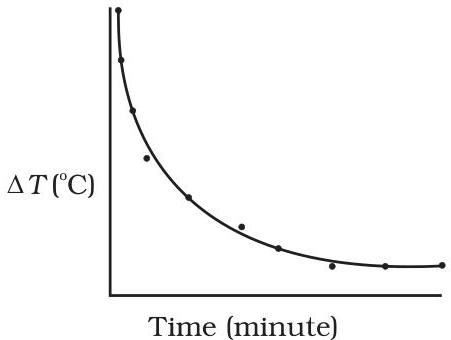 Fig. 10.19 Curve showing cooling of hot water with time.
Analysis of this graph will allow one to deduce the relationship between the rate at which hot water cools and the temperature differential between the water and its ambient environment. It will also become apparent that the initial rate of thermal energy dissipation is more pronounced, subsequently diminishing as the object's temperature declines.
This experimental procedure demonstrates that a heated object transfers thermal energy to its environment primarily through thermal radiation. The velocity of this heat transfer is contingent upon the temperature disparity between the object and its surroundings. Isaac Newton was the pioneer in systematically investigating the correlation between the thermal energy dissipated by an object within a defined enclosure and its intrinsic temperature.
As per Newton's law of cooling, the instantaneous rate of thermal energy dissipation, represented as $-\mathrm{d}Q / \mathrm{d}t$, is directly proportional to the temperature differential, $\Delta T = (T_{2} - T_{1})$, existing between the object and its ambient environment. It is crucial to note that this principle is accurately applicable only when the temperature difference is modest. Furthermore, the magnitude of heat loss via radiation is also influenced by the surface characteristics of the object and the extent of its exposed surface area. Consequently, we can formulate this as:
$
- \frac {d Q}{d t} = k \left(T _ {2} - T _ {1}\right) \tag {10.19} $
In this expression, $k$ denotes a positive proportionality constant, whose value is contingent upon both the surface area and the intrinsic properties of the body's surface. Consider an object with mass $m$ and specific heat capacity $s$, currently at temperature $T_{2}$, situated within surroundings at temperature $T_{1}$. Should its temperature decrease by an infinitesimal quantity $\mathrm{d}T_{2}$ over an infinitesimal time interval $\mathrm{d}t$, the corresponding thermal energy lost is given by:
$ \mathrm {d} Q = m s \mathrm {d} T _ {2} $
Thus, the rate at which heat is dissipated can be expressed as:
$ \frac {d Q}{d t} = m s \frac {d T _ {2}}{d t} \tag {10.20} $
By combining Equations (10.15) and (10.16), we obtain:
$
- m s \frac {d T _ {2}}{d t} = k \left(T _ {2} - T _ {1}\right) $
$ \frac {d T _ {2}}{T _ {2} - T _ {1}} = - \frac {k}{m s} d t = - K d t \tag {10.21} $
where $K = k / (ms)$
Upon integration,
$ \log_e \left(T _ {2} - T _ {1}\right) = - K t + c \tag {10.22} $
$ \text {or} T _ {2} = T _ {1} + C ^ {\prime} \mathrm {e} ^ {- K t}; \text {where} C ^ {\prime} = \mathrm {e} ^ {c} \tag {10.23} $
Equation (10.23) facilitates the determination of the cooling duration for an object across a specified temperature interval.
When temperature differentials are minor, the cumulative rate of heat dissipation, encompassing conduction, convection, and radiation, is directly proportional to the temperature disparity. This principle serves as a reliable approximation in various scenarios, such as heat transfer from a radiator to an ambient space, thermal leakage through an enclosure wall, or the cooling process of a beverage container on a surface.
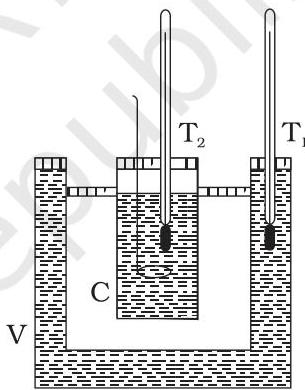 (a)
(a)
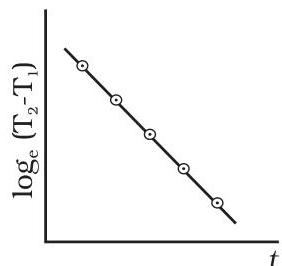 (b)
Fig. 10.20 Verification of Newton's Law of cooling.
(b)
Fig. 10.20 Verification of Newton's Law of cooling.
The validity of Newton's law of cooling can be empirically confirmed using the experimental apparatus depicted in Figure 10.20(a). This arrangement comprises a double-walled vessel (V), with water occupying the inter-wall space. Within this double-walled container, a copper calorimeter (C) filled with hot water is situated. Two thermometers, inserted through corks, are employed to record the temperatures $T_2$ of the water within the calorimeter and $T_1$ of the hot water in the interstitial region of the double walls, respectively. The temperature of the hot water in the calorimeter is systematically recorded at uniform time increments. Subsequently, a graphical representation is constructed, plotting $\log_e(T_2 - T_1)$ [or $\ln(T_2 - T_1)$] against time $(t)$. The
characteristic form of the resultant graph is observed to be a linear function possessing a negative gradient, as illustrated in Figure 10.20(b). This outcome substantiates the assertion of Equation 10.22.
Example 10.8 A vessel containing heated food undergoes cooling from $94^{\circ}\mathrm{C}$ to $86^{\circ}\mathrm{C}$ over a period of 2 minutes, while the ambient temperature remains constant at $20^{\circ}\mathrm{C}$. Determine the time required for it to cool from $71^{\circ}\mathrm{C}$ to $69^{\circ}\mathrm{C}$.
Answer The mean temperature derived from $94^{\circ}\mathrm{C}$ and $86^{\circ}\mathrm{C}$ is $90^{\circ}\mathrm{C}$, which represents a $70^{\circ}\mathrm{C}$ differential above the ambient temperature. In this scenario, the vessel experiences an $8^{\circ}\mathrm{C}$ temperature reduction over a 2-minute interval.
Applying Equation (10.21), we obtain:
$ \frac{\text{Change in temperature}}{\text{Time}} = K \Delta T $
$ \frac{8^{\circ}\mathrm{C}}{2\ \mathrm{min}} = K(70^{\circ}\mathrm{C}) $
The mean value of $69^{\circ}\mathrm{C}$ and $71^{\circ}\mathrm{C}$ is $70^{\circ}\mathrm{C}$, signifying a $50^{\circ}\mathrm{C}$ elevation above the ambient temperature. The constant $K$ retains its identical value for this subsequent condition as for the initial one.
$ \frac{2^{\circ}\mathrm{C}}{\text{Time}} = K(50^{\circ}\mathrm{C}) $
When we divide above two equations, we have
$ \frac{8^{\circ}\mathrm{C}/2\ \mathrm{min}}{2^{\circ}\mathrm{C}/\mathrm{time}} = \frac{K(70^{\circ}\mathrm{C})}{K(50^{\circ}\mathrm{C})} $
$ \begin{array}{l} \text{Time} = 0.7\ \mathrm{min} \ = 42\ \mathrm{s} \end{array} $
SUMMARY
- Thermal energy, commonly referred to as heat, constitutes a form of energy transfer occurring between an object and its ambient environment, driven by a disparity in their respective temperatures. The quantitative descriptor for an object's thermal state is its temperature.
- Devices designed for temperature measurement, known as thermometers, operate by exploiting a specific quantifiable characteristic (termed a thermometric property) that exhibits variation with temperature. The utilization of diverse thermometric properties results in the establishment of distinct temperature scales. For the establishment of a temperature scale, a pair of reference points is selected, to which arbitrary temperature values are ascribed. These two numerical assignments subsequently define both the zero point and the magnitude of the unit interval for the given scale.
- The interrelationship between Celsius temperature $(t_{\mathrm{c}})$ and Fahrenheit temperature $(t_{\mathrm{F}})$ is expressed as:
$ t_{\mathrm{F}} = (9/5) t_{\mathrm{C}} + 32 $
- The ideal gas law, which correlates pressure $(P)$, volume $(V)$, and absolute temperature $(T)$, is given by:
$ PV = \mu R T $
where $\mu$ denotes the quantity of substance in moles and $R$ represents the universal gas constant.
- On the absolute temperature scale, the scale's zero point signifies the temperature at which all matter in the universe exhibits the minimum conceivable molecular kinetic energy. The Kelvin absolute temperature scale $(T)$ shares an identical unit interval size with the Celsius scale $(T_{\mathrm{c}})$, but diverges in its reference point, as shown by:
$ T_{\mathrm{C}} = T - 273.15 $
- The coefficients for linear expansion $(\alpha_{l})$ and volumetric expansion $(\alpha_{v})$ are formally defined through the following expressions:
$ \frac{\Delta l}{l} = \alpha_{l} \Delta T $
$ \frac{\Delta V}{V} = \alpha_{V} \Delta T $
Here, $\Delta l$ and $\Delta V$ signify the alterations in length $l$ and volume $V$, respectively, corresponding to a temperature variation of $\Delta T$. Their interrelationship is given by:
$ \alpha_{v} = 3 \alpha_{I} $
- The specific heat capacity of a given material is quantitatively expressed as:
$ s = \frac{1}{m} \frac{\Delta Q}{\Delta T} $
In this context, $m$ represents the mass of the material, and $\Delta Q$ signifies the thermal energy required to induce a temperature change of $\Delta T$. Correspondingly, the molar specific heat capacity of a substance is defined as:
$ C = \frac{1}{\mu} \frac{\Delta Q}{\Delta T} $
where $\mu$ denotes the molar quantity of the substance.
The latent heat of fusion $(L_{t})$ is defined as the thermal energy required per unit mass to transform a substance from its solid state to its liquid state, occurring at a constant temperature and pressure. Analogously, the latent heat of vaporization $(L_{z})$ represents the thermal energy per unit mass needed to convert a substance from its liquid phase to its vapor phase, without any accompanying change in temperature or pressure.
Thermal energy can be transmitted through three primary mechanisms: conduction, convection, and radiation.
Conduction involves the transmission of thermal energy between adjacent regions within a material via molecular interactions, without any macroscopic movement of the material itself. For a uniform bar of length $L$ and cross-sectional area $A$, where its extremities are held at temperatures $T_{C}$ and $T_{D}$, the rate of heat transfer $H$ is described by:
$ H = K A \frac{T_{C} - T_{D}}{L} $
where $K$ represents the material's thermal conductivity within the bar.
- Newton's Law of Cooling According to Newton's Law of Cooling, the rate at which an object cools is directly proportional to the temperature difference between the object and its ambient environment:
$ \frac{\mathrm{d}Q}{\mathrm{d}t} = -k (T_{2} - T_{1}) $
Here, $T_{1}$ denotes the temperature of the surrounding medium, while $T_{2}$ signifies the temperature of the object itself.
| Quantity | Symbol | Dimensions | Unit | Remark |
|---|---|---|---|---|
| Amount of substance | μ | [mol] | mol | |
| Celsius temperature | t_{c} | [K] | °C | |
| Kelvin absolute temperature | T | [K] | K | t_{c} = T - 273.15 |
| Co-efficient of linear expansion | α_{l} | [K^{-1}] | K^{-1} | |
| Co-efficient of volume expansion | α_{v} | [K^{-1}] | K^{-1} | α_{v} = 3 α_{l} |
| Heat supplied to a system | ΔQ | [ML^{2} T^{-3}] | J | Q is not a state variable |
| Specific heat capacity | s | [L^{2} T^{-2} K^{-1}] | J kg^{-1} K^{-1} | |
| Thermal Conductivity | K | [M LT^{-3} K^{-1}] | J s^{-1} K^{-1} | H = -KA \frac{dT}{dx} |
POINTS TO PONDER
- The relationship between the Kelvin temperature scale $(T)$ and the Celsius temperature $t_{\mathrm{c}}$ is defined by the equation:
$ T = t _ {\mathrm {c}} + 2 7 3. 1 5 $
Furthermore, the declaration that $T = 273.16 , \mathrm{K}$ corresponds to the triple point of water constitutes an exact definition. Due to these established conventions, the Celsius values for the melting point of water and its boiling point (both observed at 1 atm pressure) are exceptionally close to, though not precisely, $0^{\circ}\mathrm{C}$ and $100^{\circ}\mathrm{C}$, respectively. Historically, the Celsius scale was originally calibrated such that these latter points were precisely $0^{\circ}\mathrm{C}$ and $100^{\circ}\mathrm{C}$ by definition; however, the triple point of water is now the favored reference point because it represents a singular, unambiguous temperature.
Within a system where a liquid is in equilibrium with its vapor, both the pressure and temperature are uniform across the entire system. Nevertheless, the two coexisting phases exhibit distinct molar volumes, which implies a difference in their densities. This principle extends to any system comprising multiple phases in equilibrium.
The process of heat transfer invariably necessitates a temperature differential existing either between two distinct systems or within separate regions of a single system. Consequently, any form of energy transference that does not, in some manner, entail a temperature difference is not classified as heat.
Convection is characterized by the movement of material within a fluid, which arises from disparities in the temperatures of its various constituents. For instance, when a heated bar is positioned beneath a stream of running water, the heat dissipation primarily occurs through conduction between the bar's surface and the water, rather than through convective processes within the body of the water itself.
EXERCISES
10.1 Neon and carbon dioxide possess triple points at $24.57\mathrm{K}$ and $216.55\mathrm{K}$, respectively. Convert these temperature readings to the Celsius and Fahrenheit scales.
10.2 Consider two distinct absolute temperature scales, $A$ and $B$, for which the triple point of water is established as 200 A and 350 B, correspondingly. Determine the mathematical relationship connecting $T_{\mathrm{A}}$ and $T_{\mathrm{B}}$.
10.3 The ohmic electrical resistance of a specific thermometric device exhibits a temperature-dependent variation, approximated by the following expression:
$ R = R _ {0} \left[ 1 + \alpha \left(T - T _ {0}\right) \right] $
When the device is at the triple-point of water (273.16 K), its resistance measures $101.6\Omega$. At the normal melting point of lead (600.5 K), the resistance is $165.5\Omega$. Calculate the temperature corresponding to a resistance reading of 123.4 Ω.
10.4 Answer the following:
(a) The triple-point of water serves as a fundamental reference point within contemporary thermometry. Elucidate the rationale for this designation. Furthermore, identify the deficiencies associated with employing the melting point of ice and the boiling point of water as primary fixed points, a practice initially adopted for the Celsius scale.
(b) As previously noted, the original Celsius scale incorporated two fixed points, designated as $0^{\circ}\mathrm{C}$ and $100^{\circ}\mathrm{C}$. In the context of the absolute scale, one established fixed point is the triple-point of water, which is ascribed a value of 273.16 K on the Kelvin absolute scale. Identify the complementary fixed point on this Kelvin scale.
(c) The absolute temperature, denoted $T$ (Kelvin scale), bears the following relationship to the temperature $t_{\mathrm{c}}$ on the Celsius scale:
$ t _ {\mathrm {c}} = T - 2 7 3. 1 5 $
Provide an explanation for the presence of the value 273.15 in this equation, as opposed to 273.16.
(d) Determine the temperature value of the triple-point of water when expressed on an absolute scale where the magnitude of each unit interval is equivalent to that of the Fahrenheit scale.
10.5 Consider two ideal gas thermometers, designated $A$ and $B$, which employ oxygen and hydrogen as their thermometric substances, respectively. The empirical data presented below were recorded:
| Temperature | Pressure thermometer A | Pressure thermometer B |
|---|---|---|
| Triple-point of water | $1.250 \times 10^{5} \mathrm{~Pa}$ | $0.200 \times 10^{5} \mathrm{~Pa}$ |
| Normal melting point of sulphur | $1.797 \times 10^{5} \mathrm{~Pa}$ | $0.287 \times 10^{5} \mathrm{~Pa}$ |
(a) Ascertain the absolute temperature of the normal melting point of sulphur, as indicated by both thermometer $A$ and thermometer $B$. (b) Account for the minor disparity observed in the temperature values provided by thermometers $A$ and $B$ (assuming both instruments are fully functional). Additionally, propose an experimental refinement that could mitigate this discrepancy between the two measurements.
10.6 A steel measuring tape, having a nominal length of $1\mathrm{m}$, is precisely calibrated for an ambient temperature of $27.0^{\circ}\mathrm{C}$. Using this tape, a steel rod's length is determined to be $63.0~\mathrm{cm}$ during a warm period when the temperature reaches $45.0^{\circ}\mathrm{C}$. Calculate the true length of the steel rod on that particular day. Subsequently, determine the length of the identical steel rod if it were measured on a day when the temperature is $27.0^{\circ}\mathrm{C}$. The coefficient of linear expansion for steel is given as $1.20 \times 10^{-5} \mathrm{K}^{-1}$.
10.7 A substantial steel wheel is designated for installation onto a shaft constructed from the identical material. At a temperature of $27^{\circ}\mathrm{C}$, the shaft's external diameter measures $8.70\mathrm{cm}$, whereas the central aperture of the wheel is $8.69\mathrm{cm}$ in diameter. To facilitate this fitting, the shaft is chilled using 'dry ice'. Determine the shaft's temperature at which the wheel will precisely slip onto it. Assume the coefficient of linear expansion for steel remains invariant across the pertinent temperature range:
$ \alpha_{\text{steel}} = 1.20 \times 10^{-5} \mathrm{K}^{-1}. $
10.8 A circular opening is cut into a copper sheet. The diameter of this opening is $4.24\mathrm{cm}$ when the sheet is at $27.0^{\circ}\mathrm{C}$. What is the resulting change in the hole's diameter when the copper sheet is heated to $227^{\circ}\mathrm{C}$? The coefficient of linear expansion for copper is $1.70 \times 10^{-5} \mathrm{K}^{-1}$.
10.9 A brass wire, initially $1.8\mathrm{m}$ long at $27^{\circ}\mathrm{C}$, is stretched with minimal tension between two rigid anchoring points. If this wire is subsequently cooled to a temperature of $-39^{\circ}\mathrm{C}$, what magnitude of tension is generated within it, given that its diameter is $2.0\mathrm{mm}$? The coefficient of linear expansion for brass is $2.0 \times 10^{-5} \mathrm{K}^{-1}$; Young's modulus for brass is $0.91 \times 10^{11} \mathrm{Pa}$.
10.10 A brass rod, measuring $50\mathrm{cm}$ in length and $3.0\mathrm{mm}$ in diameter, is mechanically coupled to a steel rod of identical length and diameter. Assuming both original segments are at $40.0^{\circ}\mathrm{C}$, calculate the total alteration in length of this combined rod when its temperature is elevated to $250^{\circ}\mathrm{C}$. Furthermore, is any 'thermal stress' induced at the junction between the two dissimilar metals? The extremities of the composite rod are unconstrained, allowing for free thermal expansion. (The coefficient of linear expansion for brass is $2.0 \times 10^{-5} \mathrm{K}^{-1}$, and for steel, it is $1.2 \times 10^{-5} \mathrm{K}^{-1}$).
10.11 The volumetric expansion coefficient for glycerine is specified as $49 \times 10^{-5} \mathrm{K}^{-1}$. Determine the fractional alteration in its density corresponding to a temperature increase of $30^{\circ}\mathrm{C}$.
10.12 A drilling apparatus rated at $10\mathrm{kW}$ is utilized to bore a hole into a compact aluminum block, which has a mass of $8.0\mathrm{kg}$. What is the resulting temperature increase of the block after 2.5 minutes of operation, assuming that $50%$ of the power input is either absorbed in heating the machine itself or dissipated to the surrounding environment? The specific heat capacity of aluminum is $0.91\mathrm{Jg}^{-1}\mathrm{K}^{-1}$.
10.13 A copper block, weighing $2.5\mathrm{kg}$, is heated in a furnace to a temperature of $500^{\circ}\mathrm{C}$ and subsequently placed upon a substantial block of ice. What is the maximum quantity of ice that can be melted by this process? (The specific heat capacity of copper is $0.39\mathrm{Jg}^{-1}\mathrm{K}^{-1}$; the latent heat of fusion for water is $335\mathrm{Jg}^{-1}$).
10.14 In an experimental procedure designed to ascertain the specific heat capacity of a metallic substance, a $0.20\mathrm{kg}$ block of this metal, initially at $150^{\circ}\mathrm{C}$, is immersed into a copper calorimeter. This calorimeter possesses a water equivalent of $0.025\mathrm{kg}$ and contains $150~\mathrm{cm}^3$ of water, both initially at $27^{\circ}\mathrm{C}$. The system ultimately reaches a thermal equilibrium at $40^{\circ}\mathrm{C}$. Compute the specific heat capacity of the metal. If heat losses to the ambient environment were not negligible, would your calculated specific heat value be greater than or smaller than the true specific heat of the metal?
10.15 The following data presents the molar specific heats of several common gases, measured at ambient temperature.
| Gas | Molar specific heat (C_{v})
(cal mol^{-1} K^{-1}) | | --- | --- | | Hydrogen | 4.87 | | Nitrogen | 4.97 | | Oxygen | 5.02 | | Nitric oxide | 4.99 | | Carbon monoxide | 5.01 | | Chlorine | 6.17 |
It is notable that the experimentally determined molar specific heats for these gases diverge significantly from those characteristic of monatomic gases. A representative molar specific heat for a monatomic gas is approximately 2.92 cal/mol K. Account for this discrepancy. Furthermore, what conclusions can be drawn from the comparatively elevated value observed for chlorine?
10.16 Consider a child with a body temperature of 101°F who receives an antipyrin (a febrifuge) that enhances the evaporative cooling from the skin. If the child's fever reduces to 98°F over a 20-minute interval, determine the average additional rate of perspiration-induced evaporation attributed to the medication. Assume that heat dissipation occurs exclusively through evaporation. The child's mass is 30 kg. The specific heat capacity of the human body is considered equivalent to that of water, and the latent heat of vaporization for water at this temperature is approximately 580 cal g⁻¹.
10.17 A 'thermacole' icebox offers an economical and effective solution for preserving modest amounts of prepared food, particularly during warmer months. An icebox, shaped as a cube with 30 cm sides, possesses a wall thickness of 5.0 cm. If 4.0 kg of ice is placed inside, calculate the approximate mass of ice that will persist after 6 hours. The ambient external temperature is 45°C, and the thermal conductivity coefficient for thermacole is 0.01 J s⁻¹ m⁻¹ K⁻¹. [The latent heat of fusion for water is 335 × 10³ J kg⁻¹]
10.18 A boiler constructed from brass features a base surface area of 0.15 m² and a uniform thickness of 1.0 cm. When positioned on a gas stove, it facilitates water boiling at a rate of 6.0 kg per minute. Determine the approximate temperature of the flame region that directly contacts the boiler. The thermal conductivity of brass is 109 J s⁻¹ m⁻¹ K⁻¹; the latent heat of vaporization for water is 2256 × 10³ J kg⁻¹.
10.19 Elucidate the reasons for the following observations:
(a) an object exhibiting high reflectivity tends to be an inefficient thermal emitter (b) on a cool day, a brass cup imparts a sensation of being considerably colder than a wooden serving tray (c) an optical pyrometer, designed for high-temperature measurement and calibrated for ideal black-body radiation, yields an underestimated temperature reading when used on a red-hot iron object exposed to the open air, yet provides an accurate temperature measurement when the identical object is situated within a furnace (d) the Earth, devoid of its atmospheric layer, would experience excessively frigid conditions, rendering it uninhabitable (e) heating apparatuses that employ steam circulation are more efficacious in heating structures compared to those that utilize hot water circulation
10.20 An object undergoes cooling from 80°C to 50°C within a 5-minute period. Determine the duration required for this object to cool from 60°C to 30°C, given that the ambient temperature of the surroundings is 20°C.