WORK, ENERGY AND POWER
5.1 Introduction
5.1.1 The Scalar Product
Building upon our understanding of vectors and their applications from Chapter 3, where we explored quantities such as displacement, velocity, acceleration, and force, and mastered vector addition and subtraction, our next step involves vector multiplication. There are two primary methods for multiplying vectors that we will encounter: one, termed the scalar product, yields a scalar quantity from two vectors, while the other, known as the vector product, generates a new vector from two existing ones. The vector product will be addressed in Chapter 6; this section is dedicated to the scalar product of two vectors. The scalar product, also referred to as the dot product, of any two vectors $\mathbf{A}$ and $\mathbf{B}$, is symbolized as $\mathbf{A} \cdot \mathbf{B}$ (pronounced "
A dot B") and is formally defined as:
$ \mathbf {A} \cdot \mathbf {B} = A B \cos \theta \tag {5.1a} $
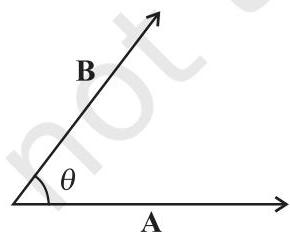
Here, $\theta$ represents the angle subtended between the two vectors, as depicted in Fig. 5.1(a). Given that $A$, $B$, and $\cos \theta$ are all scalar quantities, their product, the dot product of $\mathbf{A}$ and $\mathbf{B}$, is inherently a scalar. While individual vectors $\mathbf{A}$ and $\mathbf{B}$ possess distinct directions, their scalar product lacks any directional attribute.
From the definition in Eq. (5.1a), we can express the scalar product as:
$ \begin{array}{l} \mathbf {A} \cdot \mathbf {B} = A (B \cos \theta) \ = B (A \cos \theta) \ \end{array} $
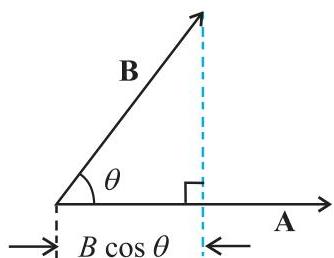
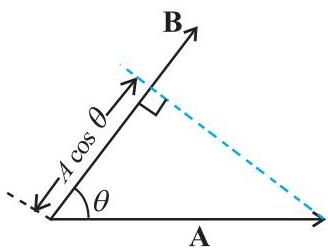
In a geometric context, $B \cos \theta$ signifies the scalar projection of vector $\mathbf{B}$ onto vector $\mathbf{A}$, as illustrated in Fig. 5.1(b). Conversely, $A \cos \theta$ represents the scalar projection of vector $\mathbf{A}$ onto vector $\mathbf{B}$, shown in Fig. 5.1(c). Consequently, $\mathbf{A} \cdot \mathbf{B}$ can be interpreted as the product of the magnitude of $\mathbf{A}$ and the scalar component of $\mathbf{B}$ aligned with $\mathbf{A}$. Alternatively, it is the product of the magnitude of $\mathbf{B}$ and the scalar component of $\mathbf{A}$ aligned with $\mathbf{B}$.
Equation (5.1a) further indicates that the scalar product adheres to the commutative principle:
$ \mathbf {A} \cdot \mathbf {B} = \mathbf {B} \cdot \mathbf {A} $
The scalar product also conforms to the distributive law over vector addition:
$ \mathbf {A} \cdot (\mathbf {B} + \mathbf {C}) = \mathbf {A} \cdot \mathbf {B} + \mathbf {A} \cdot \mathbf {C} $
Furthermore, for a real scalar $\lambda$, the following property holds: $\mathbf{A} \cdot (\lambda \mathbf{B}) = \lambda (\mathbf{A} \cdot \mathbf{B})$.
The formal derivations of these properties are provided as an exercise for the reader.
For the orthogonal unit vectors $\hat{\mathbf{i}},\hat{\mathbf{j}},\hat{\mathbf{k}}$, their scalar products are defined as:
$ \begin{array}{l} \hat {\mathbf {i}} \cdot \hat {\mathbf {i}} = \hat {\mathbf {j}} \cdot \hat {\mathbf {j}} = \hat {\mathbf {k}} \cdot \hat {\mathbf {k}} = 1 \ \hat {\mathbf {i}} \cdot \hat {\mathbf {j}} = \hat {\mathbf {j}} \cdot \hat {\mathbf {k}} = \hat {\mathbf {k}} \cdot \hat {\mathbf {i}} = 0 \ \end{array} $
When two vectors are expressed in their component forms as:
$ \mathbf {A} = A _ {x} \hat {\mathbf {i}} + A _ {y} \hat {\mathbf {j}} + A _ {z} \hat {\mathbf {k}} $
$ \mathbf {B} = B _ {x} \hat {\mathbf {i}} + B _ {y} \hat {\mathbf {j}} + B _ {z} \hat {\mathbf {k}} $
their scalar product is then calculated as:
$ \begin{array}{l} \mathbf {A} \cdot \mathbf {B} = \left(A _ {x} \hat {\mathbf {i}} + A _ {y} \hat {\mathbf {j}} + A _ {z} \hat {\mathbf {k}}\right) \cdot \left(B _ {x} \hat {\mathbf {i}} + B _ {y} \hat {\mathbf {j}} + B _ {z} \hat {\mathbf {k}}\right) \ = A _ {x} B _ {x} + A _ {y} B _ {y} + A _ {z} B _ {z} \tag {5.1b} \ \end{array} $
Based on the scalar product's definition and (Eq. 5.1b), it follows that:
$ \text{(i)} \quad \mathbf {A} \cdot \mathbf {A} = A _ {x} A _ {x} + A _ {y} A _ {y} + A _ {z} A _ {z} $
$ \operatorname {Or}, \quad A ^ {2} = A _ {x} ^ {2} + A _ {y} ^ {2} + A _ {z} ^ {2} \tag {5.1c} $
Given that $\mathbf{A} \cdot \mathbf{A} = |\mathbf{A}| |\mathbf{A}| \cos 0 = A^2$, this relationship holds true.
(ii) When vectors $\mathbf{A}$ and $\mathbf{B}$ are mutually orthogonal, their scalar product $\mathbf{A} \cdot \mathbf{B}$ evaluates to zero.
Example 5.1 Determine the angle subtended by the force vector $\mathbf{F} = (3\hat{\mathbf{i}} +4\hat{\mathbf{j}} -5\hat{\mathbf{k}})$ units and the displacement vector $\mathbf{d} = (5\hat{\mathbf{i}} +4\hat{\mathbf{j}} +3\hat{\mathbf{k}})$ units. Additionally, calculate the scalar projection of $\mathbf{F}$ onto $\mathbf{d}$.
Solution: The scalar product $\mathbf{F} \cdot \mathbf{d}$ is computed as $F_{x} d_{x} + F_{y} d_{y} + F_{z} d_{z}$:
$ \begin{array}{l} = 3 (5) + 4 (4) + (- 5) (3) \ = 16 \text{ unit} \ \end{array} $
Consequently, given that $\mathbf{F} \cdot \mathbf{d} = F d \cos \theta$, we have $F d \cos \theta = 16$ units.
Next, the magnitude squared of vector $\mathbf{F}$ is given by $\mathbf{F} \cdot \mathbf{F} = F^2 = F_x^2 + F_y^2 + F_z^2$:
$ \begin{array}{l} = 9 + 16 + 25 \ = 50 \text{ unit} \ \end{array} $
Similarly, the square of the magnitude of vector $\mathbf{d}$ is expressed as $\mathbf{d} \cdot \mathbf{d} = d^2 = d_x^2 + d_y^2 + d_z^2$:
$ \begin{array}{l} = 25 + 16 + 9 \ = 50 \text{ unit} \ \end{array} $
$ \therefore \cos \theta = \frac {16}{\sqrt {50} \sqrt {50}} = \frac {16}{50} = 0.32, $
$ \theta = \cos^{-1} 0.32 $
 (a)
(a)
 (b)
(b)
 (c)
Fig. 5.1 (a) The scalar product, or dot product, of two vectors, $\mathbf{A}$ and $\mathbf{B}$, yields a scalar quantity defined as $\mathbf{A} \cdot \mathbf{B} = AB \cos \theta$. (b) The term $B \cos \theta$ represents the scalar projection of vector $\mathbf{B}$ onto vector $\mathbf{A}$. (c) Analogously, $A \cos \theta$ denotes the scalar projection of vector $\mathbf{A}$ onto vector $\mathbf{B}$.
(c)
Fig. 5.1 (a) The scalar product, or dot product, of two vectors, $\mathbf{A}$ and $\mathbf{B}$, yields a scalar quantity defined as $\mathbf{A} \cdot \mathbf{B} = AB \cos \theta$. (b) The term $B \cos \theta$ represents the scalar projection of vector $\mathbf{B}$ onto vector $\mathbf{A}$. (c) Analogously, $A \cos \theta$ denotes the scalar projection of vector $\mathbf{A}$ onto vector $\mathbf{B}$.
5.2 NOTIONS OF WORK AND KINETIC ENERGY: THE WORK-ENERGY THEOREM
In Chapter 3, the relationship governing rectilinear motion with constant acceleration $a$ was established as:
$ v ^ {2} - u ^ {2} = 2 a s \tag {5.2} $
Here, $u$ signifies the initial speed, $v$ the final speed, and $s$ the distance covered. By multiplying both sides of this equation by $m / 2$, we arrive at:
$ \frac {1}{2} m v ^ {2} - \frac {1}{2} m u ^ {2} = m a s = F s \tag {5.2a} $
The final equivalence, $mas = Fs$, is derived directly from Newton's Second Law of motion. We can extend Equation (5.2) to three-dimensional scenarios through the use of vector quantities:
$ v ^ {2} - u ^ {2} = 2 \mathbf {a}. \mathbf {d} $
In this context, $\mathbf{a}$ represents the acceleration vector and $\mathbf{d}$ denotes the displacement vector of the object.
Applying the multiplication by $m / 2$ to both sides once more yields:
$ \frac {1}{2} m v ^ {2} - \frac {1}{2} m u ^ {2} = m \mathbf {a}. \mathbf {d} = \mathbf {F}. \mathbf {d} \tag {5.2b} $
This preceding equation serves as the foundational basis for defining the concepts of work and kinetic energy. The expression on the left-hand side represents the alteration in the value of 'one-half the product of mass and the square of speed' from its initial state to its final state. Each such quantity is termed 'kinetic energy', symbolized by $K$. Conversely, the right-hand side is characterized as the scalar product of the displacement and the force component acting in the direction of that displacement. This quantity is designated as 'work', denoted by $W$. Consequently, Equation (5.2b) can be re-expressed as:
$ K _ {j} - K _ {1} = W \tag {5.3} $
where $K_{i}$ and $K_{j}$ denote the initial and final kinetic energies of the object, respectively. Work is fundamentally associated with the application of a force across a given displacement. Specifically, work is performed by a force acting upon a body throughout a particular displacement. The work-energy (WE) theorem states that the change in a particle's kinetic energy is equivalent to the total work exerted upon it by the net force, and Equation (5.2) exemplifies a specific instance of this theorem. The extension of this derivation to encompass variable forces will be explored in a subsequent section.
Example 5.2 A raindrop is commonly understood to descend under the combined influence of a downward gravitational force and an opposing resistive force. This resistive force is recognized to be directly proportional to the drop's speed, though its precise nature is unspecified. Imagine a drop with a mass of $1.00\mathrm{g}$ commencing its fall from an altitude of $1.00\mathrm{km}$. It impacts the Earth's surface at a velocity of $50.0\mathrm{ms}^{-1}$. (a) Determine the work performed by the gravitational force. What is the work carried out by the unquantified resistive force?
Answer (a) The alteration in the kinetic energy of the raindrop is calculated as:
$ \begin{array}{l} \Delta K = \frac {1}{2} m v ^ {2} - 0 \ = \frac {1}{2} \times 1 0 ^ {- 3} \times 5 0 \times 5 0 \ = 1. 2 5 \mathrm {J} \ \end{array} $
This calculation presumes that the drop begins its descent from a state of rest.
If we consider $g$ to be a constant acceleration due to gravity, approximated at $10\mathrm{m} / \mathrm{s}^2$, the work executed by the gravitational force is determined to be:
$ \begin{array}{l} W _ {g} = m g h \ = 1 0 ^ {- 3} \times 1 0 \times 1 0 ^ {3} \ = 1 0. 0 \mathrm {J} \ \end{array} $
(b) Applying the work-energy theorem, we establish the relationship:
$ \Delta K = W _ {g} + W _ {r} $
where $W_{r}$ signifies the work imparted by the resistive force upon the raindrop. Thus
$ \begin{array}{l} W _ {r} = \Delta K - W _ {g} \ = 1. 2 5 - 1 0 \ = - 8. 7 5 \mathrm {J} \ \end{array} $
is negative.
5.3 WORK
As previously established, work is intrinsically linked to a force and the displacement through which it acts. Let us consider an object of mass $m$ subjected to a constant force $\mathbf{F}$. This object undergoes a displacement $\mathbf{d}$ along the positive $x$-axis, as depicted in Fig. 5.2.
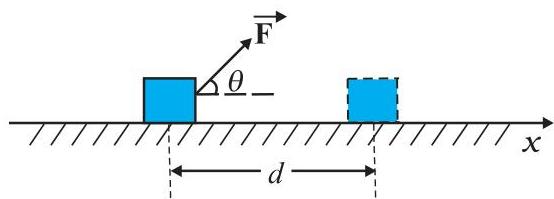 Fig. 5.2 An object undergoes a displacement $\mathbf{d}$ under the influence of the force $\mathbf{F}$.
The work performed by the force is formally defined as the product of the component of the force aligned with the direction of the displacement and the magnitude of that displacement. Consequently,
$ W = (F \cos \theta) d = \mathbf {F}. \mathbf {d} \tag {5.4} $
It becomes evident that in the absence of displacement, no work is accomplished, irrespective of the magnitude of the applied force. For instance, when considerable effort is expended pushing against an immovable brick wall, the force exerted on the wall results in no work being done. Nevertheless, one's muscles alternately contract and relax, consuming internal energy and leading to fatigue. This illustrates that the concept of work in physics deviates from its common linguistic usage.
Work is not done under the following conditions:
(i) The displacement is zero, as demonstrated in the aforementioned scenario. A weightlifter who maintains a 150 kg mass steadily on their shoulder for a duration of 30 seconds performs no work on the load during this interval. (ii) The applied force is zero. A block sliding across a frictionless horizontal surface, while not experiencing any horizontal force (due to the absence of friction), may still traverse a substantial distance. (iii) The force and displacement vectors are orthogonal to each other. This condition arises because for $\theta = \pi /2$ rad ($= 90^{\circ}$), the cosine value, $\cos (\pi /2)$, is zero. For the block traversing a smooth horizontal plane, the gravitational force $mg$ performs no work because its action is perpendicular to the direction of motion. Analogously, if one assumes a perfectly circular orbit for the Moon around the Earth, the Earth's gravitational force does no work. This is because the Moon's instantaneous displacement is tangential to its path, whereas the Earth's gravitational force is directed radially inward, resulting in $\theta = \pi /2$.
Work can assume both positive and negative values. If the angle $\theta$ lies between $0^{\circ}$ and $90^{\circ}$, the term $\cos \theta$ in Eq. (5.4) will be positive. Conversely, if $\theta$ falls between $90^{\circ}$ and $180^{\circ}$, $\cos \theta$ will be negative. In numerous practical situations, the frictional force opposes the displacement, implying $\theta = 180^{\circ}$. In such cases, the work performed by friction is negative ($\cos 180^{\circ} = -1$).
From Eq. (5.4), it is clear that work and energy share identical dimensions, specifically $\left[\mathrm{ML}^2\mathrm{T}^{-2}\right]$. The standard SI unit for both is the joule (J), named in honor of the renowned British physicist James Prescott Joule (1811-1869). Given the widespread application of work and energy as fundamental physical concepts, a variety of alternative units exist, some of which are enumerated in Table 5.1.
Table 5.1 Alternative Units of Work/Energy in J
| erg | $10^{-7}$ J |
|---|---|
| electron volt (eV) | $1.6 \times 10^{-19}$ J |
| calorie (cal) | 4.186 J |
| kilowatt hour (kWh) | $3.6 \times 10^{6}$ J |
$\triangleright$ Example 5.3 A bicycle rider executes a skidding halt over a distance of $10\mathrm{m}$ . Throughout this maneuver, the force exerted by the road upon the bicycle measures $200\mathrm{N}$ and acts precisely contrary to the direction of motion. (a) Determine the work performed by the road on the bicycle. (b) Calculate the work performed by the bicycle on the road.
Solution The work executed upon the bicycle by the road corresponds to the work generated by the resistive (frictional) force acting on the bicycle, originating from the road.
(a) The resistive force and the displacement vector are oriented at an angle of $180^{\circ}$ (or $\pi$ radians) relative to one another. Consequently, the work performed by the road is given by,
$ \begin{array}{l} W _ {r} = F d \cos \theta \ = 2 0 0 \times 1 0 \times \cos \pi \ = - 2 0 0 0 J \ \end{array} $
This negative work is precisely what causes the bicycle to decelerate to a stop, consistent with the Work-Energy theorem.
(b) According to Newton's Third Law, an equivalent and opposing force is exerted on the road by the bicycle. This force also possesses a magnitude of $200\mathrm{N}$ . Nevertheless, the road itself experiences no discernible displacement. Therefore, the work performed by the bicycle on the road is null.
The principal insight derived from Example 5.3 is that while the force exerted by body B on body A is invariably equal in magnitude and opposite in direction to the force exerted by body A on body B (as stipulated by Newton's Third Law), the work performed on A by B is not necessarily of equal magnitude and opposite sign to the work performed on B by A.
5.4 KINETIC ENERGY
Previously established, an object possessing mass $m$ and velocity $\mathbf{v}$ is characterized by its kinetic energy $K$, defined as:
$ K = \frac {1}{2} m \mathbf {v}. \mathbf {v} = \frac {1}{2} m v ^ {2} \tag {5.5} $
This form of energy, $K$, is a scalar quantity. It quantifies the capacity of an object to perform work solely due to its state of motion. The underlying principle has been recognized intuitively for centuries; for instance, the kinetic energy inherent in rapidly moving water has historically powered corn mills, and wind's kinetic energy has propelled sailing vessels. Illustrative values for the kinetic energies of diverse objects are presented in Table 5.2.
Table 5.2 Typical kinetic energies (K)
| Object | Mass (kg) | Speed (m s^{-1}) | K (J) |
|---|---|---|---|
| Car | 2000 | 25 | $6.3 \times 10^{5}$ |
| Running athlete | 70 | 10 | $3.5 \times 10^{3}$ |
| Bullet | $5 \times 10^{-2}$ | 200 | $10^{3}$ |
| Stone dropped from 10 m | 1 | 14 | $10^{2}$ |
| Rain drop at terminal speed | $3.5 \times 10^{-5}$ | 9 | $1.4 \times 10^{-3}$ |
| Air molecule | $\approx 10^{-26}$ | 500 | $\approx 10^{-21}$ |
▶ Example 5.4 During a ballistics exercise, a police officer discharges a 50.0 g bullet at a velocity of 200 m s-1 (as referenced in Table 5.2) into a 2.00 cm thick section of soft plywood. After traversing the plywood, the bullet retains merely 10% of its original kinetic energy. Determine the bullet's final speed upon exit.
Answer The bullet's initial kinetic energy is calculated as $mv^2/2 = 1000 , \text{J}$. Subsequently, its final kinetic energy is $0.1 \times 1000 = 100 , \text{J}$. Let $v_f$ denote the velocity of the bullet as it exits the material;
$ \begin{array}{l} \frac{1}{2} m v_f^2 = 100 , \text{J} \ v_f = \sqrt{\frac{2 \times 100 , \text{J}}{0.05 , \text{kg}}} \ = 63.2 , \text{m} , \text{s}^{-1} \end{array} $
This indicates a speed reduction of approximately 68%, rather than 90%.
5.5 WORK DONE BY A VARIABLE FORCE
Forces encountered in real-world scenarios are rarely constant; instead, a variable force is the more typical occurrence. Figure 5.3 visually represents such a varying force acting in a single dimension.
When considering a minuscule displacement $\Delta x$, the force $F(x)$ may be approximated as invariant across this interval, in which case the work performed is given by:
$ \Delta W = F(x) \Delta x $
This concept is depicted in Figure 5.3(a). By aggregating the areas of successive rectangular segments shown in Figure 5.3(a), the cumulative work executed is derived as:
$ W \equiv \sum_{x_i}^{x_f} F(x) \Delta x \tag{5.6} $
Here, the summation extends from the initial position $x_i$ to the final position $x_f$.
As the displacements tend towards an infinitesimal value, the summation encompasses an unbounded number of terms; however, the sum converges to a definitive value that corresponds precisely to the area bounded by the curve in Figure 5.3(b). Consequently, the work done is expressed as:
$ \begin{array}{l} W = \lim_{\Delta x \to 0} \sum_{x_i}^{x_f} F(x) \Delta x \ = \int_{x_i}^{x_f} F(x) , dx \tag{5.7} \end{array} $
In this expression, 'lim' denotes the mathematical limit of the sum as $\Delta x$ approaches zero. Therefore, for a force that varies with position, the work done can be precisely formulated as a definite integral of the force with respect to displacement (refer also to Appendix 3.1).
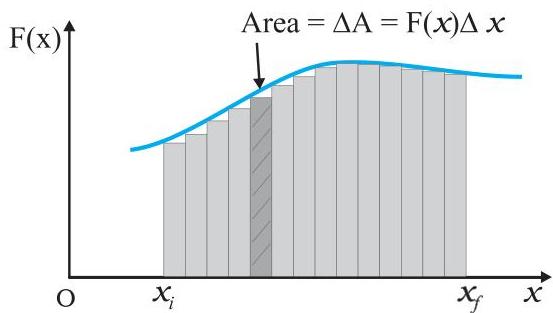 Fig. 5.3(a)
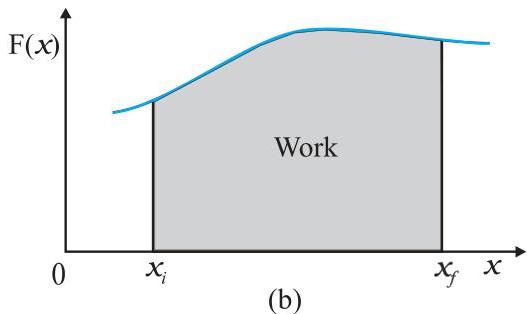 Fig. 5.3 (a) The shaded rectangle represents the work done by the varying force $F(x)$, over the small displacement $\Delta x$, $\Delta W = F(x) \Delta x$. (b) adding the areas of all the rectangles we find that for $\Delta x \to 0$, the area under the curve is exactly equal to the work done by $F(x)$.
Example 5.5 A woman applies force to propel a trunk across a rough railway platform. Initially, she exerts a force of $100\mathrm{N}$ over a $10\mathrm{m}$ distance. Subsequently, her exertion diminishes linearly with distance, reducing her applied force to $50\mathrm{N}$. The trunk is moved a total distance of $20\mathrm{m}$. Illustrate the applied force from the woman and the opposing frictional force, which is $50\mathrm{N}$, as functions of displacement. Determine the work performed by both forces across the $20\mathrm{m}$ trajectory.
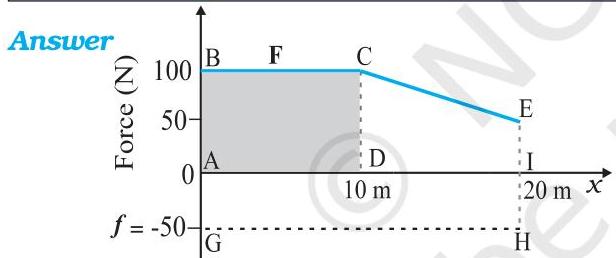 Fig. 5.4 Plot of the force $F$ applied by the woman and the opposing frictional force $f$ versus displacement.
The profile of the force exerted by the woman is depicted in Fig. 5.4. At a displacement of $x = 20 , \text{m}$, the applied force $F$ is $50 , \text{N}$ (which is not zero). We are informed that the frictional force, denoted $f$, has a magnitude of $|\mathbf{f}| = 50 , \text{N}$. This force acts to resist the motion, thus its direction is contrary to that of $\mathbf{F}$. Consequently, it is represented on the negative portion of the force axis in the plot.
The work accomplished by the woman is calculated as:
$W_{F} \rightarrow$ area of the rectangle ABCD + area of the trapezium CEID
$ \begin{array}{l} W _ {F} = 1 0 0 \times 1 0 + \frac {1}{2} (1 0 0 + 5 0) \times 1 0 \ = 1 0 0 0 + 7 5 0 \ = 1 7 5 0 \mathrm {J} \ \end{array} $
The work performed by the frictional force, denoted as $W_f$, corresponds to the area of the rectangle AGHI.
$ \begin{array}{l} W _ {f} = (- 5 0) \times 2 0 \ = - 1 0 0 0 \mathrm {J} \ \end{array} $
It is important to note that areas situated on the negative region of the force axis are assigned a negative value.
5.6 THE WORK-ENERGY THEOREM FOR A VARIABLE FORCE
Having established an understanding of the concepts of work and kinetic energy, we can now proceed to demonstrate the work-energy theorem specifically for a variable force. Our analysis will be restricted to a single dimension. The instantaneous rate of change of kinetic energy with respect to time is given by
$ \begin{array}{l} \frac {\mathrm {d} K}{\mathrm {d} t} = \frac {\mathrm {d}}{\mathrm {d} t} \left(\frac {1}{2} m v ^ {2}\right) \ = m \frac {\mathrm {d} v}{\mathrm {d} t} v \ = F v \text {(from Newton's Second Law)} \ = F \frac {\mathrm {d} x}{\mathrm {d} t} \ \end{array} $
Consequently,
$ \mathrm {d} K = F \mathrm {d} x $
By performing integration from the initial spatial coordinate $(x_i)$ to the final spatial coordinate $(x_f)$, we obtain:
$ \int_ {K _ {i}} ^ {K _ {f}} \mathrm {d} K = \int_ {x _ {i}} ^ {x _ {f}} F \mathrm {d} x $
Here, $K_i$ and $K_f$ represent the initial and final kinetic energies, respectively, associated with positions $x_i$ and $x_f$.
$ \text {or} \quad K _ {f} - K _ {i} = \int_ {x _ {i}} ^ {x _ {f}} F \mathrm {d} x \tag {5.8a} $
In accordance with Equation (5.7), it is deduced that
$ K _ {f} - K _ {i} = W \tag {5.8b} $
Therefore, the work-energy theorem is established for scenarios involving a variable force.
Although the work-energy theorem proves advantageous in numerous problem-solving contexts, it typically does not encompass the full spectrum of dynamical information inherent in Newton's second law. Fundamentally, it constitutes an integral formulation of Newton's second law. Newton's second law describes the instantaneous relationship between acceleration and force. Conversely, the work-energy theorem entails an integration across a duration of time. Consequently, the temporal data intrinsically present within Newton's second law is effectively 'integrated out' and thus
not directly manifest. Furthermore, it is observed that Newton's second law, when applied to two or three dimensions, is expressed in a vector format, whereas the work-energy theorem is cast in a scalar form. This scalar representation consequently omits directional information that is inherently part of Newton's second law.
Example 5.6 A block with a mass of $m = 1$ kg, initially moving on a horizontal surface with speed $v_i = 2$ m s$^{-1}$, enters a rough patch ranging from $x = 0.10$ m to $x = 2.01$ m. Within this specified range, the retarding force $F_r$ acting on the block exhibits an inverse proportionality to $x$,
$ \begin{array}{l} F_r = \frac{-k}{x} \text{ for } 0.1 < x < 2.01 \text{ m} \ = 0 \text{ for } x < 0.1 \text{ m and } x > 2.01 \text{ m} \end{array} $
with $k$ having a value of $0.5$ J. Determine the final kinetic energy and the final speed $v_f$ of the block upon its traversal of this region.
Solution: Utilizing Equation (5.8a),
$ \begin{array}{l} K_f = K_t + \int_{0.1}^{2.01} \frac{(-k)}{x} , dx \ = \frac{1}{2} m v_i^2 - k \ln(x) \Big|_{0.1}^{2.01} \ = \frac{1}{2} m v_i^2 - k \ln(2.01/0.1) \ = 2 - 0.5 \ln(20.1) \ = 2 - 1.5 = 0.5 \text{ J} \ v_f = \sqrt{2 K_f / m} = 1 \text{ m s}^{-1} \end{array} $
It is important to note that the symbol $\ln$ represents the natural logarithm, which uses base $e$, rather than the common logarithm with base 10 [$\ln X = \log_e X = 2.303 \log_{10}X$].
5.7 THE CONCEPT OF POTENTIAL ENERGY
The term 'potential' inherently implies a latent capability or a capacity for future activity. In the context of physics, 'potential energy' evokes the concept of energy that is 'stored.' Consider, for instance, a drawn bowstring, which holds potential energy; upon its release, the arrow is propelled with considerable velocity. Similarly, the Earth's crust is characterized by non-uniformity, exhibiting discontinuities and structural shifts known as fault lines. These geological features can be likened to 'compressed springs,' harboring substantial potential energy. The sudden release and readjustment of these fault lines precipitate an earthquake. Consequently, potential energy is defined as the 'stored energy' that an object possesses due to its position or its specific arrangement. When unconstrained, this stored energy is converted into kinetic energy. Let us now elaborate on this concept of potential energy with greater specificity.
For an object of mass $m$, the gravitational force acting upon it is given by $mg$. We can consider $g$ to be a constant value when in close proximity to the Earth's surface. This 'proximity' signifies that the object's height $h$ above the Earth's surface is negligible in comparison to the Earth's radius $R_p (h << R_p)$, thereby allowing us to disregard fluctuations in $g$ at such elevations*. For the subsequent discussion, we will designate the upward direction as positive. If we elevate the object to a height $h$, the work performed by an external agent to counteract the gravitational force amounts to $mgh$. This expended work is subsequently stored as potential energy. The gravitational potential energy of an object, expressed as a function of its height $h$, is symbolized by $V(h)$, and it corresponds to the negative of the work exerted by the gravitational force during the object's ascent to that height.
$ V(h) = mgh $
Considering $h$ as a variable quantity, it becomes evident that the gravitational force $F$ is equivalent to the negative of the derivative of $V(h)$ with respect to $h$. Therefore,
$ F = -\frac{d}{dh} V(h) = -mg $
The presence of the negative sign signifies that the gravitational force acts in a downward direction. Upon release, the object accelerates downwards. Immediately preceding impact with the ground, its velocity can be determined by the kinematic equation,
$ v^2 = 2gh $
This expression can be reformulated as
$ \frac{1}{2} m v^2 = mgh $
This demonstrates that the gravitational potential energy possessed by the object at height $h$, once the object is set free, is converted entirely into the kinetic energy of the object as it reaches the ground.
From a physical standpoint, the concept of potential energy is exclusively relevant to forces for which the work performed in opposition to them is 'accumulated' as energy. Subsequently, upon the removal of external constraints, this stored energy becomes apparent as kinetic energy. In mathematical terms, and for the sake of simplicity within a single dimension, the potential
- The variation of $g$ with height is discussed in Chapter 7 on Gravitation.
energy $V(x)$ is defined provided that the force $F(x)$ can be expressed as
$ F(x) = -\frac{\mathrm{d}V}{\mathrm{d}x} $
Consequently, this leads to
$ \int_{x_i}^{x_f} F(x) \mathrm{d}x = -\int_{V_i}^{V_f} \mathrm{d}V = V_i - V_f $
A conservative force, exemplified by gravity, performs work that is solely contingent upon the system's initial and final configurations. Our prior discussions included instances involving inclined planes. For instance, when an object of mass $m$ is released from rest at the apex of a smooth (frictionless) inclined plane of height $h$, its velocity upon reaching the base is $\sqrt{2gh}$, irrespective of the plane's angle. Consequently, at the bottom of this incline, the object possesses a kinetic energy equivalent to $mgh$. Should the work performed or the kinetic energy acquired be influenced by variables such as velocity or the specific trajectory followed by the object, the force would then be classified as non-conservative.
Potential energy is characterized by dimensions of $[\mathrm{ML}^2\mathrm{T}^{-2}]$ and is measured in joules (J), sharing these specifications with kinetic energy and mechanical work. To emphasize, for a conservative force, the alteration in potential energy, denoted $\Delta V$, corresponds to the negative value of the work executed by that force.
$ \Delta V = -F(x) \Delta x \tag{5.9} $
The illustration of the falling ball within this section demonstrated the transformation of potential energy into kinetic energy. This phenomenon serves as an intimation of a significant conservation principle foundational to mechanics, which we shall now investigate further.
5.8 THE CONSERVATION OF MECHANICAL ENERGY
To illustrate this fundamental principle, we will focus on one-dimensional motion. Consider a body undergoing a displacement $\Delta x$ while acted upon by a conservative force $F$. According to the work-energy theorem, we establish that:
$ \Delta K = F(x) \Delta x $
For a conservative force, it is possible to define a potential energy function $V(x)$ such that:
$ -\Delta V = F(x) \Delta x $
These two equations lead to the following implication:
$ \begin{array}{l} \Delta K + \Delta V = 0 \ \Delta(K + V) = 0 \tag{5.10} \end{array} $
This signifies that the sum of the body's kinetic energy $K$ and potential energy $V$, denoted $K + V$, remains constant. When considering the entire trajectory from an initial point $x_i$ to a final point $x_j$, this constancy implies:
$ K_i + V(x_i) = K_j + V(x_j) \tag{5.11} $
The combined quantity $K + V(x)$ is referred to as the total mechanical energy of the system. While the kinetic energy $K$ and potential energy $V(x)$ may individually fluctuate across different points, their aggregate sum is invariant. This elucidates the appropriateness of the designation 'conservative force'.
Let us examine several definitions that characterize a conservative force:
- A force $F(x)$ is deemed conservative if it can be derived from a scalar potential function $V(x)$ through the relationship provided by Eq. (5.9). The extension of this concept to three dimensions necessitates the application of a vector derivative, a topic beyond the purview of this text.
- The work executed by a conservative force is solely contingent upon its initial and final positions. This characteristic is evident from the relationship:
$ W = K_j - K_i = V(x_i) - V(x_j) $
which clearly demonstrates dependence exclusively on the endpoints.
- A third defining property states that the work performed by such a force over a closed path is zero. This outcome is again deducible from Eq. (5.11), given that for a closed path, $x_i = x_j$.
Consequently, the principle of conservation of total mechanical energy can be articulated as follows:
The total mechanical energy of a system is conserved if the forces, doing work on it, are conservative.
To provide a more tangible understanding of the foregoing discussion, we can revisit the example of gravitational force and, in the subsequent section, the spring force. Figure 5.5 illustrates a ball of mass $m$ being released from a cliff of height $H$.
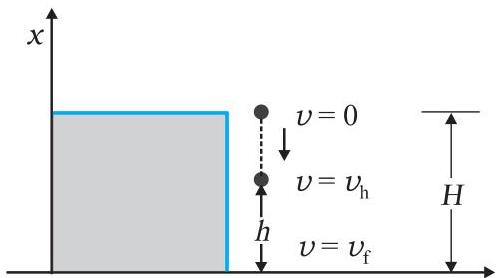 Fig. 5.5 The conversion of potential energy to kinetic energy for a ball of mass $m$ dropped from a height $H$.
The total mechanical energies $E_{0}, E_{h}$, and $E_{H}$ of the ball at the designated heights of zero (ground level), $h$, and $H$, respectively, are expressed as:
$ E _ {H} = m g H \tag {5.11 a} $
$ E _ {h} = m g h + \frac {1}{2} m v _ {h} ^ {2} \tag {5.11 b} $
$ E _ {0} = (1 / 2) m v _ {f} ^ {2} \tag {5.11 c} $
A constant force represents a specific instance of a spatially dependent force $F(x)$. Therefore, the mechanical energy is conserved in this scenario. This leads to:
$ E _ {H} = E _ {0} $
or,
$ mgH = \frac{1}{2} mv_f^2 $
$ v _ {f} = \sqrt {2 g H} $
This result aligns with the outcome derived in section 5.7 for a freely falling object.
Furthermore, applying the conservation principle yields:
$ E _ {H} = E _ {h} $
which consequently implies:
$ v _ {\mathrm {h}} ^ {2} = 2 g (H - h) \tag {5.11 d} $
This phenomenon is a familiar outcome from kinematics.
When an object is at height $H$, its energy is exclusively potential. As it descends to height $h$, a portion of this energy converts into kinetic energy, becoming entirely kinetic upon reaching the ground. This sequence exemplifies the principle of mechanical energy conservation.
Example 5.7 Consider a bob with
mass $m$, attached to a lightweight
string of length $L$. It is given an initial horizontal velocity $v_{c}$ at its lowest position, A, enabling it to traverse a semi-circular path in the vertical plane. The string loses tension solely upon arrival at the uppermost point, C, as depicted in Fig. 5.6. Determine expressions for (i) $v_{c}$; (ii) the velocities at points B and C; and (iii) the ratio of kinetic energies $(K_{0} / K_{c})$ at B and C. Discuss the subsequent motion of the bob once it attains point C.
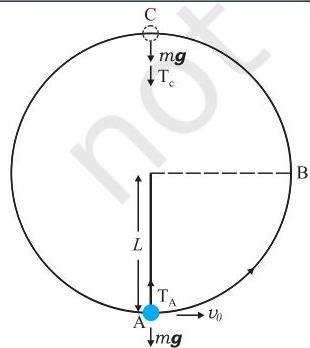 Fig. 5.6
Answer (i) The bob experiences two external forces: gravitational attraction and the string's tension $(T)$. The tension force performs no work because its direction is consistently perpendicular to the bob's displacement. Consequently, the bob's potential energy is solely a function of the gravitational force. The system's total mechanical energy, $E$, remains invariant. We establish the potential energy of the system as zero at the lowest position, A. Therefore, at point A:
$ E = \frac {1}{2} m v _ {0} ^ {2} \tag {5.12} $
$ T _ {A} - m g = \frac {m v _ {0} ^ {2}}{L} [ \text {Newton's Second Law} ] $
where $T_{A}$ represents the tension within the string at A. Upon reaching the apex, point C, the string goes slack, indicating that the tension $(T_{C})$ in the string diminishes to zero.
Thus, at C
$ E = \frac {1}{2} m v _ {c} ^ {2} + 2 m g L \tag {5.13} $
$ m g = \frac {m v _ {c} ^ {2}}{L} \quad [ \text {Newton's Second Law} ] \tag {5.14} $
Here, $v_{c}$ denotes the speed at C. Utilizing Eqs. (5.13) and (5.14), the total energy is determined as:
$ E = \frac {5}{2} m g L $
By equating this energy expression with the energy at A, we obtain:
$ \frac {5}{2} m g L = \frac {m}{2} v _ {0} ^ {2} $
or,
$ v _ {0} = \sqrt {5 g L} $
(ii) As directly evident from Eq. (5.14):
$ v _ {C} = \sqrt {g L} $
At B, the energy is
$ E = \frac {1}{2} m v _ {B} ^ {2} + m g L $
By setting this expression equal to the energy at A, and incorporating the outcome from part (i), specifically $v_0^2 = 5gL$, we get:
$ \begin{array}{l} \frac {1}{2} m v _ {B} ^ {2} + m g L = \frac {1}{2} m v _ {0} ^ {2} \ = \frac {5}{2} m g L \ \end{array} $
$
\therefore v _ {B} = \sqrt {3 g L} \tag {5.16} $
(iii) The comparative ratio of the kinetic energies observed at points B and C is calculated as:
$ \frac {K _ {B}}{K _ {C}} = \frac {\frac {1}{2} m v _ {B} ^ {2}}{\frac {1}{2} m v _ {C} ^ {2}} = \frac {3}{1} $
Upon reaching point C, the string loses tension, and the bob's velocity vector is directed horizontally towards the left. Should the string be severed at this precise moment, the bob would subsequently undergo projectile motion, analogous to an object launched horizontally from a cliff's edge. Conversely, if the string remains intact, the bob will persist in its circular trajectory, completing the full revolution.
5.9 THE POTENTIAL ENERGY OF A SPRING
The force exerted by a spring serves as a notable instance of a variable and conservative force. As depicted in Fig. 5.7, consider a block affixed to one end of a spring, resting upon a frictionless horizontal plane. The opposing end of the spring is secured to a rigid fixture. The spring itself is considered lightweight, permitting its treatment as a massless entity. Within the framework of an ideal spring, the spring force, denoted $F_{s}$, exhibits direct proportionality to $x$, where $x$ represents the displacement of the block from its equilibrium configuration. This displacement can manifest as either a positive extension [Fig. 5.7(b)] or a negative compression [Fig. 5.7(c)]. This fundamental force relationship for springs is recognized as Hooke's law and is mathematically expressed as:
$ F _ {s} = - k x $
The constant $k$ is designated as the spring constant, with its standard unit being $\mathrm{Nm}^{-1}$. A spring is characterized as "stiff" when its constant $k$ possesses a large value, whereas it is deemed "soft" if $k$ is comparatively small.
Let us consider the scenario where the block is drawn outward, as illustrated in Fig. 5.7(b). If the maximal extension achieved is $x_{m}$, the work executed by the spring force is determined by the integral:
$ \begin{array}{l} W _ {s} = \int_ {0} ^ {x _ {m}} F _ {s} d x = - \int_ {0} ^ {x _ {m}} k x d x \ = - \frac {k x _ {m} ^ {2}}{2} \tag {5.15} \ \end{array} $
This relationship can alternatively be derived through the geometric interpretation of the area under the force-displacement curve, specifically the triangle shown in Fig. 5.7(d). It is pertinent to observe that the work performed by an external pulling force, $F$, is positive, as it must counteract the opposing spring force.
$ W = + \frac {k x _ {m} ^ {2}}{2} \tag {5.16} $
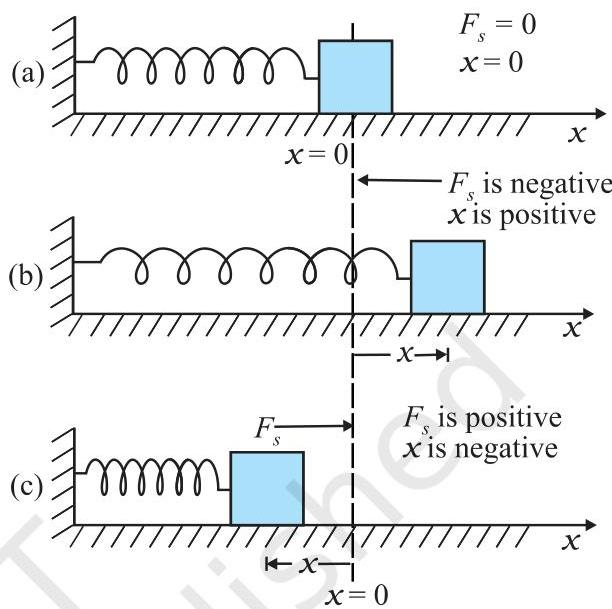
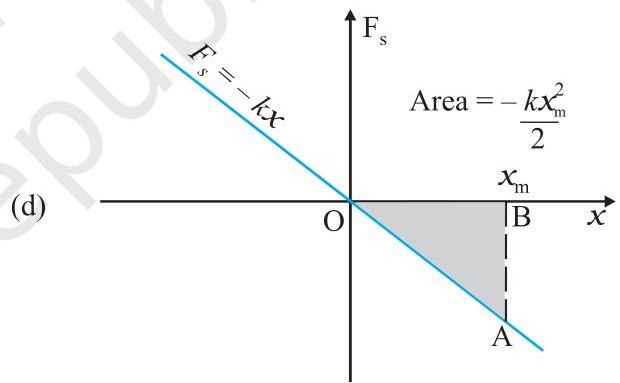 Fig. 5.7 Illustration of the spring force with a block attached to the free end of the spring. (a) The spring force $F_{s}$ is zero when the displacement $x$ from the equilibrium position is zero. (b) For the stretched spring $x > 0$ and $F_{s} < 0$ (c) For the compressed spring $x < 0$ and $F_{s} > 0$ . (d) The plot of $F_{s}$ versus $x$ . The area of the shaded triangle represents the work done by the spring force. Due to the opposing signs of $F_{s}$ and $x$ , this work done is negative. $W_{s} = -kx_{m}^{2} / 2$ .
An analogous principle applies when the spring undergoes compression, resulting in a displacement $x_{c} (< 0)$. In such a case, the spring force performs work $W_{s} = -kx_{c}^{2} / 2$, while the external force $F$ performs work $+kx_{c}^{2}/2$. If the block's position changes from an initial displacement $x_{i}$ to a final displacement $x_{f}$, the work done by the spring force $W_{s}$ is given by:
$ W _ {s} = - \int_ {x _ {i}} ^ {x _ {f}} k x , dx = \frac {k x _ {i} ^ {2}}{2} - \frac {k x _ {f} ^ {2}}{2} \tag {5.17} $
Consequently, the work executed by the spring force is contingent solely upon the initial and final positions. Specifically, if the block is displaced from $x_{i}$ and subsequently returned to $x_{i}$, the work done is:
$ \begin{array}{l} W _ {s} = - \int_ {x _ {i}} ^ {x _ {f}} k x , dx = \frac {k x _ {i} ^ {2}}{2} - \frac {k x _ {f} ^ {2}}{2} \ = 0 \tag {5.18} \ \end{array} $
The work performed by the spring force over a complete cyclic process is zero. Through this analysis, we have explicitly demonstrated that the spring force (i) is exclusively dependent on position, as initially posited by Hooke, $(F_{s} = -kx)$; and (ii) performs work that relies solely on the initial and final positions, as exemplified by Eq. (5.17). These characteristics affirm that the spring force is indeed a conservative force.
The potential energy $V(x)$ of a spring is conventionally established as zero when the block-spring system resides at its equilibrium point. For a displacement $x$ (whether an extension or a compression), the preceding analysis indicates that this energy can be expressed as:
$ V (x) = \frac {k x ^ {2}}{2} \tag {5.19} $
It can be readily confirmed that the negative spatial derivative, $-\mathrm{d}V / \mathrm{d}x$, yields $-kx$, which corresponds to the spring force. If a block of mass $m$, as illustrated in Fig. 5.7, is displaced to an extreme position $x_{m}$ and subsequently released from rest, its total mechanical energy at any arbitrary position $x_{f}$ — provided $x$ lies within the range of $-x_{m}$ to $+x_{m}$ — will be described by:
$ \frac {1}{2} k x _ {m} ^ {2} = \frac {1}{2} k x ^ {2} + \frac {1}{2} m v ^ {2} $
This formulation is derived directly from the principle of mechanical energy conservation. A direct implication is that both the speed and the kinetic energy achieve their maximal values at the equilibrium position, $x = 0$. Specifically:
$ \frac {1}{2} m v _ {m} ^ {2} = \frac {1}{2} k x _ {m} ^ {2} $
where $v_{m}$ denotes the maximum attainable speed.
This further simplifies to
$ v _ {m} = \sqrt{\frac{k}{m}} x_{m} $
It is pertinent to observe that the ratio $k / m$ possesses the dimensions of $[\mathrm{T}^{-2}]$, confirming the dimensional consistency of our derived equation. A continuous interconversion occurs between kinetic energy and potential energy, and vice versa; however, the total mechanical energy of the system remains invariant. This dynamic is visually represented in Fig. 5.8.
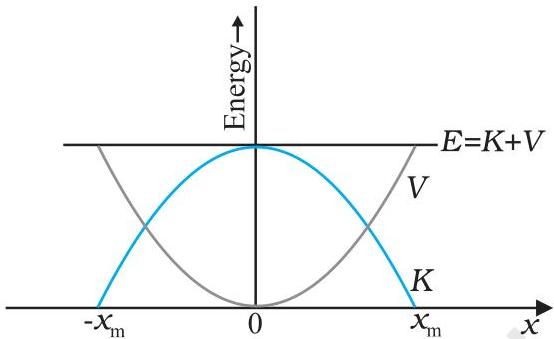 Fig. 5.8 Illustrative parabolic representations of the potential energy $V$ and kinetic energy $K$ for a block connected to a Hooke's law spring. These plots demonstrate an inverse relationship, where an increase in one energy form corresponds to a decrease in the other, while their sum, the total mechanical energy $E = K + V$, is conserved.
Example 5.8 Automotive manufacturers employ simulations of car accidents to investigate collisions involving moving vehicles and strategically positioned springs of varying constants. Consider a typical simulation featuring a car of mass $1000,\mathrm{kg}$ traveling at a speed of $18.0,\mathrm{km/h}$ on a frictionless surface, which then collides with a horizontally mounted spring having a spring constant of $5.25 \times 10^{3},\mathrm{N},\mathrm{m}^{-1}$. Determine the maximum compression experienced by the spring.
Answer At the point of maximum spring compression, the entire kinetic energy possessed by the car is transformed into the potential energy stored within the spring.
The kinetic energy of the moving car is calculated as:
$ \begin{array}{l} K = \frac {1}{2} m v ^ {2} \ = \frac {1}{2} \times 10^{3} \times 5 \times 5 \ K = 1.25 \times 10^{4} , \mathrm{J} \ \end{array} $
Here, the initial speed of $18,\mathrm{km},\mathrm{h}^{-1}$ has been converted to $5,\mathrm{m},\mathrm{s}^{-1}$ (a useful conversion to recall is that $36,\mathrm{km},\mathrm{h}^{-1} = 10,\mathrm{m},\mathrm{s}^{-1}$). According to the principle of mechanical energy conservation, at its maximum compression $x_{m}$, the potential energy $V$ stored in the spring is equivalent to the car's initial kinetic energy $K$.
$ V = \frac {1}{2} k x _ {m} ^ {2} $
$ = 1.25 \times 10^4 \text{ J} $
Solving for $x_m$, we obtain:
$ x_m = 2.00 \text{ m} $
It is important to acknowledge that this scenario involves certain idealizations. Specifically, the spring is assumed to be massless, and the surface is considered to exhibit negligible friction.
We conclude this section by making a few remarks on conservative forces.
(i) The preceding analyses lack temporal information. While the extent of compression can be determined in the aforementioned example, the duration of this compressive action cannot. Obtaining temporal data for such a system necessitates the application of Newton's Second Law.
(ii) Not every force exhibits conservative properties. Frictional forces, for instance, are non-conservative. Consequently, the principle of energy conservation must be adapted when such forces are operative. Example 5.9 serves to demonstrate this point.
(iii) The datum for zero potential energy is conventionally chosen arbitrarily. Its selection is based on practical convenience. For the spring force, we established $V(x) = 0$ when $x = 0$, signifying that the unextended spring possessed no potential energy. In the context of a constant gravitational force $mg$, the potential energy was designated as zero at the Earth's surface. Subsequently, in a forthcoming chapter, it will be observed that for the force governed by the universal law of gravitation, the most appropriate zero reference is situated at an infinite separation from the gravitational source. Nevertheless, once the potential energy reference point is established within a particular analysis, it is imperative to maintain its consistent application throughout that analysis. Shifting this reference during the course of a problem is impermissible.
Example 5.9 Consider Example 5.8 taking the coefficient of friction, $\mu$, to be 0.5 and calculate the maximum compression of the spring.
Answer When friction is present, both the spring force and the frictional force exert opposition to the spring's compression, as illustrated in Fig. 5.9.
We apply the work-energy theorem, in preference to the principle of mechanical energy conservation.
The change in kinetic energy is
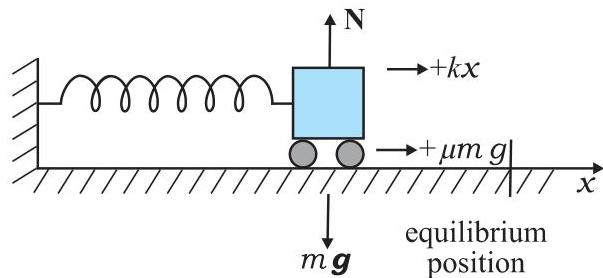 Fig. 5.9 The forces acting on the car.
$ \Delta K = K_f - K_i = 0 - \frac{1}{2} m v^2 $
The work done by the net force is
$ W = - \frac{1}{2} k x_m^2 - \mu m g x_m $
By equating these, we obtain
$ \frac{1}{2} m v^2 = \frac{1}{2} k x_m^2 + \mu m g x_m $
Subsequently, with $g = 10.0 \text{ m s}^{-2}$, we calculate $\mu mg = 0.5 \times 10^3 \times 10 = 5 \times 10^3 \text{ N}$. Upon algebraic rearrangement of the preceding equation, the following quadratic expression for the unknown $x_m$ is derived:
$ k x_m^2 + 2 \mu m g x_m - m v^2 = 0 $
$ x_m = \frac{ - \mu m g + \left[ \mu^2 m^2 g^2 + m k v^2 \right]^{1/2} }{k} $
where the positive square root is selected, as $x_m$ must be positive. Substituting the numerical values yields
$ x_m = 1.35 \text{ m} $
This result, as anticipated, is smaller than that obtained in Example 5.8.
Should a body be subjected to two forces, specifically a conservative force $F_c$ and a non-conservative force $F_{nc}$, the formulation for the conservation of mechanical energy requires alteration. According to the Work-Energy (WE) theorem,
$ (F_c + F_{nc}) \Delta x = \Delta K $
However,
$ F_c \Delta x = - \Delta V $
Consequently,
$ \Delta (K + V) = F_{nc} \Delta x $
$ \Delta E = F_{nc} \Delta x $
where $E$ denotes the total mechanical energy. Integrated over the trajectory, this expression takes the form
$ E_f - E_i = W_{nc} $
wherein $W_{nc}$ represents the cumulative work performed by the non-conservative forces along the specified path. It is important to note that
WORK, ENERGY AND POWER
In contrast to conservative forces, the work done by non-conservative forces, $W_{nc}$, is dependent on the specific path
taken from an initial point $i$ to a final point $f$.
5.10 POWER
Beyond merely calculating the work performed on an object, it is frequently important to ascertain the speed at which this work is accomplished. For instance, an individual is considered physically capable not just for ascending four floors of a building, but for doing so rapidly. Power is formally defined as the temporal rate at which work is executed or energy is conveyed.
The average power exerted by a force is given by the ratio of the total work, $W$, to the total elapsed time $t$:
$ P_{aw} = \frac{W}{t} $
Instantaneous power, conversely, is defined as the limiting value of the average power as the time interval approaches zero:
$ P = \frac{\mathrm{d}W}{\mathrm{d}t} \tag{5.20} $
The infinitesimal work $dW$ performed by a force $\mathbf{F}$ over an infinitesimal displacement $d\mathbf{r}$ is expressed as $\mathrm{d}W = \mathbf{F}.d\mathbf{r}$. Consequently, instantaneous power can also be formulated as:
$ \begin{array}{l} P = \mathbf{F} \cdot \frac{\mathrm{d} \mathbf{r}}{\mathrm{d} t} \ = \mathbf{F} \cdot \mathbf{v} \tag{5.21} \end{array} $
Here, $\mathbf{v}$ represents the instantaneous velocity at the moment the force $\mathbf{F}$ is applied.
Power is a scalar quantity, much like work and energy. Its dimensional representation is $[\mathrm{ML}^2\mathrm{T}^{-3}]$. Within the International System of Units (SI), the unit for power is the watt (W), which is equivalent to $1,\mathrm{J},\mathrm{s}^{-1}$. This unit was named in honor of James Watt, a pivotal figure in the development of the steam engine during the eighteenth century.
Another recognized unit for power is the horsepower (hp):
$ 1,\mathrm{hp} = 746,\mathrm{W} $
This unit continues to be employed for specifying the output of vehicles such as automobiles and motorbikes.
The watt unit is commonly encountered when purchasing electrical appliances like light bulbs, heating devices, and refrigerators. For example, a 100-watt bulb operating for 10 hours consumes 1 kilowatt-hour (kWh) of energy:
$ \begin{array}{l} 100,(\text{watt}) \times 10,(\text{hour}) \ = 1000,\text{watt hour} \ = 1,\text{kilowatt hour (kWh)} \ = 10^3,(\mathrm{W}) \times 3600,(\mathrm{s}) \ = 3.6 \times 10^6,\mathrm{J} \end{array} $
Electricity bills typically itemize energy consumption in kWh. It is crucial to note that kWh signifies a unit of energy, not power.
Example 5.10 An elevator, with a maximum permissible load of $1800,\mathrm{kg}$ (comprising the elevator cabin and its passengers), ascends at a constant speed of $2,\mathrm{m},\mathrm{s}^{-1}$. A frictional force of $4000,\mathrm{N}$ opposes its motion. Calculate the minimum power, in both watts and horsepower, that the motor must supply to the elevator.
Answer The cumulative downward force acting on the elevator is given by:
$ F = m g + F_{f} = (1800 \times 10) + 4000 = 22000,\mathrm{N} $
To maintain constant velocity, the motor must generate sufficient power to counteract this total downward force. Therefore, the required power is:
$ P = \mathbf{F} \cdot \mathbf{v} = 22000 \times 2 = 44000,\mathrm{W} = 59,\mathrm{hp} $
5.11 COLLISIONS
Within the domain of physics, the investigation of motion (defined as a change in spatial configuration) is a core endeavor. Concurrently, efforts are directed toward identifying physical quantities that remain invariant throughout a physical process. The principles of momentum and energy conservation serve as quintessential illustrations of such invariants. This particular section will focus on applying these fundamental laws to a frequently observed phenomenon: collisions. Common recreational activities, including billiards, marbles, and carrom, inherently feature collisional interactions. Our examination will delve into the collision between two masses, presented in an idealized conceptual framework.
Let us consider a system comprising two distinct masses, $m_1$ and $m_2$. Initially, particle $m_1$ possesses a velocity characterized by speed $v_{1i}$, where the subscript 'i' denotes the initial state. For analytical convenience, we may assume $m_2$ is initially static; this choice does not compromise the generality of our analysis. In this specific scenario, mass $m_1$ impacts the stationary mass $m_2$, as visually represented in Fig. 5.10.
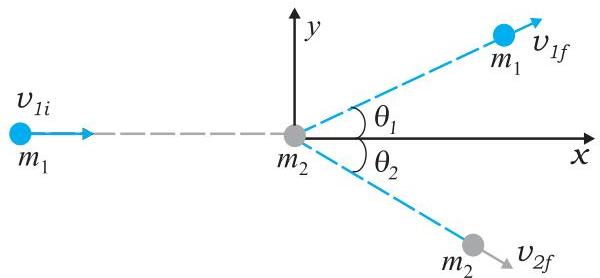 Fig. 5.10 Collision of mass $m_1$, with a stationary mass $m_2$.
Subsequent to the impact, the masses $m_1$ and $m_2$ are observed to diverge along distinct trajectories. Our subsequent analysis will reveal the inherent interdependencies that govern the masses, their respective velocities, and the angles of their post-collision paths.
5.11.1 Elastic and Inelastic Collisions
In any collision, the total linear momentum of the system is invariably conserved; the momentum prior to the impact is equivalent to the momentum after the impact. This principle can be substantiated as follows: when two objects engage in a collision, the reciprocal impulsive forces exerted between them over the collision duration $\Delta t$ instigate alterations in their individual momenta:
$ \Delta \mathbf {p} _ {1} = \mathbf {F} _ {1 2} \Delta t $
$ \Delta \mathbf {p} _ {2} = \mathbf {F} _ {2 1} \Delta t $
Here, $\mathbf{F}{12}$ designates the force applied to the first particle by the second, and analogously, $\mathbf{F}{21}$ signifies the force applied to the second particle by the first. In accordance with Newton's third law, $\mathbf{F}{12} = -\mathbf{F}{21}$. This relationship consequently implies:
$ \Delta \mathbf {p} _ {1} + \Delta \mathbf {p} _ {2} = \mathbf {0} $
This conclusion remains valid even if the forces exhibit complex variations throughout the collision interval $\Delta t$. As Newton's third law holds true at every instantaneous moment, the cumulative impulse imparted to the first object is equal in magnitude and opposite in direction to that imparted to the second.
Conversely, the total kinetic energy of the system is not necessarily conserved. The forceful impact and subsequent deformation occurring during a collision can lead to the generation of thermal energy and sound. A fraction of the initial kinetic energy is thus converted into these alternative energy forms. A helpful conceptualization of deformation during a collision involves envisioning a 'compressed spring'. If this 'spring'—representing the interaction between the two masses—fully recovers its original configuration without any energy dissipation, then the initial kinetic energy of the system will precisely equal its final kinetic energy; however, the kinetic energy during the collision time $\Delta t$ will not remain constant. Such an interaction is termed an elastic collision. On the other hand, the deformation might not be entirely relieved, potentially causing the two bodies to coalesce and move as a single entity after the collision. A collision in which the two particles unite and proceed together is defined as a completely inelastic collision. The more prevalent scenario involves partial recovery from deformation, resulting in some loss of the initial kinetic energy; this is appropriately categorized as an inelastic collision.
5.11.2 Collisions in One Dimension
Let us first examine a perfectly inelastic collision occurring along a single dimension. Referring to Fig. 5.10,
$ \theta_ {1} = \theta_ {2} = 0 $
$ m _ {1} v _ {1 i} = \left(m _ {1} + m _ {2}\right) v _ {f} \quad (\text {momentum conservation}) $
$ v _ {f} = \frac {m _ {1}}{m _ {1} + m _ {2}} v _ {1 i} \tag {5.22} $
The decrease in kinetic energy resulting from this collision is determined as follows:
$ \begin{array}{l} \Delta K = \frac {1}{2} m _ {1} v _ {1 i} ^ {2} - \frac {1}{2} (m _ {1} + m _ {2}) v _ {f} ^ {2} \ = \frac {1}{2} m _ {1} v _ {1 i} ^ {2} - \frac {1}{2} \frac {m _ {1} ^ {2}}{m _ {1} + m _ {2}} v _ {1 i} ^ {2} \quad [ \text {using Eq. (5.22)} ] \ = \frac {1}{2} m _ {1} v _ {1 i} ^ {2} \left[ 1 - \frac {m _ {1}}{m _ {1} + m _ {2}} \right] \ = \frac {1}{2} \frac {m _ {1} m _ {2}}{m _ {1} + m _ {2}} v _ {1 i} ^ {2} \ \end{array} $
This value is inherently positive, as anticipated.
Subsequently, let us consider an elastic collision. Employing the previously established notation, where $\theta_{1} = \theta_{2} = 0$, the governing equations for the conservation of momentum and kinetic energy are presented as:
$ m _ {1} v _ {1 i} = m _ {1} v _ {1 f} + m _ {2} v _ {2 f} \tag {5.23} $
$ m _ {1} v _ {1 i} ^ {2} = m _ {1} v _ {1 f} ^ {2} + m _ {2} v _ {2 f} ^ {2} \tag {5.24} $
An inference drawn from Equations (5.23) and (5.24) yields:
$ m _ {1} v _ {1 i} \left(v _ {2 f} - v _ {1 i}\right) = m _ {1} v _ {1 f} \left(v _ {2 f} - v _ {1 f}\right) $
which can be rearranged as:
$ \begin{array}{l} v _ {2 f} \left(v _ {1 i} - v _ {1 f}\right) = v _ {1 i} ^ {2} - v _ {1 f} ^ {2} \ = \left(v _ {1 i} - v _ {1 f}\right) \left(v _ {1 i} + v _ {1 f}\right) \ \end{array} $
Consequently, it is established that
$ \therefore v_{2f} = v_{1i} + v_{1f} \tag {5.25} $
Upon substituting this expression into Equation (5.23), the following results are derived:
$ v _ {1 f} = \frac {\left(m _ {1} - m _ {2}\right)}{m _ {1} + m _ {2}} v _ {1 i} \tag {5.26} $
and
$ v_{2f} = \frac{2m_1v_{1i}}{m_1 + m_2} \tag {5.27} $
Therefore, the final velocities, designated as the 'unknowns' ${v_{1f}, v_{2f}}$, are expressed as functions of the initial parameters, or 'knowns' ${m_1, m_2, v_{1i}}$. Distinct scenarios arising from this analysis warrant particular attention.
Case I: If the two masses are equal
$ \begin{array}{l} v _ {1 f} = 0 \ v _ {2 f} = v _ {1 i} \ \end{array} $
The initial mass ceases motion, imparting its initial velocity to the second mass upon impact.
Case II: If one mass dominates, e.g. $m_2 >> m_1$
$ v _ {1 f} \simeq - v _ {1 i} \quad v _ {2 f} \simeq 0 $
The more massive object remains largely unaffected, whereas the less massive object undergoes a reversal of its velocity.
Example 5.11 Slowing down of neutrons: Within a nuclear reactor, it is essential for a high-velocity neutron (typically $10^{7}\mathrm{ms}^{-1}$) to be decelerated to $10^{3}\mathrm{ms}^{-1}$. This reduction in speed increases its likelihood of interacting with the isotope $^{235}_{92}\mathrm{U}$, thereby inducing nuclear fission. Demonstrate that a neutron is capable of dissipating a substantial portion of its kinetic energy during an elastic collision with a light nucleus, such as deuterium or carbon, whose mass is merely a few multiples of the neutron's mass. The substance comprising these light nuclei, commonly heavy water $(\mathrm{D}_2\mathrm{O})$ or graphite, is referred to as a moderator.
The kinetic energy possessed by the neutron initially can be expressed as:
$ K _ {1 i} = \frac {1}{2} m _ {1} v _ {1 i} ^ {2} $
Conversely, its kinetic energy following the interaction, as derived from Equation (5.26), is given by:
$ K _ {1 f} = \frac {1}{2} m _ {1} v _ {1 f} ^ {2} = \frac {1}{2} m _ {1} \left(\frac {m _ {1} - m _ {2}}{m _ {1} + m _ {2}}\right) ^ {2} v _ {1 i} ^ {2} $
The proportion of kinetic energy dissipated, denoted as $f_1$, is calculated as:
$ f _ {1} = \frac {K _ {1 f}}{K _ {1 i}} = \left(\frac {m _ {1} - m _ {2}}{m _ {1} + m _ {2}}\right) ^ {2} $
Correspondingly, the fractional kinetic energy acquired by the moderating nuclei, represented by $K_{2f} / K_{1i}$, is:
$ \begin{array}{l} f _ {2} = 1 - f _ {1} \text{ (elastic collision)} \ = \frac {4 m _ {1} m _ {2}}{\left(m _ {1} + m _ {2}\right) ^ {2}} \ \end{array} $
This outcome can also be corroborated by direct substitution from Equation (5.27).
Considering deuterium, where $m_{2} = 2m_{1}$, the calculations yield $f_{1} = 1 / 9$ and $f_{2} = 8 / 9$, indicating that approximately $90%$ of the neutron's kinetic energy is transferred to the deuterium nucleus. For carbon, the corresponding values are $f_{1} = 71.6%$ and $f_{2} = 28.4%$. It is important to note, however, that in practical scenarios, the actual energy transfer may be less than these theoretical maximums, primarily because perfectly head-on collisions are infrequent.
A collision is defined as one-dimensional, or a head-on collision, when the initial and final velocity vectors of both interacting bodies are confined to a single straight line. For idealized small, spherical objects, this specific condition is met if the trajectory of the first body intersects the center of the second body, assuming the latter is initially stationary. More broadly, collisions are typically two-dimensional, characterized by both initial and final velocity vectors residing within a common plane.
5.11.3 Collisions in Two Dimensions
Figure 5.10 illustrates a scenario involving the collision of a mass $m_{1}$ (initially in motion) with a stationary mass $m_{2}$. The principle of linear momentum conservation applies to such an interaction. Given that momentum is a vector quantity, its conservation necessitates three distinct equations, one for each spatial dimension ($x, y, z$). If we define the plane containing the final velocity vectors of both $m_{1}$ and $m_{2}$ as the $x-y$ plane, then the conservation of the linear momentum's $z$-component dictates that the collision event unfolds entirely within this $x-y$ plane. Consequently, the component equations for the $x$ and $y$ directions are:
$ m _ {1} v _ {1 i} = m _ {1} v _ {1 f} \cos \theta_ {1} + m _ {2} v _ {2 f} \cos \theta_ {2} \tag {5.28} $
$ 0 = m _ {1} v _ {1 f} \sin \theta_ {1} - m _ {2} v _ {2 f} \sin \theta_ {2} \tag {5.29} $
Typically, the masses ${m_1, m_2}$ and the initial velocity $v_{1i}$ are known quantities. This setup presents a system with four unknown variables — ${v_{1f}, v_{2f}, \theta_1, \text{and } \theta_2}$ — yet only two independent equations are available. Should the conditions $\theta_1 = \theta_2 = 0$ hold, these expressions simplify to recover Equation (5.23), which describes a one-dimensional collision.
Moreover, if the collision is characterized as elastic, then the conservation of kinetic energy provides an additional governing equation:
$ \frac {1}{2} m _ {1} v _ {1 i} ^ {2} = \frac {1}{2} m _ {1} v _ {1 f} ^ {2} + \frac {1}{2} m _ {2} v _ {2 f} ^ {2} \tag {5.30} $
This introduces a third equation into our system. However, with four unknowns, the system remains underspecified by one equation. To render the problem uniquely solvable, at least one of the four unknowns, for instance $\theta_{1}$, must be empirically determined or provided. For example, $\theta_{1}$ could be ascertained by systematically positioning a detector at various angles between the $x$ and $y$ axes. Once ${m_1, m_2, v_{1i}, \theta_1}$ are established, the remaining variables ${v_{1f}, v_{2f}, \theta_2}$ can be derived from Equations (5.28) through (5.30).
Example 5.12 Let us analyze the collision shown in Figure 5.10, involving two billiard balls of identical mass, $m_{1} = m_{2}$. The initial moving ball is designated as the cue ball, while the stationary ball is termed the target ball. A billiard player aims to pocket the target ball into a corner, implying a final trajectory for the target ball at an angle $\theta_{2} = 37^\circ$. Assuming the collision is perfectly elastic, and neglecting effects such as friction and rotational dynamics, the objective is to determine the angle $\theta_{1}$.
Answer Considering the conservation of momentum, and given that the masses are equivalent:
$ \begin{array}{l} \mathbf{v} _ {1 i} = \mathbf{v} _ {1 f} + \mathbf{v} _ {2 f} \ \text{or} \quad v _ {1 i} ^ {2} = \left(\mathbf{v} _ {1 f} + \mathbf{v} _ {2 f}\right) \cdot \left(\mathbf{v} _ {1 f} + \mathbf{v} _ {2 f}\right) \ = v _ {1 f} ^ {2} + v _ {2 f} ^ {2} + 2 \mathbf{v} _ {1 f} \cdot \mathbf{v} _ {2 f} \ \end{array} $
$
= \left{v_{1f}^2 + v_{2f}^2 + 2v_{1f}v_{2f} \cos \left(\theta_1 + 37^\circ\right) \right} \tag{5.31} $
Given that the collision is elastic and the masses $m_1$ and $m_2$ are equal, the conservation of kinetic energy implies:
$ v_{1i}^2 = v_{1f}^2 + v_{2f}^2 \tag{5.32} $
By comparing Equation (5.31) with Equation (5.32), we deduce:
$ \cos (\theta_1 + 37^\circ) = 0 $
This condition necessitates that $\theta_1 + 37^\circ = 90^\circ$. Consequently, the angle $\theta_1$ is found to be $53^\circ$.
This derivation substantiates the principle that for a glancing elastic collision between two objects of identical mass, where one object is initially stationary, their trajectories post-collision will be mutually perpendicular.
A significant simplification arises when analyzing interactions involving idealized spherical bodies possessing smooth surfaces, where the occurrence of a collision is predicated solely on their physical contact. This scenario is exemplified by phenomena observed in recreational activities such as marbles, carrom, and billiards.
While direct physical contact is typically a prerequisite for collisions in macroscopic, everyday contexts, phenomena such as a comet's trajectory from distant reaches towards the sun, or an alpha particle's approach to a nucleus followed by a deflection, necessitate consideration of forces that operate without immediate contact, termed action-at-a-distance. This type of interaction is designated as scattering. The resultant velocities and trajectories of the interacting particles are determined by their initial kinematic states, the nature of their inter-particle forces, and their intrinsic properties including mass, morphology, and dimensions.
SUMMARY
- The work-energy principle posits that the alteration in a body's kinetic energy corresponds precisely to the total work exerted upon it by the resultant force.
$ K_f - K_i = W $
A force is classified as conservative if, firstly, the work performed by it on an object is independent of the trajectory taken, being solely contingent on the initial and final positions $(x, x')$. Alternatively, secondly, it is conservative if the net work executed by the force over any arbitrary closed path, where the object returns to its starting point, amounts to zero.
In the context of a one-dimensional conservative force, a potential energy function $V(x)$ can be established, defined by the relationship:
$ F(x) = -\frac{\mathrm{d}V(x)}{\mathrm{d}x} $
or, equivalently,
$ V(x) = \int_{x_1}^{x_f} F(x) , \mathrm{d}x $
The conservation of mechanical energy principle asserts that the aggregate mechanical energy of a system persists without change, provided that the sole forces acting upon that system are conservative in nature.
The gravitational potential energy associated with a particle of mass $m$, situated at an elevation $x$ above the Earth's surface, is given by:
$ V(x) = m g x $
This formulation presumes a negligible variation of the acceleration due to gravity, $g$, with altitude.
- For a spring characterized by a force constant $k$ and experiencing an extension $x$, its elastic potential energy is quantified as:
$ V(x) = \frac{1}{2} k x^2 $
- The scalar product, also known as the dot product, of two vectors $\mathbf{A}$ and $\mathbf{B}$ is denoted as $\mathbf{A} \cdot \mathbf{B}$. This operation yields a scalar value, defined by the expression $\mathbf{A} \cdot \mathbf{B} = AB \cos \theta_1$, where $\theta_1$ represents the angle subtended between vectors $\mathbf{A}$ and $\mathbf{B}$. The resultant scalar quantity may be positive, negative, or zero, contingent upon the specific value of $\theta$. Conceptually, the scalar product can be understood as the product of the magnitude of one vector and the orthogonal projection of the second vector onto the direction of the first. For orthonormal unit vectors, the following relationships hold:
$ \mathbf{i} \cdot \mathbf{i} = \mathbf{j} \cdot \mathbf{j} = \mathbf{k} \cdot \mathbf{k} = 1 \text{ and } \mathbf{i} \cdot \mathbf{j} = \mathbf{j} \cdot \mathbf{k} = \mathbf{k} \cdot \mathbf{i} = 0 $
Furthermore, scalar products inherently conform to both the commutative and distributive algebraic principles.
| Physical Quantity | Symbol | Dimensions | Units | Remarks |
|---|---|---|---|---|
| Work | W | $[\mathrm{ML}^2\mathrm{T}^{-2}]$ | J | W = F.d |
| Kinetic energy | K | $[\mathrm{ML}^2\mathrm{T}^{-2}]$ | J | K = $\frac{1}{2}mv^2$ |
| Potential energy | V(x) | $[\mathrm{ML}^2\mathrm{T}^{-2}]$ | J | F(x) = $-\frac{\mathrm{d}V(x)}{\mathrm{d}x}$ |
| Mechanical energy | E | $[\mathrm{ML}^2\mathrm{T}^{-2}]$ | J | E = K + V |
| Spring constant | k | $[\mathrm{MT}^{-2}]$ | N m^{-1} | F = -kx V(x) = $\frac{1}{2}kx^2$ |
| Power | P | $[\mathrm{ML}^2\mathrm{T}^{-3}]$ | W | P = F.v P = $\frac{\mathrm{d}W}{\mathrm{d}t}$ |
POINTS TO PONDER
- The expression 'calculate the work done' lacks specificity. It is essential to explicitly state or contextually imply the particular force or ensemble of forces responsible for the work, acting upon a designated object across a defined displacement.
- Work is fundamentally a scalar quantity, capable of exhibiting either positive or negative values. This contrasts with quantities such as mass and kinetic energy, which are inherently positive scalars. Notably, the work performed by frictional or viscous forces on a body in motion is invariably negative.
- According to Newton's Third Law, the vector sum of mutually exerted forces between any two bodies is zero:
$ \mathbf{F}{12} + \mathbf{F}{21} = 0 $
Nevertheless, the algebraic sum of the work executed by these two forces does not necessarily equate to zero; specifically,
$ W_{12} + W_{21} \neq 0 $
Though, instances where this sum does cancel can occur. 4. It is occasionally feasible to ascertain the work accomplished by a force, even in scenarios where the precise characteristics of that force remain unestablished. This principle is demonstrably illustrated in Example 5.2, where the Work-Energy (WE) theorem is applied under such conditions. 5. The Work-Energy (WE) theorem is intrinsically linked to Newton's Second Law; indeed, it can be conceptualized as a scalar manifestation of the Second Law. Furthermore, the principle governing the conservation of mechanical energy can be understood as a direct derivation of the WE theorem when applied to conservative forces. 6. The Work-Energy (WE) theorem maintains its validity across all inertial reference frames. Its applicability can also be extended to non-inertial frames, contingent upon the incorporation of pseudoforces into the computation of the resultant force acting on the body in question. 7. For a body experiencing a conservative force, its potential energy invariably contains an arbitrary additive constant. Consequently, the reference point at which potential energy is defined as zero is entirely a matter of convention. In the context of gravitational potential energy, $mgh$, the ground is typically designated as the zero potential energy level. Similarly, for the spring potential energy, $kx^2/2$, the equilibrium position of the oscillating mass serves as the zero potential energy reference. 8. Not all forces encountered within the domain of mechanics possess an associated potential energy function. As an illustration, the work performed by friction along a closed path is non-zero, thereby precluding the assignment of a potential energy to frictional forces. 9. In the course of a collision: (a) the aggregate linear momentum remains invariant throughout every instantaneous phase of the event; (b) the conservation of kinetic energy, even in elastic collisions, is applicable only subsequent to the completion of the collision and does not pertain to every instant during the collision. This is because the interacting objects undergo deformation and may achieve a momentary state of relative rest.
EXERCISES
5.1 Comprehending the polarity of work performed by a force on an object is fundamental. Meticulously determine whether the subsequent quantities are positive or negative:
(a) The work executed by an individual when elevating a bucket from a well using a rope attached to it. (b) The work accomplished by the gravitational force in the scenario described immediately above. (c) The work done by the frictional force acting on a body as it descends an inclined plane. (d) The work exerted by an externally applied force upon a body traversing a rough horizontal surface at a constant velocity. (e) The work carried out by the air's resistive force on a vibrating pendulum as it gradually comes to a halt.
5.2 An object with a mass of $2\mathrm{kg}$, initially at rest, is set in motion by a horizontal force of $7\mathrm{N}$ applied on a surface exhibiting a coefficient of kinetic friction of $0.1$. Calculate the following:
(a) The work performed by the applied force over a duration of $10\mathrm{s}$. (b) The work performed by the frictional force over a duration of $10\mathrm{s}$. (c) The work performed by the resultant (net) force acting on the body over a duration of $10\mathrm{s}$. (d) The alteration in the body's kinetic energy over a duration of $10\mathrm{s}$.
Furthermore, provide an interpretation of your derived results.
5.3 Presented in Fig. 5.11 are various instances of one-dimensional potential energy functions. The total energy of the particle is indicated by a cross mark on the vertical axis. For each case, identify any regions where the particle cannot exist given its specified energy. Additionally, specify the minimum total energy required for the particle in each configuration. Consider straightforward physical situations where these potential energy profiles might be relevant.
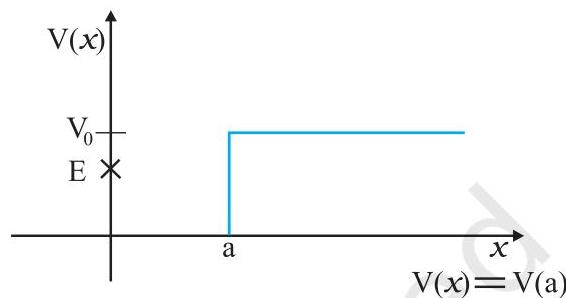
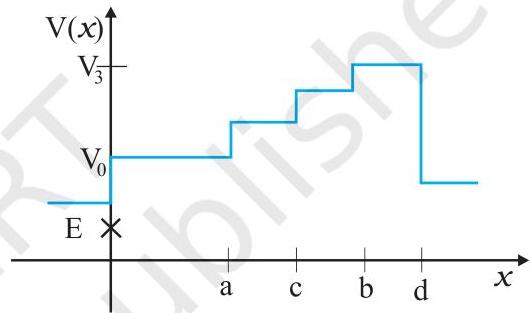
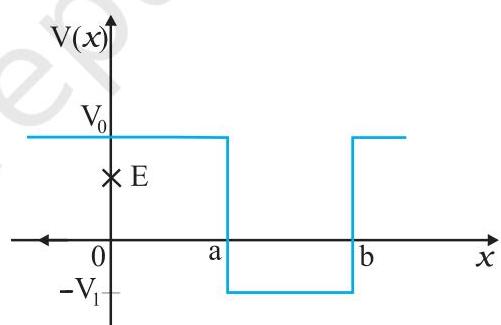
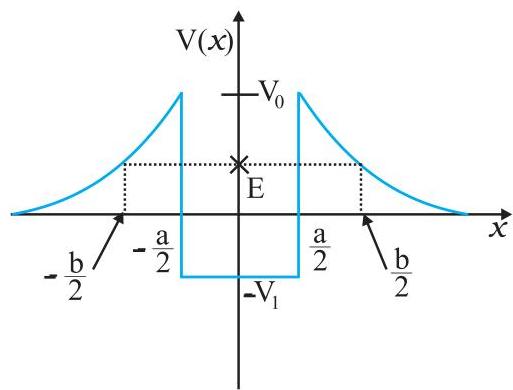 Fig. 5.11
5.4 The potential energy function describing a particle undergoing linear simple harmonic motion is expressed as $V(x) = kx^2 / 2$, where $k$ represents the oscillator's force constant. With $k = 0.5\mathrm{Nm}^{-1}$, the graphical representation of $V(x)$ against $x$ is depicted in Fig. 5.12. Demonstrate that a particle possessing a total energy of $1\mathrm{J}$, when moving under the influence of this potential, must undergo a reversal of direction upon reaching the positions $x = \pm 2\mathrm{m}$.
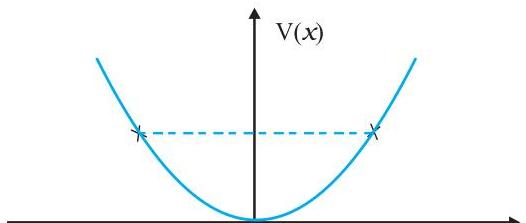 Fig. 5.12
5.5 Address the following inquiries:
(a) The external structure of a rocket in flight experiences combustion due to atmospheric friction. From which source is the thermal energy necessary for this burning derived: the rocket itself or the surrounding atmosphere? (b) Comets traverse highly elliptical trajectories around the sun. The gravitational force exerted by the sun on the comet is generally not orthogonal to the comet's instantaneous velocity.
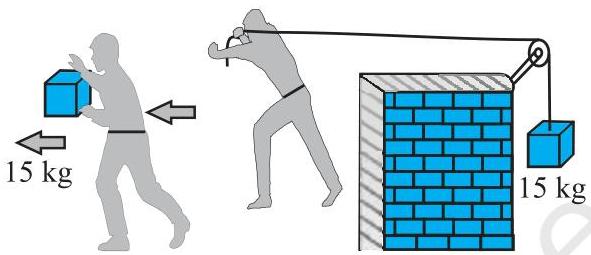 (i) Fig. 5.13 (ii)
Nevertheless, the total work performed by the gravitational force over one complete orbit of the comet is zero. Provide an explanation for this phenomenon.
(c) Consider an artificial satellite tracing an orbital path around Earth within an exceedingly tenuous atmospheric layer. Despite the gradual depletion of its total energy due to resistive forces exerted by this atmosphere, which are present even at minimal levels, why does the satellite's orbital velocity progressively augment as its trajectory brings it nearer to the Earth's surface? (d) Referencing Fig. 5.13(i), a person traverses a distance of $2\mathrm{m}$ while supporting a $15\mathrm{kg}$ mass in their hands. In contrast, Fig. 5.13(ii) depicts the same individual covering the identical distance by pulling a rope, which passes over a pulley, with a $15\mathrm{kg}$ mass suspended from its opposite end. Between these two scenarios, which one involves a larger magnitude of work performed?
5.6 Underline the correct alternative :
(a) Should a conservative force exert positive work upon an object, its associated potential energy will consequently increase/decrease/remain constant. (b) The work expended by an object in overcoming frictional resistance invariably leads to a reduction in its kinetic/potential energy. (c) The temporal derivative of the aggregate momentum of a system comprising multiple particles bears proportionality to the external force/sum of the internal forces acting on that system. (d) During an inelastic collision between two entities, the quantities that persist without alteration post-collision include the total kinetic energy/total linear momentum/total energy of the two-body system.
5.7 State if each of the following statements is true or false. Give reasons for your answer.
(a) For an elastic collision involving two bodies, it is asserted that both the momentum and the energy of each individual body are conserved. (b) The aggregate energy of a given system invariably remains constant, irrespective of the presence of any internal or external forces acting upon the bodies within it. (c) The work accomplished during the displacement of an object along a closed path is zero for all natural forces. (d) In the context of an inelastic collision, the system's ultimate kinetic energy is perpetually lower than its initial kinetic energy.
5.8 Answer carefully, with reasons :
(a) When two billiard balls undergo an elastic collision, is the cumulative kinetic energy maintained throughout the brief interval of their direct contact? (b) Is the aggregate linear momentum preserved during the fleeting period of an elastic impact between two balls?
(c) How do the responses to questions (a) and (b) differ when considering an inelastic collision? (d) Assuming the potential energy intrinsic to two billiard balls is solely a function of the spatial separation between their respective centers, would the resultant collision be classified as elastic or inelastic? (It is important to note that this refers to the potential energy associated with the interaction force during the collision, rather than gravitational potential energy).
5.9 A physical object commences its motion from a state of rest and proceeds in one dimension under the influence of a constant acceleration. The instantaneous power imparted to this object at time $t$ exhibits proportionality to
(i) $t^{1 / 2}$
(ii) $t$
(iii) $t^{3 / 2}$
(iv) $t^2$
5.10 An object undergoes unidirectional motion, driven by a power source that delivers constant output. Its displacement observed over a time interval $t$ is proportional to
(i) $t^{1 / 2}$
(ii) $t$
(iii) $t^{3 / 2}$
(iv) $t^2$
5.11 An object, whose movement is restricted to the $z$-axis within a Cartesian coordinate system, experiences a perpetual force $\mathbf{F}$ defined as follows:
$ \mathbf {F} = - \hat {\mathbf {i}} + 2 \hat {\mathbf {j}} + 3 \hat {\mathbf {k}} \mathbf {N} $
In this context, $\hat{\mathbf{i}},\hat{\mathbf{j}},\hat{\mathbf{k}}$ denote the unit vectors corresponding to the $x-$ , $y-$ and $z$ -axes of the coordinate system, respectively. Calculate the work performed by this force when displacing the object by $4\mathrm{m}$ exclusively along the $z$ -axis.
5.12 During a cosmic ray investigation, an electron and a proton are observed, possessing kinetic energies of $10 \mathrm{keV}$ and $100 \mathrm{keV}$ , respectively. Determine which particle, the electron or the proton, exhibits a higher velocity. Subsequently, compute the ratio of their respective speeds. (Given: electron mass $= 9.11 \times 10^{-31} \mathrm{kg}$ , proton mass $= 1.67 \times 10^{-27} \mathrm{kg}$ , and the conversion factor $1 \mathrm{eV} = 1.60 \times 10^{-19} \mathrm{~J}$ ).
5.13 A spherical raindrop, with a radius of $2\mathrm{mm}$ , commences its descent from an altitude of $500\mathrm{m}$ above the Earth's surface. Initially, its acceleration diminishes (attributable to atmospheric viscous resistance) until it reaches precisely half its initial elevation, at which point it achieves its maximum, or terminal, velocity, maintaining this constant speed for the remainder of its descent. Calculate the work performed by the gravitational force upon the raindrop during both the initial and subsequent halves of its trajectory. Furthermore, determine the total work expended by the resistive force throughout the entire fall, given that its impact speed upon reaching the ground is $10\mathrm{ms}^{-1}$ .
5.14 Within a gaseous enclosure, a molecule strikes a horizontal boundary surface at a velocity of $200\mathrm{ms}^{-1}$ , forming an angle of $30^{\circ}$ with the normal to the surface, and subsequently recoils with an identical speed. Assess whether linear momentum is conserved during this collision. Additionally, classify the collision as either elastic or inelastic.
5.15 A pumping apparatus situated on the ground level of a structure is capable of elevating water to completely fill a reservoir with a volume of $30\mathrm{m}^3$ within a time frame of $15\mathrm{min}$ . Considering that the reservoir is positioned $40\mathrm{m}$ above the ground, and the pump operates with an efficiency of $30%$ , calculate the electrical power input required by the pump.
5.16 Two identical spherical ball bearings, in mutual contact and positioned on a frictionless horizontal surface, are struck head-on by a third ball bearing of equivalent mass, initially possessing a speed $V$ . Assuming the collision is perfectly elastic, identify which of the scenarios depicted in Fig. 5.14 represents a plausible outcome subsequent to the impact.
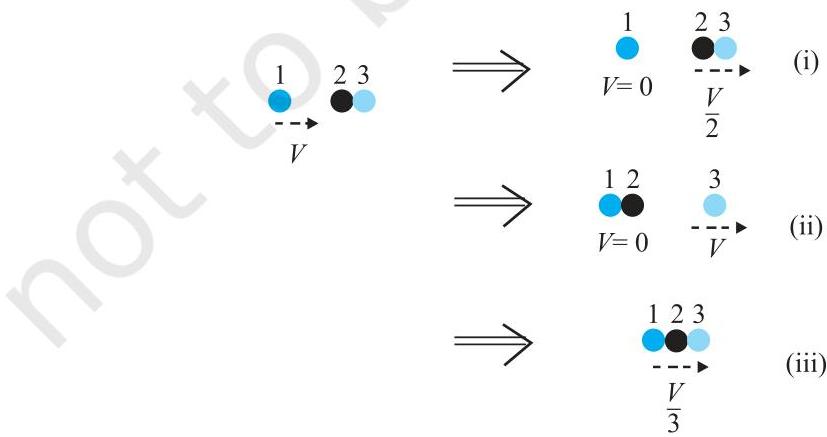 Fig. 5.14
WORK, ENERGY AND POWER
5.17 As illustrated in Fig. 5.15, pendulum bob A, initially displaced to an angle of $30^{\circ}$ from the vertical and subsequently released, collides with bob B, an identical mass at rest on a horizontal surface. Determine the maximum height attained by bob A following the collision. For this analysis, disregard the physical dimensions of the bobs and presume the collision to be elastic.
5.18 A pendulum's bob is set free from a starting point horizontally aligned with its pivot. Assuming the pendulum's length measures $1.5 , \text{m}$, calculate the velocity of the bob as it reaches its nadir, considering that $5%$ of its initial potential energy was dissipated due to air resistance.
5.19 A carriage, with a mass of $300,\text{kg}$ and laden with a $25,\text{kg}$ sandbag, traverses a frictionless track at a constant speed of $27,\text{km/h}$ . Subsequent to an initial period, sand begins to egress from an aperture in the trolley's base at a continuous rate of $0.05,\text{kg},\text{s}^{-1}$. Determine the velocity of the trolley once the entirety of the sandbag's contents has been discharged.
5.20 An object with a mass of $0.5,\text{kg}$ moves along a linear path. Its velocity is given by the expression $v = ax^{6/2}$, where the constant $a$ has a value of $5,\text{m}^{-1/2},\text{s}^{-1}$. Determine the total work performed by the net force as the object undergoes a displacement from an initial position of $x = 0$ to a final position of $x = 2,\text{m}$.
5.21 A windmill's rotating blades define a circular area $A$. (a) If the wind moves at a velocity $v$ orthogonal to this circular area, calculate the mass of air that traverses the area within a time interval $t$. (b) What is the kinetic energy associated with this volume of air? (c) Supposing the windmill transforms $25%$ of the wind's kinetic energy into usable electrical energy, and given that $A = 30,\text{m}^2$, $v = 36,\text{km/h}$, and the air density is $1.2,\text{kg},\text{m}^{-3}$, determine the resulting electrical power output.
5.22 An individual engaged in weight loss (a dieter) repeatedly lifts a $10,\text{kg}$ mass, performing one thousand repetitions, raising it to a height of $0.5,\text{m}$ during each lift. It is assumed that the gravitational potential energy released when the mass is lowered is entirely dissipated. (a) Calculate the total work performed by the individual against the gravitational force. (b) Given that fat provides $3.8 \times 10^{7},\text{J}$ of energy per kilogram and is converted into mechanical energy with an efficiency of $20%$, determine the quantity of fat consumed by the dieter.
5.23 A household consumes electrical power at a rate of $8,\text{kW}$. (a) Solar radiation directly impinges upon a horizontal surface at an average intensity of $200,\text{W}$ per square meter. Assuming that $20%$ of this incident energy can be transformed into beneficial electrical energy, what surface area would be requisite to furnish the $8,\text{kW}$ demand? (b) Contrast this calculated area with the typical dimensions of a residential rooftop.
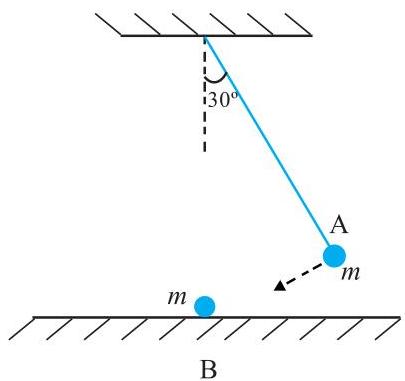 Fig. 5.15